

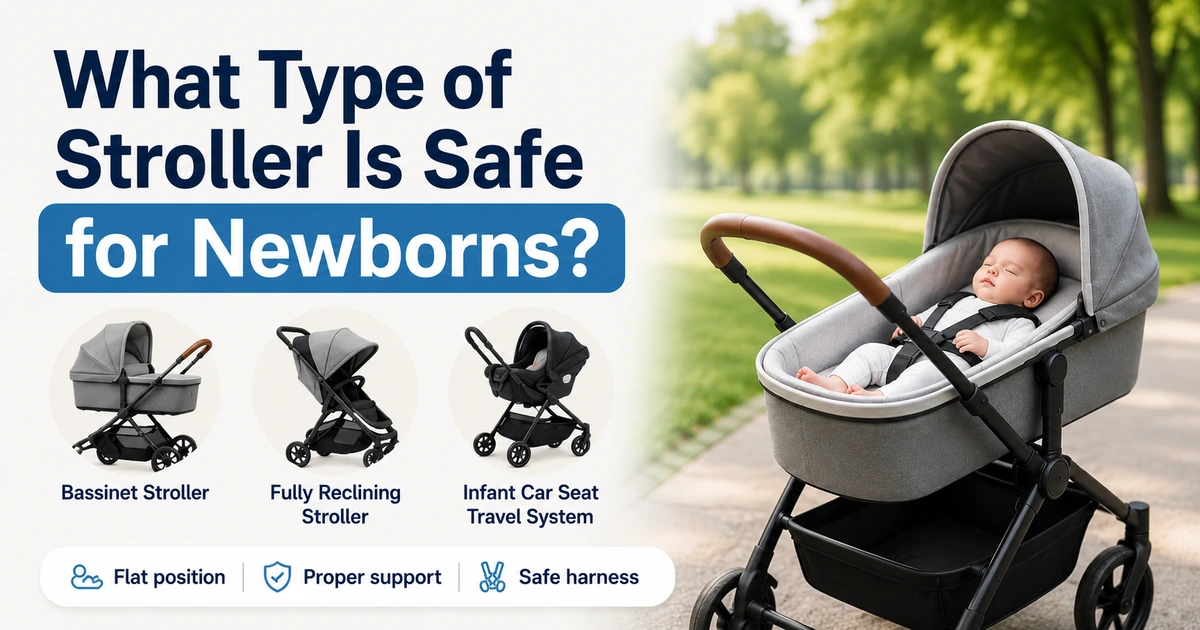
Choosing a stroller for a newborn is different from choosing a stroller for an older baby or toddler. A newborn cannot sit upright, cannot control the head properly, and needs strong support for the neck, back, and body.
So, many new parents ask: What type of stroller is safe for newborns? The safest stroller for a newborn is usually one that allows a flat or near-flat position, such as a bassinet stroller, a fully reclining stroller approved for newborn use, or a compatible infant car seat travel system for short, supervised trips.
This guide explains which stroller types are safest for newborns, which parents should avoid in the early months, and which safety features matter most before buying.
Quick Answer
A newborn needs a stroller that properly supports the head, neck, back, and body. A fully upright stroller seat is usually not suitable for newborns because they lack sufficient head and neck control.
| Stroller Type | Safe for Newborns? | Best Use |
|---|---|---|
| Bassinet stroller | Yes, if approved by the manufacturer | Newborn walks and flat-position support |
| Fully reclining stroller | Yes, if approved for newborn use | Parents who want one stroller for the early months and later use |
| Infant car seat travel system | Yes, for short supervised trips | Car-to-stroller convenience |
| Regular upright stroller | No, usually not for newborns | Older babies with good head and neck control |
| Umbrella stroller | Usually no | Toddlers or older babies, depending on the model |
| Jogging stroller | Not for jogging with newborns | Older babies only when the manual allows it |
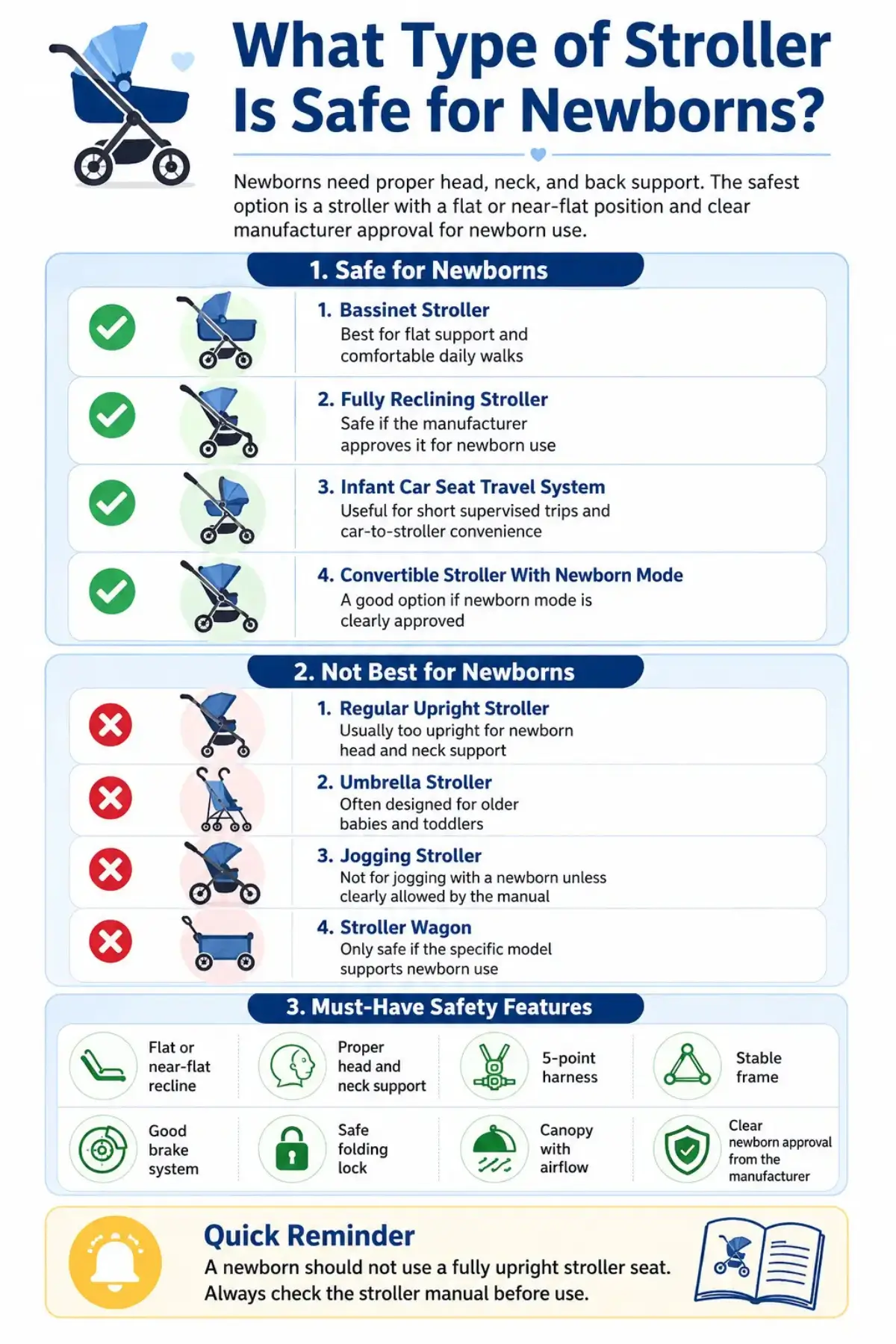
Why Newborns Need a Special Stroller Setup
Newborns are not ready for a regular seated stroller position. Their head is heavy relative to the rest of their body, and their neck muscles are still developing.
If a newborn is placed too upright, the baby may slump forward or sideways. This can make the baby uncomfortable and may create an unsafe body position.
A newborn-safe stroller should provide:
- Proper head and neck support
- Good back support
- Flat or near-flat positioning
- A secure harness system
- Stable frame and safe brake system
- Manufacturer approval for newborn use
Before using any stroller for a newborn, always check the stroller manual. A stroller may look soft and comfortable, but that does not automatically mean it is newborn-safe.
1. Bassinet Stroller
A bassinet stroller is one of the best stroller types for newborns because it allows the baby to lie in a flatter position. This provides better support for the baby’s back, neck, and head during the early months.
A bassinet stroller is especially useful for parents who take daily walks and want a more newborn-friendly setup than a regular stroller seat.
Why a Bassinet Stroller Can Be Good for Newborns
- It supports a flat or near-flat position.
- It gives newborns more body support.
- It is comfortable for supervised walks.
- It usually gives more space than an infant car seat.
- It can be easier for parents to check the baby during walks.
What to Check Before Buying a Bassinet Stroller
- Is the bassinet approved for newborn use?
- Does it have a firm and supportive base?
- Is the bassinet securely attached to the stroller frame?
- Does the stroller have a good brake system?
- Does the canopy allow airflow?
- What is the bassinet’s weight limit?
Helpful guide: If you are comparing newborn stroller options, read our Bassinet Stroller vs Car Seat Stroller guide.
2. Fully Reclining Stroller
A fully reclining stroller can also be safe for newborns if the manufacturer clearly says it is suitable for newborn use. This type of stroller allows the seat to recline to a flat or near-flat position.
This is helpful for parents who want a stroller that works from the newborn stage and continues as the baby grows.
Benefits of a Fully Reclining Stroller
- Can support younger babies better than upright seats
- May work longer than a bassinet-only setup
- Useful for daily walks and short outings
- Can be adjusted as the baby grows
- Often easier to store than a full bassinet system
Important Safety Checks
- The stroller must be approved for newborn use.
- The recline should properly support the baby’s body.
- The harness should fit a small baby securely.
- The stroller should have a stable frame.
- The brake should be easy to lock.
- The baby should not slide down in the seat.
Do not assume that every reclining stroller is safe for newborns. Some strollers recline, but not enough for newborn support.
Helpful guide: For more newborn-friendly options, read our Best Infant Stroller guide.
3. Infant Car Seat Travel System
A travel system uses an infant car seat that attaches to a stroller frame. This can be convenient for short trips because parents can move the baby from the car to the stroller without removing the baby from the car seat.
However, an infant car seat stroller setup should be used carefully. It is useful for travel and errands, but it should not replace a flat newborn stroller or a safe sleep space.
When a Travel System Makes Sense
- Quick doctor visits
- Short shopping trips
- Moving from the car to the stroller
- Parents who drive often
- Families who want one connected system
Travel System Safety Checklist
- The infant car seat must be compatible with the stroller.
- The car seat should click securely into the stroller.
- The baby must be buckled into the car seat harness.
- The stroller frame must be fully locked open.
- The setup should be used for supervised travel, not long sleep.
- Both the car seat and stroller manuals should be followed.
Helpful guide: If you want a stroller-and-car-seat combo, read our Best Infant Car Seat and Stroller guide.
4. Convertible Stroller With Newborn Mode
Some modern strollers are convertible. They may offer bassinet mode, car seat compatibility, or a seat that reclines deeply for newborn use.
This type of stroller can be useful for parents who want a single stroller that adapts as the baby grows.
Why Parents Like Convertible Strollers
- They can work from newborn to toddler stage.
- Some models support bassinet mode.
- Some models accept infant car seats.
- They may offer parent-facing and forward-facing positions.
- They can reduce the need to buy multiple strollers.
What Parents Should Check
- Does it clearly say newborn-safe?
- Does the seat recline enough?
- Is the bassinet mode actually approved for newborns?
- Are adapters needed for car seats?
- Is the frame stable?
- Does the harness fit a newborn properly?
A convertible stroller is only safe for newborns when the manufacturer approves the newborn mode.
Which Stroller Types Are Not Best for Newborns?
Some stroller types are useful later, but they are not ideal for newborns. Parents should be careful before using these in the early months.
Regular Upright Stroller
A regular upright stroller is usually not safe for newborns because newborns cannot sit upright with stable head and neck control.
Umbrella Stroller
Most umbrella strollers are designed for older babies or toddlers. They often have limited recline and less support for newborns.
Jogging Stroller
A jogging stroller should not be used for jogging with a newborn. Some jogging strollers allow attachment of an infant car seat for walking only, but parents should always follow the stroller manual.
Stroller Wagon
Many stroller wagons are better for older babies and toddlers. Newborn use depends on the model, bassinet support, and manufacturer approval.
Newborn Stroller Safety Features to Look For
When buying a stroller for a newborn, safety features matter more than style. A beautiful stroller is not enough if it does not properly support a newborn.
| Feature | Why It Matters |
|---|---|
| Flat or near-flat recline | Helps support the newborn’s body position |
| 5-point harness | Helps secure the baby at the shoulders, waist, and between the legs |
| Good brake system | Keeps the stroller from rolling when stopped |
| Stable frame | Reduces tipping risk |
| Safe folding lock | Prevents accidental folding during use |
| Canopy with airflow | Protects from the sun while allowing ventilation |
| Clear newborn approval | Confirms the stroller is designed for early infant use |
Official source: Parents can read stroller safety guidance on the American Academy of Pediatrics’ HealthyChildren.org page.
Newborn Sleep Safety in a Stroller
Newborns often fall asleep during stroller walks. This is normal, but a stroller should not be used as a regular sleeping space unless the product is specifically approved for that use.
If your baby falls asleep in a stroller, keep the baby supervised and move the baby to a safe sleep surface when possible.
Do not add:
- Loose pillows
- Soft blankets under the baby
- The manufacturer does not approve extra head supports
- Thick padding
- Unapproved body inserts
Official source: Parents can read safe sleep guidance from the HealthyChildren.org safe sleep guide by the American Academy of Pediatrics.
Bassinet Stroller vs Travel System for Newborns
Both bassinet strollers and travel systems can be useful for newborns, but they are not the same.
| Feature | Bassinet Stroller | Travel System |
|---|---|---|
| Baby position | Flat or near-flat | Angled infant car seat position |
| Best for | Walks and newborn comfort | Short car-to-stroller trips |
| Convenience | Good for neighborhood walks | Good for errands and driving families |
| Time spent | Usually longer during the newborn stage | Usually shorter while the baby fits the infant car seat |
| Main warning | Check the weight limit and safe use instructions | Do not use a car seat as a long-term sleep space |
Should a Newborn Face the Parent or Face Forward?
For newborns, parent-facing mode is often more practical because parents can easily see the baby, check the baby’s breathing position, adjust the shade, and respond quickly.
Parent-facing stroller benefits:
- Easy to check the baby’s face
- Better for bonding during walks
- Helpful for monitoring comfort
- Useful for young babies who need attention
Forward-facing mode becomes more useful when babies are older, more alert, and able to sit with better control.
Can a Newborn Use a Lightweight Travel Stroller?
Some lightweight travel strollers are newborn-friendly, but many are not. A lightweight stroller is safe for newborns only if it has a newborn-approved recline, compatible bassinet, or approved infant car seat attachment.
Before buying a lightweight stroller for a newborn, check:
- Does it recline flat or near-flat?
- Does the manual allow newborn use?
- Does the harness fit a small baby?
- Is the frame stable?
- Does it support a compatible infant car seat?
- Is the canopy breathable?
Helpful guide: If you travel often, read our Best Travel Stroller guide.
Common Mistakes Parents Should Avoid
Newborn stroller safety problems often occur because parents choose a stroller based on design, price, or popularity rather than newborn support.
- Using a fully upright stroller seat too early
- Buying an umbrella stroller for a newborn
- Assuming all reclining strollers are newborn-safe
- Using unapproved pillows or inserts
- Leaving the baby sleeping unsupervised in a stroller
- Not using the harness
- Hanging heavy bags from the handlebars
- Forgetting to lock the brake
- Ignoring the stroller manual
- Not checking product recalls or safety warnings
Amazon Buying Tips
When shopping for a newborn stroller on Amazon, do not rely only on the product title. Some listings say “newborn stroller,” but the details may show that the seat is not fully suitable for newborn use.
Before buying, check:
- Minimum age recommendation
- Maximum weight limit
- Seat recline angle
- Bassinet availability
- Infant car seat compatibility
- Harness type
- Brake system
- Recent parent reviews
- Official manufacturer information
- Return policy
Check Newborn-Safe Stroller Options on Amazon
Final Answer: What Type of Stroller Is Safe for Newborns?
The safest stroller type for newborns is usually a bassinet stroller, a fully reclining stroller approved for newborn use, or a compatible infant car seat travel system for short supervised trips.
A newborn should not use a regular, fully upright stroller seat because newborns need proper support for the head, neck, and body.
If you want the safest choice, look for a stroller with newborn approval, flat or near-flat positioning, a secure harness, a stable frame, reliable brakes, and clear manufacturer instructions.
Best rule: If the stroller does not clearly support newborn use, do not use it for a newborn.
Frequently Asked Questions
What stroller is best for a newborn?
A bassinet stroller, a fully reclining stroller approved for newborns, or a compatible infant car seat travel system is usually best for a newborn.
Can a newborn sit in a regular stroller?
No, a newborn usually should not sit in a regular upright stroller because they do not have enough head and neck control.
Is a bassinet stroller necessary for newborns?
A bassinet stroller is not always necessary, but it is one of the most newborn-friendly options. A fully reclining stroller or compatible infant car seat setup may also work if approved by the manufacturer.
Can a newborn use a travel system?
Yes, a newborn can use a compatible infant car seat travel system for short supervised trips if the car seat and stroller are correctly connected and used according to the manual.
Can a newborn sleep in a stroller?
A newborn may fall asleep during a stroller walk, but the stroller should not replace a safe sleep space. Keep the baby supervised and follow safe sleep guidance.
Are umbrella strollers safe for newborns?
Most umbrella strollers are not ideal for newborns because they often lack full recline and proper newborn support.
Can a newborn use a jogging stroller?
A newborn should not be jogged in a jogging stroller. Some jogging strollers may accept infant car seats for walking only, but parents must follow the manual.
What recline is safe for a newborn stroller?
A newborn stroller should offer a flat or near-flat position and must be approved by the manufacturer for newborn use.

Sanat Barua is the founder of Stroller Haven. He researches stroller models, manufacturer specifications, and safety standards to help parents compare options and make confident, informed decisions.
His research draws on official manufacturer documentation and product manuals, publicly available owner feedback, and safety guidance from sources such as the U.S. Consumer Product Safety Commission (CPSC) and the American Academy of Pediatrics (AAP). Stroller Haven is a research-based website: products are not described as physically tested unless an article states that testing took place. Stroller Haven is updated regularly as new models and safety information become available.