

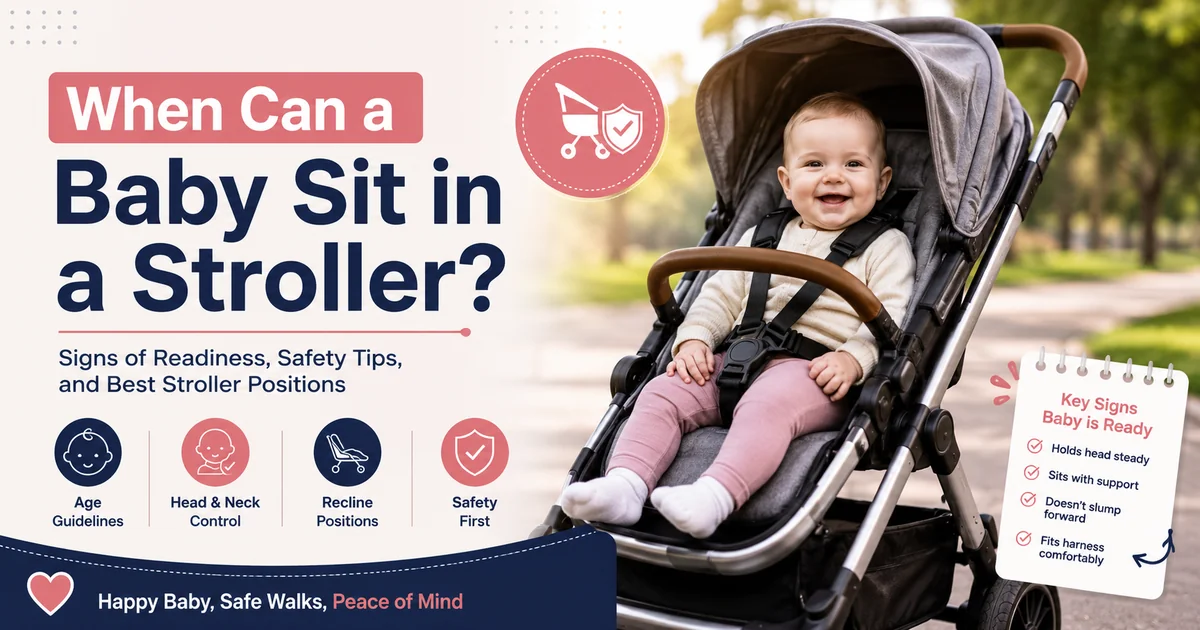
Many new parents ask the same question: when can a baby sit in a stroller? The simple answer is that many babies can use a more upright stroller seat once they have strong head and neck control, often around 6 months. However, every baby develops differently, so age alone is not enough.
Before placing your baby in an upright stroller seat, you should check your baby’s body control, the stroller’s recline option, the harness fit, and the manufacturer’s age and weight recommendations.
This guide explains when babies can sit in a stroller, what signs of readiness to look for, what stroller setup is safer for newborns, and what mistakes parents should avoid.
Quick Answer
Most babies are ready for a more upright stroller seat when they can hold their head steady, sit with good support, and fit safely in the stroller harness. For many babies, this happens around 6 months, but some babies may need more time.
| Baby Age | Recommended Stroller Setup | Important Safety Note |
|---|---|---|
| Newborn to 3 months | Bassinet, fully reclining stroller, or compatible infant car seat setup | Baby needs strong head, neck, and back support |
| 3 to 6 months | Reclined stroller seat, bassinet, or infant car seat travel system | Do not use a fully upright seat unless baby has enough control |
| Around 6 months | More upright stroller seat may be possible | Baby should have good head and neck control |
| 6 to 9 months | Adjustable stroller seat with harness | Some babies still need recline and extra support |
| 9 months and older | Regular stroller seat usually works if baby fits safely | Still follow stroller weight limit and harness rules |
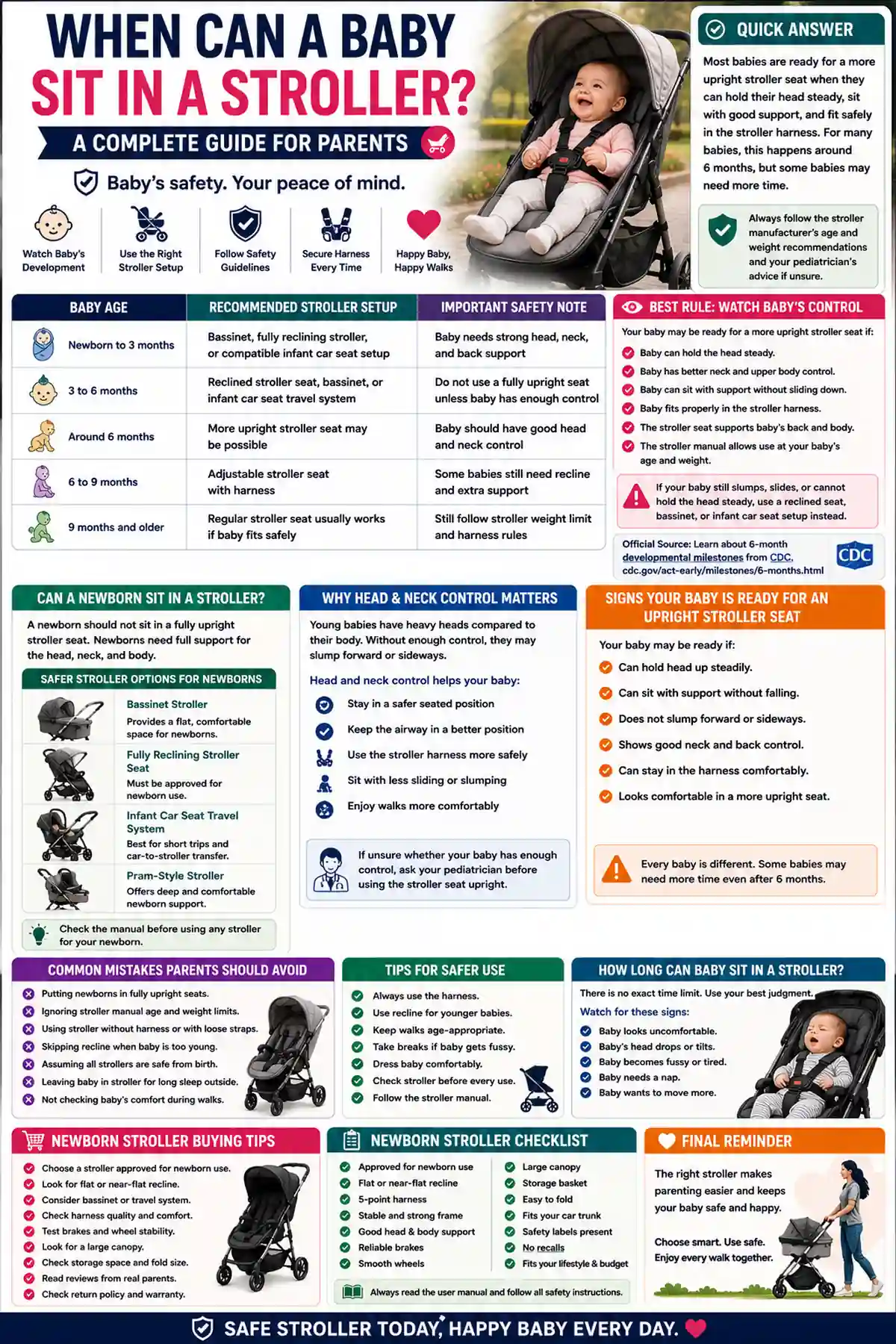
The Best Rule: Watch Baby’s Control, Not Only Age
Age is helpful, but it should not be the only rule. One 6-month-old baby may sit well with support, while another may still lean forward or slump to the side.
Your baby may be ready for a more upright stroller seat if:
- Baby can hold the head steady without wobbling too much.
- Baby has better neck and upper body control.
- Baby can sit with support without sliding down.
- Baby fits properly in the stroller harness.
- The stroller seat supports your baby’s back and body.
- The stroller manual allows use for your baby’s age and weight.
If your baby still slumps, slides, or cannot hold the head steady, use a reclined seat, Bassinet, or infant car seat setup instead.
Official source: Parents can check baby movement milestones on the CDC 6-month developmental milestones page.
Can a Newborn Sit in a Stroller?
A newborn should not sit in a fully upright stroller seat. Newborns do not have enough head, neck, and trunk control. They need a stroller setup that properly supports the whole body.
For newborns, safer stroller options usually include:
- A stroller bassinet
- A fully reclining stroller seat approved for newborn use
- A compatible infant car seat attached to a stroller frame
- A pram-style stroller setup
Before using any stroller for a newborn, check the manual. Some stroller seats look comfortable but are not approved for newborns.
Newborn setup guide: If your baby is not ready for an upright seat, read What Type of Stroller Is Safe for Newborns to compare bassinets, full-recline strollers, and infant car-seat travel systems.
Helpful guide: If you are choosing a newborn stroller, read our Best Infant Stroller guide.
Why Head and Neck Control Matters
Young babies have heavy heads compared with their body size. If the stroller seat is too upright and the baby lacks sufficient control, the baby may slump forward or sideways.
This can make the baby uncomfortable and may also affect breathing position. That is why newborns and young infants need proper reclining and support.
Head and neck control helps your baby:
- Stay in a safer seated position
- Keep the airway in a better position
- Use the stroller harness more safely
- Sit with less sliding or slumping
- Enjoy walks more comfortably
If you are unsure whether your baby has enough control, ask your pediatrician before using the stroller seat upright.
Signs Your Baby Is Ready for an Upright Stroller Seat
Parents should look for practical signs before changing from a reclined setup to a more upright stroller seat.
Your baby may be ready if:
- Baby can hold the head up steadily.
- Baby can sit with support for a short time.
- Baby does not slump forward in the stroller seat.
- The stroller seat supports the baby’s back.
- The harness fits snugly over the shoulders and waist.
- Baby seems comfortable and alert during walks.
- The stroller manual allows upright use for your baby’s stage.
If your baby looks uncomfortable, slides down, or leans too much, go back to a reclined position.
Stroller Recline Positions Explained
Many strollers have adjustable recline positions. These positions matter because younger babies need more support, while older babies may enjoy sitting more upright.
| Recline Position | Best For | Safety Note |
|---|---|---|
| Flat or near-flat recline | Newborns and younger babies if the stroller is approved for it | Always check manual and avoid unsupervised sleep |
| Semi-reclined seat | Babies with some head and neck control | Good transition before full upright use |
| Upright seat | Babies with strong head, neck, and sitting control | Use harness every time |
A recline feature is useful because your baby’s needs change over time. A stroller with multiple recline options can be more flexible than a fixed upright seat.
Full-recline guide: If your baby still needs more body support, read our Full Recline Stroller for Newborns guide to understand newborn approval, recline depth, positioning, and harness fit.
Bassinet Stroller vs Upright Stroller Seat
A bassinet stroller and an upright stroller seat serve different purposes. A bassinet is usually better for newborn-style use because it supports a flatter position. An upright seat is better for older babies who can control their head and body more safely.
| Feature | Bassinet Stroller | Upright Stroller Seat |
|---|---|---|
| Best for | Newborns and young infants | Older babies with good head control |
| Body position | Flat or near-flat | More seated position |
| Support | Better full-body support for early months | Better for babies who can sit with support |
| Use period | Usually shorter | Usually longer as baby grows |
| Main warning | Check whether it is approved for sleep or only stroller use | Do not use too early if baby slumps |
Helpful guide: For a deeper comparison, read our Bassinet Stroller vs Car Seat Stroller guide.
Can You Use an Infant Car Seat Instead?
Yes, many parents use a compatible infant car seat with a stroller frame during the newborn stage. This is common with travel systems.
An infant car seat stroller setup can be useful for short trips because you can move the baby from the car to the stroller without waking them. However, an infant car seat should not be used as a long-term sleep space outside the car.
Before using an infant car seat with a stroller, check:
- The car seat is compatible with the stroller.
- The car seat clicks securely into place.
- The baby fits the car seat height and weight limits.
- The harness is snug and correctly positioned.
- You are not using unapproved inserts.
- The stroller frame is fully locked open.
Helpful guide: If you want travel system options, read our Best Infant Car Seat and Stroller guide.
When Can Baby Use a Stroller Without a Car Seat?
A baby can usually use a regular stroller seat without an infant car seat once they have enough head and neck control and the seat supports them safely. For many babies, this may be around 6 months, but some babies may need more time.
Use the stroller seat only when:
- The baby fits the stroller’s age and weight recommendation.
- The seat recline is appropriate.
- The baby does not slump forward.
- The harness fits securely.
- The stroller manual allows that setup.
If your baby is not ready, continue using a bassinet, reclined seat, or compatible infant car seat setup.
When Can Baby Sit Fully Upright in a Stroller?
A baby can sit fully upright in a stroller when they have strong head, neck, and trunk control. This often happens after the baby has been sitting with support and is becoming more stable.
The CDC 9-month milestones include sitting without support, but many babies begin practicing sitting skills earlier. This is why parents should look at their baby’s actual development rather than relying on a single age number.
Signs baby may be ready for full upright stroller use:
- Baby can sit without collapsing forward.
- Baby has steady head control.
- Baby can stay centered in the seat.
- Baby is comfortable with the stroller harness.
- Baby can ride without sliding down.
If the baby still needs help staying upright, use a semi-reclined position.
Is 3 Months Too Early for a Stroller Seat?
For most babies, 3 months is too early for a fully upright stroller seat. At this age, many babies are still developing head and upper body control.
A 3-month-old may be safer in:
- A stroller bassinet
- A fully reclined stroller seat approved for young babies
- A compatible infant car seat travel system
If the stroller seat has a deep recline and the manual allows use with a young infant, it may be okay for supervised walks. But a fully upright position is usually not ideal at this age.
Is 6 Months a Good Age for Using an Upright Stroller?
Six months is a common age when many babies have better head and neck control. Many parents begin using a more upright stroller seat around this time.
However, not every baby is ready at exactly 6 months. Some babies may need a semi-reclined position for longer.
At around 6 months, check:
- Can the baby hold the head steady?
- Can the baby sit with support?
- Does the baby stay comfortable in the stroller seat?
- Does the baby fit the harness correctly?
- Does the stroller manual allow this use?
If the answer is yes, a more upright stroller seat may be fine for supervised walks.
Stroller Safety Tips for Sitting Babies
Once your baby starts sitting in a stroller seat, safety habits become even more important because babies may move, lean, reach, or try to sit forward.
Important safety tips:
- Use the harness every time.
- Keep the harness snug and flat.
- Lock the brake whenever the stroller is stopped.
- Do not hang heavy bags from the handlebars.
- Keep the baby’s hands away when folding the stroller.
- Do not leave the baby unattended.
- Check the stroller’s weight limit.
- Use the recline setting if the baby gets tired.
- Check wheels and brakes regularly.
- Follow the manufacturer’s manual.
Official safety source: Parents can read stroller safety guidance from the American Academy of Pediatrics on HealthyChildren.org.
Can Baby Nap in a Stroller?
Babies often fall asleep during stroller walks. This is common. However, a stroller should not replace a safe sleep space.
If your baby falls asleep in the stroller:
- Keep the baby supervised.
- Make sure the airway position looks safe.
- Do not add pillows or loose blankets.
- Do not cover the stroller with thick fabric.
- Move the baby to a safe sleep space when possible.
Some stroller bassinets may have specific sleep-related approval, while others are only for supervised stroller use. Always check the manual.
Can Baby Sit in a Jogging Stroller?
A jogging stroller should be used carefully. Even if the stroller seat looks supportive, running creates more movement than normal walking.
For young babies, a jogging stroller may be used only for walking if it supports the correct infant setup, such as a compatible car seat or Bassinet, as specified in the stroller manual.
Before jogging with a baby, parents should check:
- Baby has strong head and neck control.
- The stroller manual allows jogging at your baby’s age.
- The harness fits securely.
- The front wheel is locked if required.
- The route is smooth and safe.
- Your pediatrician agrees it is safe for your baby.
Do not jog with a newborn in a regular stroller seat.
Best Stroller Type by Baby Age
The best stroller setup changes as your baby grows. This simple age-based table can help parents choose more safely.
| Baby Stage | Best Stroller Type | Why |
|---|---|---|
| Newborn | Bassinet, fully reclined stroller, or infant car seat travel system | Supports head, neck, and body better |
| 3 to 6 months | Reclined stroller or travel system | Baby may not be ready for fully upright sitting |
| 6 months and up | Adjustable stroller seat | Many babies have better head and neck control |
| 9 months and up | Regular stroller seat | Many babies can sit more steadily |
| Toddler | Toddler stroller, lightweight stroller, or travel stroller | Child needs comfort, safety harness, and enough seat space |
Helpful guide: If your child is older, read our Best Toddler Stroller guide.
What If Baby Slumps in the Stroller?
If your baby slumps in the stroller, the seat may be too upright, or your baby may not be ready for that position.
Try these steps:
- Move the seat to a more reclined position.
- Check that the harness is snug.
- Make sure the baby’s back is supported.
- Check whether the stroller is approved for your baby’s age.
- Use a bassinet or infant car seat setup if needed.
- Ask your pediatrician if you are concerned about the baby’s development.
Do not use loose pillows or unapproved inserts to force a baby into position.
Common Mistakes Parents Should Avoid
Many stroller problems happen because parents switch to an upright seat too early or do not check the stroller manual.
- Using an upright stroller seat for a newborn
- Choosing a stroller position only by age
- Ignoring head and neck control
- Not using the harness
- Using loose pillows or extra inserts
- Letting the baby sleep unsupervised in a stroller
- Forgetting to lock the brake
- Hanging heavy bags from the handlebars
- Not checking stroller weight limits
Safe stroller use is about matching the stroller setup to your baby’s stage.
Amazon Buying Tips
When shopping for a stroller on Amazon, do not buy it only because it looks beautiful or has many reviews. Check whether it is suitable for your baby’s age and development.
Before buying, check:
- Minimum age recommendation
- Maximum child weight
- Seat recline positions
- Newborn support options
- Harness type
- Brake system
- Compatibility with infant car seats
- Folded size
- Recent parent reviews
- Official product details
Check Newborn-Friendly Stroller Options on Amazon
Final Answer: When Can a Baby Sit in a Stroller?
A baby can sit in a more upright stroller seat when they have strong head and neck control, can sit with support, fit safely in the harness, and meet the stroller’s age and weight recommendations. For many babies, this may happen around 6 months, but every baby is different.
Newborns and younger babies should use a bassinet, fully reclining stroller, or compatible infant car seat travel system instead of a fully upright stroller seat.
The safest approach is simple: follow your baby’s development, check the stroller manual, use the harness every time, and choose a recline position that supports your baby properly.
Best rule: If the baby cannot hold the head steady or keeps slumping, the stroller seat is too upright.
Frequently Asked Questions
Can a 3-month-old sit in a stroller?
A 3-month-old usually should not sit in a fully upright stroller seat. A reclined stroller, Bassinet, or compatible infant car seat setup is usually safer.
Can a 6-month-old sit upright in a stroller?
Many 6-month-old babies can use a more upright stroller seat if they have good head and neck control and the stroller’s manual allows it.
Can a newborn use a stroller?
Yes, a newborn can use a stroller if it is designed for newborns, such as a bassinet stroller, a fully reclining stroller, or a compatible infant car seat travel system.
When can a baby use a stroller without a car seat?
A baby can usually use a stroller without a car seat when they have enough head and neck control and can sit safely with support in the stroller seat.
Is stroller recline important?
Yes, stroller recline is very important for younger babies because they need better support for their heads, necks, and bodies.
What if my baby slumps in the stroller?
If your baby slumps, use a more reclined position or a different stroller setup. Do not use loose pillows or unapproved inserts.
Can a baby sleep in a stroller?
Babies may fall asleep in a stroller during walks, but the stroller should not replace a safe sleep space. Keep the baby supervised and follow safe sleep guidance.
Do I need a bassinet stroller for newborns?
You do not always need a bassinet stroller, but newborns need proper support. A fully reclining stroller or compatible infant car seat travel system may also work if approved by the manufacturer.
Related Guides
- Best Infant Stroller
- Best Infant Car Seat and Stroller
- Bassinet Stroller vs Car Seat Stroller
- Stroller and Infant Car Seat Safety Guide
- Best Toddler Stroller

Sanat Barua is the founder of Stroller Haven. He researches stroller models, manufacturer specifications, and safety standards to help parents compare options and make confident, informed decisions.
His research draws on official manufacturer documentation and product manuals, publicly available owner feedback, and safety guidance from sources such as the U.S. Consumer Product Safety Commission (CPSC) and the American Academy of Pediatrics (AAP). Stroller Haven is a research-based website: products are not described as physically tested unless an article states that testing took place. Stroller Haven is updated regularly as new models and safety information become available.