

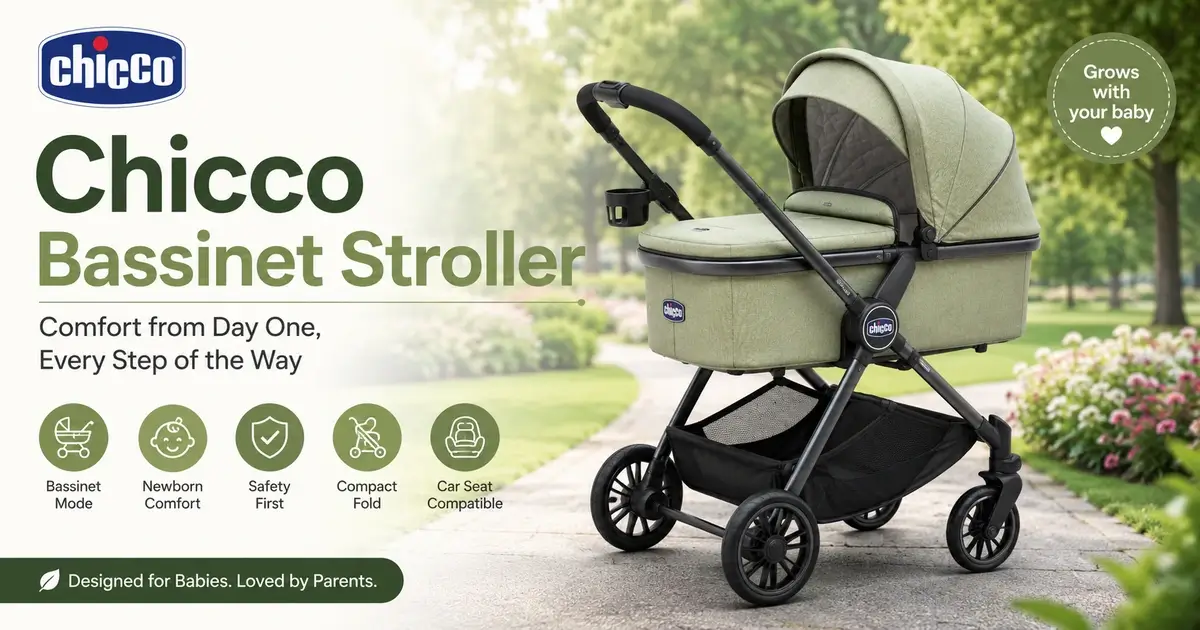
A Chicco Bassinet Stroller can provide a supportive and comfortable riding position during a baby’s early months. However, Chicco does not use the word “bassinet” for every newborn-friendly stroller setup. Instead, the company often uses terms such as infant carriage, infant seat insert, modular stroller, and infant car-seat carrier. The Chicco Corso Primo is the closest match to a convertible bassinet stroller. It’s included infant insert works with the reclining stroller seat to create a newborn-friendly carriage. Later, parents can continue using the same modular seat for an older baby or toddler. Other Corso models can also support newborn use with the correct insert or a compatible Chicco infant car seat. However, the included accessories vary between the Corso Primo, Corso LE, standard Corso, and Corso Flex. Therefore, parents should review the exact package before placing an order. This guide explains the main Chicco bassinet stroller options. It also covers infant carriage setup, car-seat compatibility, safety, folding, storage, comfort, advantages, limitations, and practical buying tips.
Quick Answer: Which Chicco Stroller Has a Bassinet Mode?
The Chicco Corso Primo is the easiest choice for parents who want a bassinet-style newborn position. Its package includes a Corso infant seat insert that transforms the fully reclined stroller seat into an infant carriage.
Parents can also buy the Corso Infant Seat Insert separately. Chicco currently lists it as compatible with Corso, Corso LE, Corso Primo, and Corso Flex models. As a result, families who already own a compatible Corso stroller may not need to buy a new travel system.
The Corso LE and standard Corso can carry compatible Chicco infant car seats. However, the travel-system versions may not include the separate carriage insert. Buyers must check the exact list of included products.
The Bravo Primo supports travel with a newborn through its infant car seat. Still, it does not provide the same convertible infant carriage as the Corso Primo. Therefore, the Corso Primo remains the strongest overall match for this keyword.
What Is a Chicco Bassinet Stroller?
A Chicco Bassinet Stroller is generally a Chicco stroller with an approved newborn-friendly configuration. The setup may use a Corso infant seat insert, a fully reclined modular seat, or a compatible Chicco infant car seat.
The Corso infant carriage is not a separate hard-shell carry cot. Instead, the infant insert fits inside the regular modular stroller seat. Parents fully recline the seat and install the insert components according to the product manual.
This design can save storage space because a single seat supports multiple stages. Parents can use the carriage mode during the early months. Later, they can remove the newborn components and continue using the seat through toddlerhood.
However, a reclining toddler seat should not automatically be treated as a newborn bassinet. Parents must use the approved insert when the stroller instructions require it. They should never create a homemade setup with pillows, blankets, or rolled towels.
Bassinet, Infant Carriage, Pramette, and Car Seat
These product terms can look similar in online listings. However, they may describe different designs and approved uses. Understanding each term helps parents select the right stroller configuration.
Traditional Stroller Bassinet
A traditional stroller bassinet is usually a separate attachment. It often has a flat base, protective sides, a canopy, and a small fitted mattress. Parents connect it directly to the stroller frame instead of using the toddler seat.
This design may provide a spacious position for a young baby. However, the bassinet requires additional trunk and home storage. Families may also use it for only a limited period before the baby outgrows it.
Not every stroller bassinet is approved for overnight sleep. Parents should check the exact manufacturer’s instructions and safety certification. A product name or photograph alone cannot confirm sleep approval.
Chicco Infant Carriage
The Chicco infant carriage uses a Corso modular stroller seat and an approved infant insert. The seat remains fully reclined during the earliest stage. The insert provides support around the baby’s head and body.
This setup can be practical for parents with limited storage. The same seat later converts into a regular parent-facing or forward-facing stroller seat. Therefore, families do not need to store a separate bassinet shell.
However, every insert component has a purpose. Parents should use the headrest, wedge, shoulder pads, and main insert as directed. They should not remove a component early simply because the baby appears comfortable.
Pramette Stroller
A pramette is a stroller seat that converts into a flat position for infants. Other stroller brands use this term more often than Chicco. Retailers may still use “pramette” when describing the Corso infant carriage.
The product design matters more than the marketing term. Some pramette seats create an enclosed infant space. Others provide only a deep recline and require an additional insert.
A pramette cannot protect a baby during vehicle travel. Parents must use a correctly installed infant car seat inside a car. They should never place a stroller seat or carriage inside a vehicle.
Infant Car-Seat Carrier
An infant car seat protects a baby during vehicle travel when installed correctly. Compatible Chicco infant seats can also click into Corso and Bravo stroller frames. This creates a convenient travel-system configuration.
Car-seat mode may help during short errands or appointments. Parents can move the secured seat from the vehicle to the stroller without immediately unbuckling the baby. This can make quick transitions easier.
However, a car seat keeps the baby in a semi-reclined position. It does not provide the same open space as an infant carriage. It should also not replace a firm, flat sleep surface after the journey ends.
Main Chicco Bassinet Stroller Options
The following table compares the main Chicco models related to newborn stroller travel. Product bundles can change, so parents should confirm the exact included items before buying.
| Chicco Model | Newborn Setup | Car-Seat Option | Best For |
|---|---|---|---|
| Corso Primo | Included infant carriage insert | Included with travel system | Complete newborn-to-toddler use |
| Corso LE | Compatible insert available | Included with travel system | Premium modular features |
| Standard Corso | Compatible insert available | Included with travel system | Lighter modular design |
| Corso Flex | Compatible insert and car-seat modes | Supports one or two infant seats | Growing families |
| Bravo Primo | Infant car-seat carrier mode | Included with travel system | Fast folding and daily errands |
The Corso Primo provides the most complete bassinet-style package. Meanwhile, the Corso LE and standard Corso may suit parents who are comfortable purchasing the infant insert separately.
Chicco Corso Primo Overview
The Chicco Corso Primo includes a modular stroller, infant carriage insert, infant car seat adapter, car seat, and stay-in-car base. Therefore, it supports several modes of travel from the newborn stage through toddlerhood.
Parents can use the included insert to create carriage mode. They can also remove the toddler seat and connect the infant car seat directly to the frame. Later, the modular seat can face the parent or the direction of travel.
The stroller seat currently supports a child up to 50 pounds. The included infant car seat model and its limits may vary by the current package. Therefore, buyers should review the exact product listing and both instruction manuals.
Official product information is available on the Chicco Corso Primo page.
Corso Primo Infant Carriage
The infant carriage is the main feature that separates the Corso Primo from many Chicco travel systems. The insert creates a supported space inside the reclining modular seat. Parents can position the carriage so the baby faces them.
Parent-facing carriage mode helps caregivers watch the baby while walking. They can check the child’s position, harness, airflow, and temperature. However, parents should stop the stroller before making any adjustments.
The carriage remains a stroller configuration rather than a separate crib. Parents should supervise the baby during use. They should also follow the manual before allowing the baby to remain asleep in the stroller.
Included Infant Seat Insert
The current Corso Primo includes a removable infant seat insert. The set contains a main insert, newborn wedge, shoulder pads, and head support. These parts work together during the earliest months.
Chicco currently directs parents to use the complete newborn setup from birth through four months. The stroller seat must remain fully reclined during this stage. After four months, parents can remove the newborn wedge according to the instructions in the insert.
The main insert can continue providing additional cushioning as the child grows. However, it must not prevent a secure harness fit. Parents should adjust the restraint whenever the child’s size or clothing changes.
Parents can review the separate Corso Infant Seat Insert page.
Parent-Facing and Forward-Facing Modes
The Corso Primo modular seat can face the parent or face forward. Parent-facing mode may suit a younger baby who benefits from closer interaction. It also allows caregivers to monitor the child more easily.
Forward-facing mode may suit an older baby or toddler. The child can see people, trees, stores, and other surroundings. However, the child must meet the developmental guidance for the selected seat position.
Parents should remove the child before reversing the seat. They should apply the parking brake and lock both seat mounts into the frame. A gentle upward pull can help confirm a secure connection.
Infant Car-Seat Mode
The Corso Primo can be converted into a lighter-frame stroller by removing the toddler seat. They can then connect the included Chicco infant car seat through the approved adapter.
This setup may work well for quick errands. For example, parents can move the baby from the vehicle to the stroller without immediately removing the harness. However, they must confirm that the seat clicks into both attachment points.
The infant car seat and carriage serve different purposes. Car-seat mode provides travel convenience, while carriage mode offers a flatter stroller position. Parents can choose the appropriate setup for each outing.
Fold, Size, and Lifting
The Corso Primo provides a compact, self-standing, one-hand fold. Chicco currently states that it folds from its regular stroller configurations. The folded stroller stands on its wheels, which helps keep the push handle away from the ground.
The full toddler stroller weighs about 26 pounds. The lighter frame-only setup weighs about 19.2 pounds. Therefore, parents who frequently lift the stroller should consider which configuration they will use most often.
The folded stroller measures about 15.5 inches long, 24.8 inches wide, and 32 inches high. However, parents should measure their actual trunk opening. A narrow opening can make even a large cargo floor difficult to access.
Wheels and Suspension
The Corso Primo uses foam-core treaded tires. The front wheels measure about 8.3 inches, while the rear wheels measure about 10.3 inches. These tires do not require routine air-pressure maintenance.
Adjustable FlexCore suspension helps soften movement over small cracks and maintains paths. As a result, the stroller may feel smoother than many compact travel models.
However, it is not a dedicated jogging or off-road stroller. Deep gravel, mud, sand, and rough trails may remain difficult. Active parents should compare a purpose-built jogging stroller instead.
Canopy and Storage
The Corso Primo has a large UPF 50+ canopy with a pull-out visor and mesh panel. The canopy provides shade, while the mesh section supports airflow. Parents should still check the baby’s temperature during warm weather.
The stroller also offers a large lower basket, organizer pockets, and a removable parent organizer. These areas can hold diapers, clothing, snacks, and other light essentials.
Parents should keep heavy cargo inside the lower basket. They should not hang a heavy diaper bag from the handlebars because added rear weight can affect balance.
Chicco Corso LE Overview
The Corso LE is a premium modular stroller with parent-facing and forward-facing modes. It also converts into a lightweight infant car-seat frame when parents remove the toddler seat.
The current Corso LE travel system includes a KeyFit Max ClearTex infant car seat, base, and adapter. However, the travel-system carton does not currently list the separate Corso infant carriage insert. Parents may need to purchase it separately.
The Corso LE stroller supports children up to 50 pounds. It also provides a multi-position reclining seat, an adjustable footrest, a large canopy, rear suspension, and an extra-large storage basket.
Review the current Chicco Corso LE Travel System page.
Who Should Choose the Corso LE?
The Corso LE may suit parents who want premium Corso features but do not need every Primo accessory. It offers the same general modular seating concept and a slightly lower full-stroller weight.
Parents can use the included infant car seat from the newborn stage. They can also add the compatible Corso Infant Seat Insert for carriage mode. However, they should include the cost of the accessory in their total budget.
The Corso LE currently weighs about 25.2 pounds when complete as a toddler stroller. Its frame-only configuration weighs about 19.1 pounds. Therefore, its weight remains similar to the Corso Primo.
Standard Chicco Corso Overview
The standard Chicco Corso provides modular seating at a lower stroller weight than the premium Primo version. The travel system currently pairs the stroller with a KeyFit 30 Zip infant car seat and base.
Parents can position the stroller seat toward themselves or forward. They can also remove the toddler seat and connect the infant car seat directly to the frame. However, the standard travel system does not normally include the Primo carriage insert.
The standard Corso full stroller weighs about 23.4 pounds. Its frame-only setup weighs approximately 17.3 pounds. Therefore, it may suit parents who want Corso flexibility with less lifting weight.
Current details appear on the standard Chicco Corso Travel System page.
Chicco Corso Flex Overview
The Chicco Corso Flex is designed for families who may need two passenger positions. It includes a modular toddler seat, a built-in youth seat, a standing platform, an infant car seat adapter, and multiple storage options.
Parents can add a second toddler seat or another infant car-seat adapter. Therefore, the stroller can support an infant and toddler, two older children, or two compatible Chicco infant car seats in approved configurations.
The Corso Flex currently supports two children, each weighing up to 40 pounds. However, the full stroller is heavier and longer than a standard Corso. Parents should consider trunk space and daily lifting before buying.
Review the available configurations on the Chicco Corso Flex page.
Corso Flex Size and Daily Use
The single toddler configuration weighs about 34.5 pounds. The frame without modular components weighs about 26.4 pounds. Adding another seat or car seat increases the total travel weight.
The stroller includes a large basket with front and rear access. It also has a removable shopping basket, parent tray, and built-in standing platform. These features can help during family errands.
However, the longer frame requires more turning space. Parents should practice steering and braking before entering a crowded store. They should also measure their trunk with every required component in mind.
Is the Chicco Bravo Primo a Bassinet Stroller?
The Bravo Primo is a premium travel system, but it is not a true bassinet-style stroller. It supports newborn travel through the included Chicco infant car seat rather than a Corso-style infant carriage.
The Bravo Primo serves as an infant car seat carrier, travel system stroller, and toddler stroller. It also provides a quick one-hand fold, a parent tray, a child tray, a canopy, suspension, and a large storage basket.
This model may suit parents who drive frequently and value fast transitions. However, parents who want a flatter newborn carriage should choose a Corso Primo or compatible Corso stroller.
Check the current Chicco Bravo Primo page.
Which Chicco Bassinet Stroller Should You Choose?
The best model depends on the family’s routine, vehicle, storage space, and plans. Parents should compare the complete system rather than choosing based solely on appearance.
Choose the Corso Primo When:
- You want the infant carriage insert included.
- You need a complete stroller and car-seat system.
- You prefer parent-facing newborn walks.
- You want premium storage features.
- You value a one-hand standing fold.
- You plan to use the stroller through toddlerhood.
The Corso Primo offers the easiest all-in-one bassinet-style setup. Parents do not need to search for a separate newborn insert. However, it usually costs and weighs more than the standard Corso.
Choose the Corso LE When:
- You want premium modular features.
- You need to include a KeyFit Max infant car seat.
- You can purchase the carriage insert separately.
- You want an adjustable handlebar.
- You need a large canopy and a basket.
The Corso LE provides many of the Primo’s main stroller features. However, parents should verify whether their selected stroller-only or travel-system package includes an infant insert.
Choose the Standard Course When:
- You prefer a lighter modular stroller.
- You want a lower starting price.
- You already own a compatible Chicco car seat.
- You can add an infant insert separately.
- You do not need every premium accessory.
The standard Corso may provide the best balance of weight and flexibility. Nevertheless, separate accessories can increase the final cost.
Choose the Corso Flex When:
- You expect to carry two children.
- You have an infant and an older child.
- You are preparing for twins.
- You need a standing platform.
- You have enough trunk space.
- You can manage a heavier stroller.
The Corso Flex provides the strongest long-term expansion. However, a one-child family may not need the additional weight and length.
Compare more Chicco models: If you are not sure you need a bassinet-style setup, see our Best Chicco Stroller Review to compare Chicco options for everyday use, travel systems, lightweight trips, and active families.
Can a Newborn Use a Chicco Stroller?
A newborn can use a Chicco stroller only in an approved infant configuration. The correct setup may use a Corso infant carriage or a compatible Chicco infant car seat.
Parents should not place a newborn in a normal upright toddler seat. Young babies lack the head, neck, and core control required for many seated positions. A deep recline alone may not provide the approved support.
The infant insert creates structured support inside the Corso seat. Meanwhile, an infant car seat protects a vehicle. Parents should use each product only for its approved purpose.
Read our newborn stroller safety guide for more information.
How to Use the Corso Infant Insert
The exact installation process may vary by insert version. Therefore, parents must use the manual supplied with their product. The steps below provide only a general overview.
- Place the stroller on a level surface.
- Apply the parking brake.
- Remove the child from the stroller.
- Fully recline the modular seat.
- Install the newborn wedge as directed.
- Place the main insert inside the seat.
- Route the harness through the correct openings.
- Attach the headrest and shoulder pads.
- Remove every twist from the straps.
- Confirm that the insert lies flat.
- Check both seat connections.
- Secure the baby before moving.
Chicco currently directs parents to use the wedge, shoulder pads, and headrest from birth through four months. After four months, they can remove the wedge and continue using the main insert as directed.
Parents should not add another mattress, pillow, or body positioner. Unapproved padding can change the baby’s position and interfere with the harness.
Infant Carriage vs Infant Car Seat
| Feature | Infant Carriage | Infant Car Seat |
|---|---|---|
| Main purpose | Supervised stroller walks | Vehicle travel |
| Position | Flatter reclined position | Semi-reclined position |
| Vehicle use | No | Yes, when installed correctly |
| Quick car transfer | No | Yes |
| Routine sleep | Check product approval | Not a routine sleep space |
The infant car seat may work best during a quick stop. Parents can transfer the secured seat from the vehicle to the stroller frame. However, they should confirm that the seat locks correctly.
The infant carriage may provide more room during a longer supervised walk. Still, parents must secure the baby in the approved stroller harness and continue to monitor the child.
Travel-system comparison: If you are also comparing complete stroller-and-car-seat packages across brands, see our Best Infant Car Seat and Stroller guide.
Read our bassinet stroller versus car-seat stroller comparison.
Can a Baby Sleep in the Chicco Carriage?
A baby may fall asleep naturally during a stroller walk. However, parents should not assume that the Corso carriage is approved for unattended or overnight sleep.
Parents should keep the baby’s face clear and continue close supervision. They should not place pillows, loose blankets, toys, or positioners inside the stroller seat.
After returning home, move the sleeping baby to a firm, flat, approved sleep surface as soon as practical. Place the baby on their back and follow current safe-sleep guidance.
Read our bassinet stroller safety guide.
When Can the Baby Use the Regular Seat?
The baby needs enough head, neck, and upper-body control for the selected stroller position. Development varies, so parents should not rely only on age.
The child should hold their head steadily and remain stable in the seat. The baby should not slump strongly forward or lean to one side.
Parents can begin with an approved reclined position and gradually adjust it as needed. When they remain uncertain, they should consult the stroller manual and the child’s healthcare professional.
Harness, Brake, and Seat Safety
Parents should use the stroller harness during every ride. Carriage mode does not remove the need for restraint. The straps should lie flat and fit securely without causing pain.
A child tray or bumper bar cannot replace the harness. Parents should secure the child before placing toys, drinks, or snacks on the tray.
Apply the parking brake whenever the stroller stops. Use it before placing the baby inside, removing the baby, reversing the seat, or connecting the infant car seat.
After attaching a modular seat or car seat, pull gently upward to check the connection. The product should remain firmly locked to the frame.
Canopy, Ventilation, and Heat
Current Corso strollers include large canopies, and premium models provide UPF 50+ fabric. Many also include a pull-out visor and mesh ventilation panel.
The canopy reduces direct sunlight but cannot eliminate all heat risks. Parents should feel the baby’s chest or upper back during warm weather. Sweating, hot skin, rapid breathing, or unusual sleepiness may indicate overheating.
Parents should not cover the complete stroller with a thick blanket. Full coverage may reduce airflow and trap warm air. Instead, use the built-in canopy and choose cooler walking times.
Folding and Trunk Fit
Corso models provide a compact one-hand standing fold. However, the exact folding process and required seat position may vary between models.
Before folding, remove the child and loose items. Apply the parking brake and check that no straps or blankets block the hinges. Then activate the approved folding control.
Parents should not force a frame that resists closing. The seat may be positioned incorrectly, or an object may be trapped in the mechanism.
Measure the vehicle’s trunk opening before buying. Also, leave space for the infant car seat, base, diaper bag, groceries, and other supplies.
Cleaning and Maintenance
Regular cleaning can improve comfort and make damage easier to notice. Crumbs, milk, dirt, and moisture often collect around the seat and infant insert.
Chicco generally recommends spot-cleaning stroller fabrics with warm water and mild detergent. Approved insert components may support delicate cold-water machine washing. However, parents should check the exact care label first.
Do not machine wash the stroller harness. Instead, clean it according to the manual and allow it to air dry. Do not use bleach unless Chicco specifically approves it.
Inspect the following parts regularly:
- Stroller frame and seat mounts
- Infant insert and newborn wedge
- Harness straps and buckle
- Front and rear wheels
- Parking brake
- Recline mechanism
- Car-seat adapter
- Canopy attachments
- Storage basket
- Folding and travel locks
Stop using the stroller when a structural part cracks, bends, or fails to lock. Contact Chicco for approved replacement parts or service.
Chicco Bassinet Stroller Advantages
- Newborn-friendly infant carriage option
- Insert included with the Corso Primo
- The separate insert works with multiple Corso models
- Parent-facing and forward-facing seating
- Compatible Chicco infant car seats
- Complete travel-system options
- On the one hand, self-standing folds
- Large canopies and storage baskets
- Larger everyday stroller wheels
- Long-term toddler use
- Expandable Corso Flex option
The main advantage is flexibility. Parents can use carriage mode, infant car-seat mode, and toddler mode without purchasing three separate stroller frames.
Chicco Bassinet Stroller Limitations
- The carriage is not a separate hard-shell bassinet.
- Some packages do not include the infant insert.
- Full-size Corso models need trunk space.
- Premium models can feel heavy.
- Car-seat mode does not provide a flat position.
- Carriage mode is not automatically approved for overnight sleep.
- Optional accessories increase the total cost.
- Corso models are not jogging strollers.
- Corso Flex becomes heavy with two children.
The main challenge is understanding the package. Parents should check the exact items included rather than relying solely on promotional photographs.
Chicco Bassinet Stroller Buying Checklist
- Confirm the exact Chicco model.
- Check whether the infant insert is included.
- Confirm all insert components are present.
- Check infant car-seat compatibility.
- Review car-seat height and weight limits.
- Measure the vehicle trunk opening.
- Compare folded stroller dimensions.
- Consider the stroller lifting weight.
- Review parent-facing seat options.
- Check wheel size and suspension.
- Review canopy and ventilation features.
- Check the basket weight limit.
- Review cleaning instructions.
- Check warranty and return terms.
- Search the current recall database.
This checklist can prevent an expensive mistake. It also helps parents choose a stroller based on their daily routine rather than appearance alone.
Browse Chicco Bassinet Stroller Options
Compare current Corso models, infant inserts, included car seats, prices, colors, and package contents before ordering.
View Chicco Bassinet Stroller Options on Amazon
Frequently Asked Questions
Does Chicco make a bassinet stroller?
Yes. Chicco offers a bassinet-style infant carriage, the Corso Primo, and a compatible Corso Infant Seat Insert.
Which Chicco stroller turns into a bassinet?
The Corso Primo includes an infant insert that creates carriage mode. Other compatible Corsa models can use the insert when purchased separately.
Does the Corso Primo include the infant insert?
Yes. The current Corso Primo package includes the main insert, newborn wedge, shoulder pads, and headrest.
Can a newborn use the Chicco Corso?
Yes, when parents use an approved Corso infant carriage setup or a compatible Chicco infant car seat.
Must the Corso seat remain fully reclined?
Yes. The current insert guidance requires full recline during the newborn stage from birth through four months.
When should parents remove the newborn wedge?
Current Chicco guidance directs parents to remove the newborn wedge when the baby reaches four months.
Does the baby need a harness in carriage mode?
Yes. Parents should use the approved stroller harness during every ride.
Can the Chicco carriage face the parent?
Yes. Corso modular seats support parent-facing configurations when installed correctly.
Can a baby sleep overnight in the carriage?
Do not assume the stroller carriage supports overnight sleep. Use an approved, firm, flat infant sleep surface at home.
Can parents add another mattress?
No. Do not add an aftermarket mattress, pillow, wedge, or positioner unless Chicco approves it for the exact model.
Is the Bravo Primo a bassinet stroller?
No. The Bravo Primo supports newborn travel through an infant car seat but does not offer the Corso infant carriage.
Can you jog with a Chicco Corso?
No. Standard Corso models are designed for everyday walking rather than jogging.
Can the Corso Flex carry two infant car seats?
Yes. The Corso Flex can carry two compatible Chicco infant car seats with the correct second adapter.
Which Chicco stroller is best for a newborn?
The Corso Primo is the simplest complete option because it includes the infant carriage insert and a compatible travel-system setup.
Is a Chicco Bassinet Stroller worth buying?
It may be worth buying for parents who want newborn support, reversible seating, car-seat compatibility, and long-term toddler use.
Final Verdict
A Chicco Bassinet Stroller is best understood as a Chicco Corso with an approved infant carriage configuration. The Corso Primo is the strongest complete option because it includes the infant seat insert and travel-system components.
The Corso LE and standard Corso also provide useful modular features. However, parents may need to purchase the infant carriage insert separately. Therefore, they should compare the total package cost.
The Corso Flex may provide better long-term value for a growing family. It can carry two children in several approved configurations. However, its larger frame requires more trunk space and lifting strength.
The Bravo Primo remains a practical travel system for frequent drivers. Still, it relies on infant car-seat mode and does not provide the same carriage position.
Before purchasing, confirm the exact model, insert compatibility, included car seat, folded dimensions, and vehicle fit. Also, read the instructions for every stroller, insert, and car seat before the first outing.
For the right family, the Chicco Corso Primo can combine newborn support, parent-facing travel, infant car-seat convenience, and long-term toddler use in one adaptable stroller system.

Sanat Barua is the founder of Stroller Haven. He researches stroller models, manufacturer specifications, and safety standards to help parents compare options and make confident, informed decisions.
His research draws on official manufacturer documentation and product manuals, publicly available owner feedback, and safety guidance from sources such as the U.S. Consumer Product Safety Commission (CPSC) and the American Academy of Pediatrics (AAP). Stroller Haven is a research-based website: products are not described as physically tested unless an article states that testing took place. Stroller Haven is updated regularly as new models and safety information become available.