

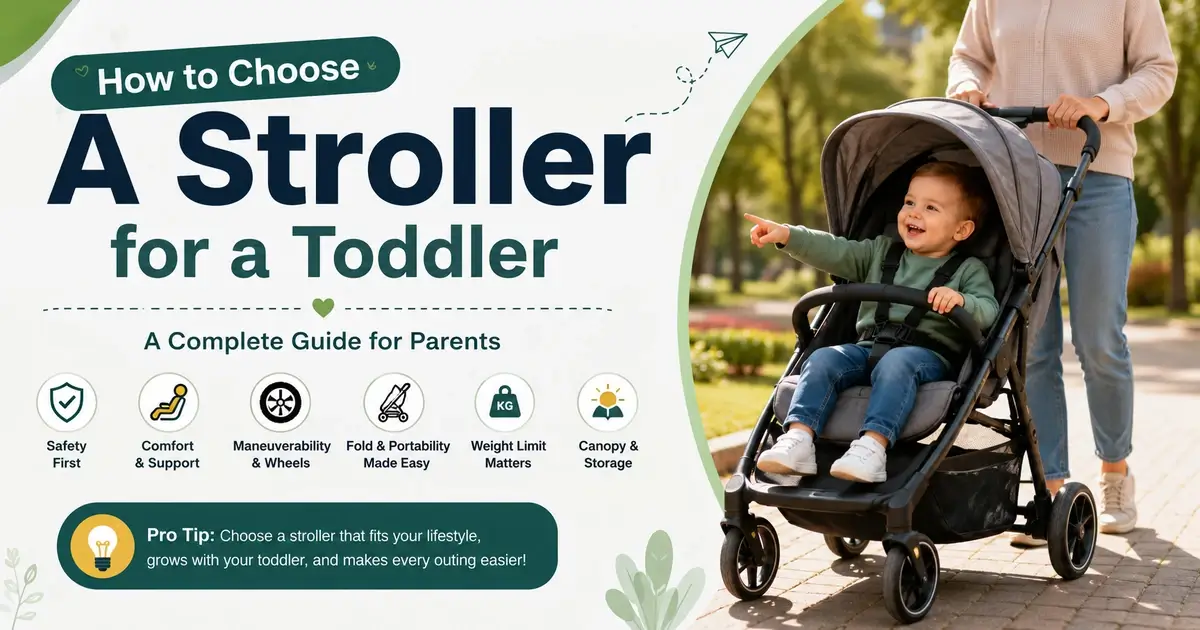
Choosing a stroller for a toddler can feel more complicated than choosing one for a newborn. Your child is now heavier, more active, and more curious about the world. A toddler may want to walk for part of the trip and ride during the rest. The stroller must therefore be comfortable, easy to access, stable, and simple for you to push. The right stroller should also fit your family’s normal routine. A stroller that works well in a shopping mall may not perform well on rough sidewalks, park trails, airports, or crowded public transport. This guide explains how to choose a stroller for a toddler, considering weight limits, seat comfort, harness design, wheels, brakes, storage, folding size, travel needs, and everyday usability. You can also compare recommended models in our best toddler stroller guide.
Quick Answer: How Do You Choose a Toddler Stroller?
Choose a toddler stroller that supports your child’s current weight and expected growth. Look for a roomy seat, an adjustable five-point harness, a supportive footrest, effective brakes, stable wheels, a useful canopy, and a fold that fits your vehicle or storage space.
The best choice should match where you walk most often. Travel families may prefer a compact stroller. Active families may need larger wheels and better suspension. Families with long daily outings may need more storage, a larger canopy, and a more supportive seat.
Why Toddlers Need Different Stroller Features
Newborn stroller selection focuses heavily on head support, full recline, bassinet compatibility, and compatibility with infant car seats. Toddler stroller selection focuses more on space, durability, mobility, and long-term comfort.
Toddlers are stronger and more mobile. They may lean forward, move their legs, reach toward nearby objects, or try to climb out.
They also need more room than infants. A narrow seat, short backrest, or low canopy may become uncomfortable even when the stroller is technically within its stated weight limit.
Your toddler may also use the stroller differently from day to day. One day, the stroller may be used for a short grocery trip. On another day, it may be used for several hours at a zoo, theme park, airport, or family event.
For that reason, a good toddler stroller must balance safety, comfort, portability, and practical daily use.
1. Check the Stroller Weight Limit
The first step is checking the manufacturer’s stated child weight limit. Do not choose a stroller based only on the recommended age range.
Children of the same age can have very different heights and weights. A stroller described as suitable for a three-year-old may not fit every three-year-old comfortably.
Check your child’s current weight and compare it with the stroller’s maximum limit. Leave enough room for future growth.
For example, a stroller that supports only slightly more than your toddler’s current weight may have a short useful life. A model with a higher limit may last longer, provided the seat dimensions are appropriate.
The weight limit usually applies to the child in the seat. Storage baskets, parent organizers, cup holders, and other accessories may have separate limits.
Do not hang heavy bags from the handlebars. Extra weight behind the stroller can affect stability and increase the risk of tipping.
Read our detailed stroller weight-limit guide for more information on child weight, cargo limits, and safe use.
Questions to Ask About Weight Capacity
- What is my toddler’s current weight?
- How much growing room does the stroller provide?
- Does the seat remain comfortable near the maximum limit?
- What is the storage basket’s weight limit?
- Are there separate limits for accessories?
2. Measure the Seat, Backrest, and Canopy Height
A high weight limit does not automatically mean that a stroller has a roomy seat.
Some compact strollers support older children but have narrow seating areas or short backrests. A taller toddler may feel crowded even when still below the stated limit.
Check the seat width, seat depth, backrest height, and distance from the seat to the canopy.
Your toddler should be able to sit without the sides pressing tightly against the body. The child’s head should not push against the canopy fabric or frame.
The seat should also provide enough depth to support the upper legs. A very shallow seat may cause the child to slide forward or place extra pressure on the harness.
Signs That a Stroller Seat May Be Too Small
- Your toddler’s shoulders feel compressed.
- The child’s head touches the canopy frame.
- The knees remain sharply bent without support.
- The harness is difficult to adjust correctly.
- The child appears uncomfortable during short trips.
Whenever possible, check the manufacturer’s measurements rather than judging only from product photos.
3. Choose a Supportive and Comfortable Seat
Toddlers may spend a long time in a stroller during travel, errands, or family outings. Seat comfort matters.
Look for a supportive backrest, adequate padding, breathable fabric, and enough room for movement.
Very thick padding is not always necessary. However, the seat should not feel hard, poorly supported, or shaped in a way that pushes the child forward.
Breathable materials can be helpful during warm weather. Mesh ventilation panels may improve airflow, especially when the canopy is extended.
Removable or wipe-clean seat fabric can also make maintenance easier. Toddlers often eat snacks, carry drinks, and bring dirt into the stroller.
Before purchasing, check whether the seat fabric can be removed and whether the manufacturer provides cleaning instructions.
Our guide to safely cleaning stroller wheels and fabric explains how to maintain the stroller without damaging its materials.
4. Look for an Adjustable Recline
Many toddlers no longer need a completely flat stroller seat. However, an adjustable recline remains useful.
A toddler may become tired during a long walk, an airport delay, a shopping trip, or a theme park visit. A reclined position can make resting more comfortable.
Check how easily the seat reclines. Some strollers use a lever. Others use straps that require two hands.
A one-hand recline can be more convenient when you are holding your child or managing bags.
Also, check whether the seat can be easily returned to an upright position. Some toddlers prefer to sit upright so they can see their surroundings.
The recline mechanism should lock securely and should not move unexpectedly when the child shifts position.
5. Choose a Five-Point Harness
A secure harness is one of the most important stroller safety features.
A five-point harness usually includes two shoulder straps, two waist straps, and one leg strap. Together, these help prevent the child from standing, sliding, or climbing out.
The harness should be adjustable as your toddler grows. The straps should lie flat and should not be twisted.
Check whether the shoulder strap height can be changed. A fixed harness position may become uncomfortable for a taller child.
The buckle should be secure enough that a toddler cannot easily release it. At the same time, an adult should be able to open it without excessive difficulty.
Do not rely on the bumper bar as a restraint. The harness should be used according to the stroller manufacturer’s instructions, even when the child seems calm.
See our five-point harness stroller safety guide for proper positioning and common harness mistakes.
6. Check the Footrest and Leg Support
A toddler’s feet should not hang awkwardly for long periods.
Look for a footrest that provides stable support. An adjustable footrest may be more comfortable as the child grows.
A very short footrest can leave a taller toddler’s legs unsupported. A poorly positioned footrest may also make it easier for the child to place their feet near the wheels.
Check the distance between the footrest and front wheels. The stroller design should reduce the chance of the child reaching moving parts.
Some travel strollers have small footrests to reduce folded size. This can be acceptable for short trips, but it may be less comfortable during long outings.
7. Match the Wheels to Your Walking Surface
The best stroller wheels depend on where you usually walk.
Small wheels can work well on smooth indoor floors, airports, and well-maintained sidewalks. They also help keep the stroller light and compact.
Larger wheels generally perform better on cracked sidewalks, grass, gravel paths, and uneven surfaces.
Suspension can improve comfort by reducing vibration. This may be especially useful if your neighborhood has rough pavement.
Check whether the front wheels swivel, lock, or provide both options.
Swivel wheels improve maneuverability in stores and crowded areas. Lockable front wheels may improve stability on uneven paths.
For more guidance, read our stroller wheel safety guide.
Wheel Selection by Environment
| Typical Environment | Useful Wheel Features |
|---|---|
| Shopping malls and stores | Small swivel wheels and a tight turning radius |
| City sidewalks | Medium wheels with suspension |
| Parks and rough paths | Larger wheels and stronger suspension |
| Airports and public transport | Lightweight wheels and compact folding |
| Jogging or fast walking | A stroller specifically designed for active use |
8. Test the Brakes
A toddler stroller should have a brake system that is easy for an adult to engage and difficult to release accidentally.
Many strollers use a foot-operated parking brake. Some have a single central brake, while others require each rear wheel to be locked separately.
A one-step brake can be more convenient because it reduces the chance of locking only one side.
The brake should hold the stroller securely on a level surface. However, a parking brake does not make it safe to leave a stroller unattended on a slope.
Apply the brake whenever you stop, place your toddler in the seat, or remove the child.
Check our stroller brake safety guide for a simple inspection routine.
9. Consider the Stroller’s Stability
Toddlers can shift their weight suddenly. A stable stroller is therefore important.
Look at the wheelbase, frame shape, seat position, and storage design. A wider wheelbase can improve stability, although it may make the stroller less compact.
Avoid placing heavy bags on the handlebars. Hanging bags can move the stroller’s center of gravity backward.
Use the storage basket for approved cargo and stay within its stated limit.
If your toddler frequently leans to one side, ensure the harness is adjusted properly and the stroller remains stable.
Read our stroller storage basket safety guide before carrying heavy supplies.
10. Check the Folded Size
A stroller may work well during a walk, but still be frustrating if it does not fit your vehicle, hallway, closet, or apartment.
Check the stroller’s folded length, width, and height.
Do not rely only on photos showing the stroller folded. A product may look compact in an image, but still occupy most of a small car trunk.
Measure your available storage space before buying.
If you drive a compact vehicle, read our guide on choosing a stroller for small car trunks.
Questions About Folding
- Can the stroller fold with the seat attached?
- Does it require one hand or two hands?
- Does it stand when folded?
- Is there an automatic fold lock?
- Must accessories be removed first?
- Can it fit beside groceries or luggage?
Also, check the stroller’s weight. A compact fold is less useful if the stroller is too heavy for you to lift safely.
11. Consider Overall Stroller Weight
A lightweight stroller can be easier to carry upstairs, place in a vehicle, or use during travel.
However, lighter does not always mean better. Very lightweight strollers may have smaller wheels, less suspension, smaller baskets, and less supportive seats.
A heavier stroller may offer better stability and comfort, but it may be harder to transport.
Think about how often you will lift the stroller. A family living in a building without an elevator may prioritize low weight. A family storing the stroller in a garage may care more about ride quality.
For frequent travel, compare compact options in our best lightweight travel stroller guide.
12. Check the Canopy and Ventilation
A useful canopy should provide adequate shade without blocking airflow.
Look for an extendable canopy that covers the child’s face and upper body while seated.
A peekaboo window can help you check your toddler without stopping. Mesh ventilation panels may also improve airflow.
The canopy should not sit too low over a taller child’s head.
Do not cover the stroller completely with a heavy blanket. This can reduce airflow and trap heat.
Read our guide to protecting a child from the sun in a stroller and our stroller canopy safety guide.
13. Evaluate the Storage Basket
Toddler outings often require snacks, drinks, spare clothing, wipes, toys, and other supplies.
Check the size and accessibility of the storage basket.
A large basket is useful, but the opening also matters. Some baskets become difficult to access when the seat is fully reclined.
Check whether the basket can hold your usual diaper bag without overloading it.
Do not place items where they can interfere with the wheels, brakes, folding mechanism, or child’s feet.
14. Check the Handlebar Height
The handlebars should be comfortable for the adults who will push the stroller most often.
A handlebar that is too low can cause the adult to bend forward. A handlebar that is too high may reduce control.
An adjustable or telescoping handlebar can be useful when caregivers have different heights.
Also, check how the handle feels during turns. A stroller may be easy to push when empty, but require more effort with a growing toddler and a loaded basket.
Our stroller handlebar safety guide explains how to use the handle safely and why heavy bags should not be placed on it.
15. Decide Which Stroller Type Fits Your Toddler
There is no single stroller type that is best for every toddler.
Your decision should depend on your normal environment, transportation, storage, and family routine.
Full-Size Stroller
A full-size stroller often provides a roomy seat, a larger canopy, better suspension, and more storage.
It may be suitable for long daily walks and extended outings.
The main disadvantages are size and weight. Some full-size models are difficult to lift or store in a small vehicle.
Lightweight Travel Stroller
A lightweight travel stroller is easier to fold, lift, and carry.
It may work well for airports, public transport, vacations, and short errands.
However, check the seat size, footrest, wheel quality, and storage capacity. Some compact strollers sacrifice comfort to reduce weight.
Umbrella Stroller
An umbrella stroller usually has a simple frame and compact fold.
It can be useful as a secondary stroller for quick trips.
Basic models may have limited recline, small canopies, minimal storage, and small wheels.
Compare the differences between our travel stroller and umbrella stroller guides.
Jogging Stroller
A jogging stroller may have large wheels, strong suspension, and a stable frame.
It can be useful for active parents and rougher surfaces.
Jogging strollers are often heavier and larger when folded. They should also be used according to the manufacturer’s age and activity instructions.
Visit our best jogging stroller guide for active-use options.
Stroller Wagon
A stroller wagon may provide more space for children and supplies.
It may be useful for parks, outdoor events, and family outings.
However, stroller wagons are usually larger and may not be permitted in every venue. They can also be harder to maneuver in narrow stores.
Review our best stroller-wagon guide and our stroller-wagon safety guide for toddlers.
Toddler Stroller Types Compared
| Stroller Type | Best For | Potential Limitation |
|---|---|---|
| Full-size stroller | Daily walks and long outings | Heavier and larger when folded |
| Travel stroller | Flights, public transport, and vacations | May have smaller wheels and storage |
| Umbrella stroller | Quick errands and backup use | May provide limited comfort |
| Jogging stroller | Active use and rougher paths | Large and heavy |
| Stroller wagon | Outdoor family trips and extra cargo | Bulky and restricted at some venues |
16. Match the Stroller to Your Daily Lifestyle
A stroller should solve the problems you face most often.
Do not choose a model only because it is popular or visually attractive.
For City Families
Look for easy steering, a narrow frame, reliable brakes, and enough wheel suspension for uneven sidewalks.
A compact fold may be important if you use public transport or live in a small apartment.
For Suburban Families
Consider trunk space, shopping basket capacity, and how easily the stroller moves between a vehicle and stores.
A self-standing fold can help when loading groceries or managing a toddler.
For Frequent Travelers
Prioritize low weight, compact folding, an easy carry method, and a secure fold lock.
Check the airline’s rules before assuming a stroller can be taken into the cabin.
For Active Families
Look for larger wheels, suspension, stable steering, and a frame designed for the intended activity.
A regular lightweight stroller should not be used as a jogging stroller unless the manufacturer clearly approves that use.
For Long Day Trips
Choose a supportive seat, good recline, a large canopy, a useful basket, a comfortable footrest, and durable wheels.
Theme park visitors may also need to check venue size restrictions and parking rules.
17. Decide Whether You Need a Single or Double Stroller
A single stroller is usually lighter, narrower, and easier to fold.
However, families planning for another child may consider a convertible stroller that can accommodate a second seat, a riding board, or other approved accessories.
Do not buy a large convertible stroller only because it may be useful someday. Consider whether the extra weight and size will affect your daily routine now.
If your older toddler walks well but becomes tired during long outings, an approved riding board may be more practical than a full second seat.
Check all age, weight, and configuration limits before adding a second child or accessory.
18. Check Ease of Entry and Exit
Toddlers often want to climb into the stroller independently.
A low seat, removable bumper bar, or swing-away bar can make entry easier.
However, the stroller should remain stable while the child enters. Apply the brake and support the child.
Do not allow a toddler to climb into or out of a stroller without adult supervision.
Check whether the footrest is designed to support climbing. Some footrests are not intended to hold the child’s full standing weight.
19. Review the Folding Mechanism for Safety
A folding mechanism should be easy for an adult to operate but protected from accidental activation.
Check for a fold lock that keeps the stroller closed during transport.
Keep your toddler away from hinges and moving frame sections while folding or unfolding.
Confirm that the stroller is fully open and locked before placing the child in the seat.
Read our guide to folding and storing a stroller safely.
20. Consider Cleaning and Maintenance
A toddler stroller will collect crumbs, spills, dirt, sand, and moisture.
Check whether the fabric can be wiped, removed, or machine-washed according to the manufacturer’s instructions.
Also, inspect how easily you can access the wheels, basket, harness, and frame for cleaning.
Replacement parts are another consideration. A stroller from a manufacturer that provides replacement wheels, harness pads, or canopies may be easier to maintain in the long term.
Regularly inspect:
- Wheel attachment points
- Brake operation
- Harness stitching
- Frame joints
- Folding locks
- Seat fabric and seams
- Canopy hinges
21. Avoid Unapproved Accessories
Accessories can improve convenience, but they can also change stroller stability or interfere with safety features.
Use accessories approved for your specific stroller whenever possible.
Be careful with universal cup holders, organizers, hooks, footmuffs, seat liners, and rain covers.
An accessory should not interfere with the harness, brakes, folding mechanism, ventilation, or wheel movement.
Heavy handlebar organizers and bag hooks can increase the risk of tipping.
22. Read the Manufacturer’s Manual
The product manual contains information that may not be obvious from a sales page.
Review the manual for:
- Child weight and height limits
- Approved seat positions
- Harness adjustment
- Brake operation
- Cleaning instructions
- Accessory compatibility
- Folding procedures
- Warnings about terrain or activity
You can also review stroller safety information from the U.S. Consumer Product Safety Commission.
Always follow the instructions for the exact stroller model and version you own.
23. Test the Stroller Before Buying When Possible
Product specifications are useful, but they do not always explain how a stroller feels in daily use.
When possible, test the stroller with your child or use a similar weight in the seat.
Check whether you can:
- Push it comfortably with one or two hands
- Turn it into a narrow space
- Apply and release the brake
- Adjust the harness
- Recline and raise the seat
- Access the storage basket
- Fold and lift it safely
- Place it in your vehicle
A stroller that feels difficult in a store may become more frustrating during a busy outing.
24. Set a Budget Based on Features You Will Use
Stroller prices vary widely. A higher price does not automatically mean that a stroller is better for your family.
Prioritize features that solve your real daily needs.
You may not need premium suspension if you only walk inside shopping centers. You may not need an ultra-compact fold if the stroller remains in a garage.
However, paying more may be worthwhile for a stronger frame, better seat support, improved maneuverability, larger wheels, or a fold you use every day.
Compare long-term usability rather than only the initial price.
A stroller that fits your toddler for several years may offer better value than a cheaper model that quickly becomes too small.
Browse Toddler Strollers
Compare current toddler stroller styles, dimensions, features, and customer feedback before making a final decision.
View Toddler Strollers on Amazon
Toddler Stroller Buying Checklist
Use this checklist before purchasing:
- The stroller supports your toddler’s current weight.
- It provides enough room for future growth.
- The seat width and backrest height are comfortable.
- The canopy does not press against the child’s head.
- The five-point harness adjusts correctly.
- The footrest supports the child’s legs.
- The wheels match your normal terrain.
- The brakes are easy to use and hold securely.
- The frame feels stable when the child moves.
- The stroller fits inside your vehicle or storage area.
- You can lift the stroller without difficulty.
- The basket holds your normal supplies.
- The handlebar is comfortable for caregivers.
- The fabric is practical to clean.
- The folding mechanism locks securely.
- The manufacturer provides clear instructions.
Common Mistakes When Choosing a Toddler Stroller
Choosing Only by Age Recommendation
Age ranges are general. Check weight, height, seat size, and harness fit.
Ignoring the Folded Dimensions
A stroller may be compact during use but still have a large folded footprint.
Choosing the Lightest Model Automatically
A very light stroller may not provide the wheel quality, seat comfort, or storage your family needs.
Ignoring the Toddler’s Height
A child may outgrow the canopy or backrest before reaching the stated weight limit.
Buying for Rare Situations
Choose based on your normal routine, not an activity that happens once a year.
Overlooking Storage Access
A large basket is less useful when it cannot be accessed with the seat reclined.
Hanging Heavy Bags on the Handlebars
This can affect stability and increase the risk of tipping.
Skipping a Test Fold
Some folding systems are less convenient than they appear in product videos.
Read our guide to common stroller mistakes for more safety and usability tips.
When Should a Toddler Stop Using a Stroller?
There is no single age when every child must stop using a stroller.
Usage depends on the child’s size, walking ability, stamina, family routine, and the stroller manufacturer’s limits.
A toddler may walk independently during short trips but still needs a stroller for airports, long events, medical needs, or extended family outings.
Stop using the stroller when your child exceeds the manufacturer’s height or weight limit, cannot fit safely in the harness, or no longer has enough seat and headroom.
You should also stop using a damaged stroller until it has been repaired in accordance with the manufacturer’s instructions.
Frequently Asked Questions
What type of stroller is best for a toddler?
The best type depends on your routine. A full-size stroller may be best for long daily walks. A lightweight travel stroller may be better for flights and public transport. A jogging stroller may suit active families, while a stroller wagon may work for outdoor family trips.
What weight limit should a toddler stroller have?
Choose a stroller with a limit comfortably above your child’s current weight. Also, check seat dimensions, canopy height, and harness fit because a toddler may outgrow the seat before reaching the maximum weight.
Does a toddler stroller need a five-point harness?
A five-point harness is strongly preferred because it helps secure the shoulders, waist, and area between the legs. Use the harness according to the stroller manufacturer’s instructions.
Is a lightweight stroller good for a toddler?
A lightweight stroller can be suitable when it supports the child’s weight and provides enough seat space, harness adjustment, foot support, and stability. Check the wheels and suspension if you use uneven sidewalks.
Can a three-year-old still use a stroller?
A three-year-old may still use a stroller if the child remains within the manufacturer’s limits and fits safely in the seat and harness. Strollers can be useful for long trips and situations involving extensive walking.
Should a toddler stroller have a recline?
An adjustable recline is helpful during long outings because it allows a tired toddler to rest. The recline mechanism should lock securely and be easy for an adult to operate.
Are bigger stroller wheels better?
Bigger wheels often perform better on rough sidewalks, grass, and uneven paths. Smaller wheels may be easier to maneuver indoors and can help reduce stroller weight and folded size.
How do I know whether a stroller will fit my toddler?
Compare your child’s weight and height with the manufacturer’s weight and height limits. Also check seat width, seat depth, backrest height, canopy clearance, footrest position, and harness adjustment.
Should I buy a travel stroller or a full-size stroller?
Choose a travel stroller when portability and compact folding are the main priorities. Choose a full-size stroller when seat comfort, storage, suspension, and long daily use are more important.
Can I hang a diaper bag from the stroller handle?
Heavy bags should not be hung from the handlebars unless the stroller manufacturer specifically approves that setup. Added rear weight can affect stability and increase the risk of tipping.
Final Thoughts
Learning how to choose a stroller for a toddler starts with understanding your child’s current size and your family’s daily routine.
Check the weight limit, seat dimensions, harness, footrest, wheels, brakes, canopy, storage, folding size, and overall stroller weight.
Do not choose based only on appearance, popularity, or price. A stroller should be comfortable for your toddler and practical for the adult who uses it.
The best stroller is the one that keeps your child safe, moves well through your everyday environment, fits your available storage space, and remains convenient during real family outings.
Before every walk, inspect the harness, brakes, wheels, frame, and folding lock. You can follow our stroller safety checklist before every walk.
For product recommendations, visit our best toddler stroller picks.

Sanat Barua is the founder of Stroller Haven. He researches stroller models, manufacturer specifications, and safety standards to help parents compare options and make confident, informed decisions.
His research draws on official manufacturer documentation and product manuals, publicly available owner feedback, and safety guidance from sources such as the U.S. Consumer Product Safety Commission (CPSC) and the American Academy of Pediatrics (AAP). Stroller Haven is a research-based website: products are not described as physically tested unless an article states that testing took place. Stroller Haven is updated regularly as new models and safety information become available.