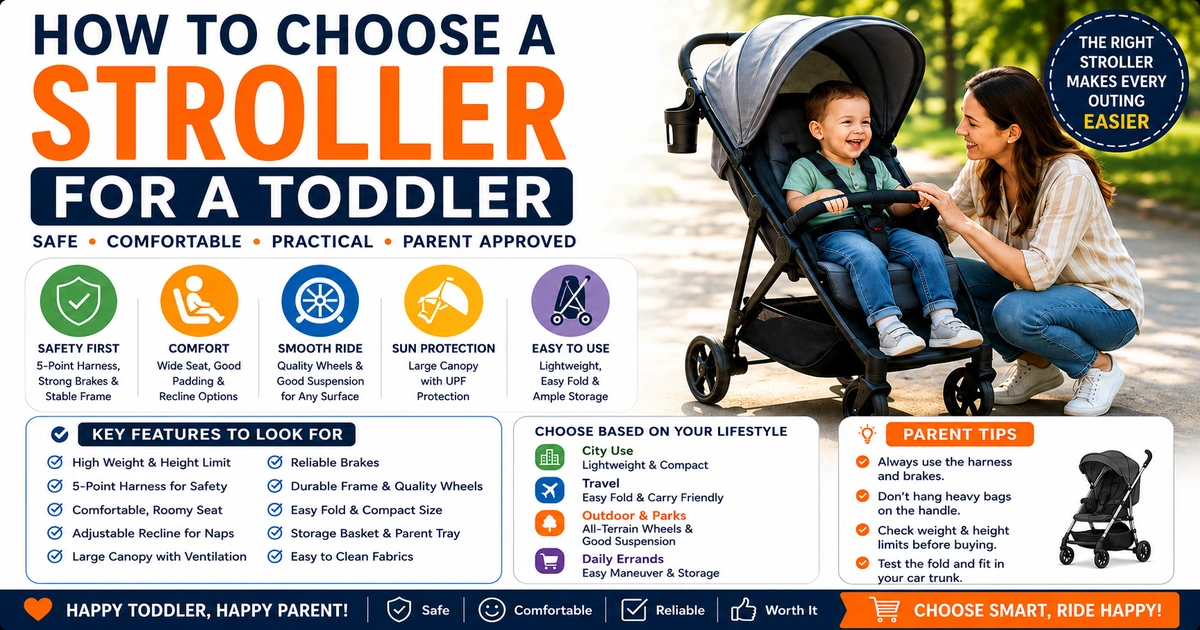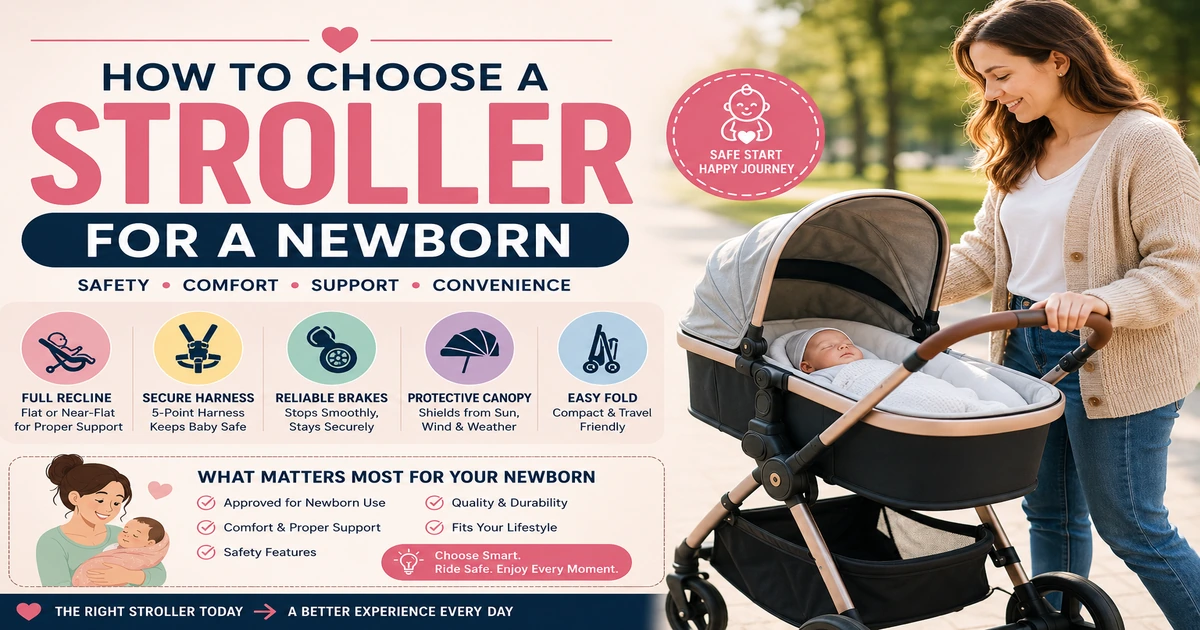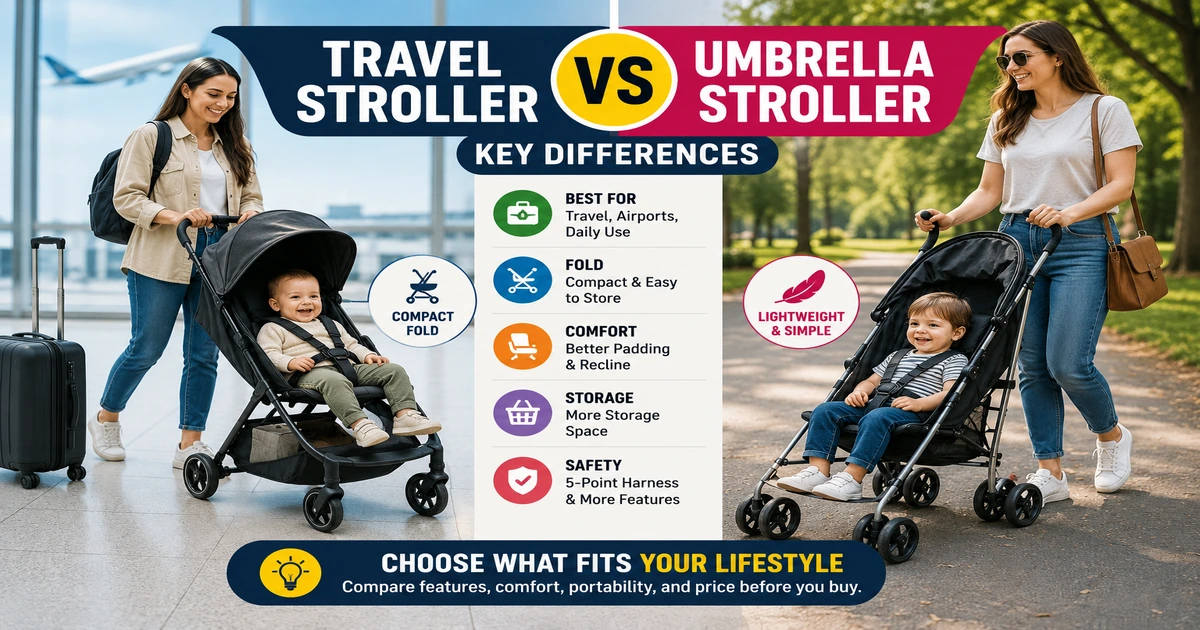
Choosing a stroller for a newborn is not only about style, price, color, or brand. A newborn needs proper support for the head, neck, back, and body because they cannot sit upright or control their head well during the early months.
So, if you are wondering how to choose a stroller for a newborn, the safest answer is simple: choose a stroller that is clearly approved for newborn use, offers a flat or near-flat position, has a secure harness, stable frame, reliable brakes, and fits your daily lifestyle.
This guide will help you understand what stroller features matter most for newborns, which stroller types are safer, what mistakes to avoid, and how to buy with more confidence.
Quick Answer
The best stroller for a newborn is usually a bassinet stroller, a fully reclining stroller approved for newborn use, or a compatible infant car seat travel system for short supervised trips.
| Feature | Why It Matters for Newborns |
|---|---|
| Flat or near-flat recline | Supports newborn head, neck, back, and body |
| Newborn approval | Confirms the stroller is designed for early infant use |
| 5-point harness | Helps keep baby secure during stroller rides |
| Stable frame | Reduces tipping risk during daily use |
| Reliable brakes | Keeps stroller from rolling when stopped |
| Good canopy | Helps protect baby from sun and light wind |
| Easy fold | Makes daily use easier for parents |
Why Newborns Need a Different Stroller
Newborns are not like older babies or toddlers. They cannot sit upright safely, and they need more body support. A regular upright stroller seat may look comfortable, but it may not support a newborn properly.
A newborn-friendly stroller should help your baby stay in a safe and supported position. This usually means a bassinet, full recline, or a compatible infant car seat setup.
Before buying, always ask:
- Is this stroller approved for newborn use?
- Does the seat recline flat or near-flat?
- Does it support the baby’s head and neck?
- Does the harness fit a small baby?
- Is the frame stable?
- Are the brakes easy to use?
- Does the stroller manual clearly explain newborn use?
Helpful guide: If you want to understand safe newborn stroller types first, read our What Type of Stroller Is Safe for Newborns? guide.
1. Choose a Stroller Approved for Newborn Use
The first rule is simple: do not guess. A stroller should clearly say it is suitable for newborns or suitable from birth. Some strollers are designed only for babies who can sit with support, while others work from the newborn stage.
Check the product page, stroller label, and user manual. If the manufacturer does not clearly say the stroller is safe for newborn use, it is better to avoid using it for a newborn.
Look for words like:
- Suitable from birth
- Newborn compatible
- Bassinet included or bassinet compatible
- Full recline or near-flat recline
- Infant car seat compatible
- Approved for newborn use
Do not rely only on Amazon titles or product images. Always confirm with the official product details when possible.
2. Look for Flat or Near-Flat Recline
A newborn stroller should support a flat or near-flat position. This helps support the baby’s body more naturally during early months.
A fully upright seat is usually not ideal for newborns because they may slump forward or sideways. This can make the baby uncomfortable and unsafe.
When checking recline, ask:
- Does the stroller recline fully?
- Is the recline approved for newborns?
- Does the seat stay stable in reclined mode?
- Does the baby slide down in the seat?
- Does the harness still fit properly when reclined?
A stroller can have recline but still not be newborn-safe. The manual should confirm it.
3. Consider a Bassinet Stroller
A bassinet stroller is often one of the best options for newborns. It allows the baby to lie in a flat or near-flat position and usually gives more space than a regular stroller seat or infant car seat.
Bassinet strollers are useful for parents who take daily neighborhood walks or want a comfortable newborn setup during the first months.
Benefits of a Bassinet Stroller
- Flat or near-flat newborn position
- Good body support
- More space for baby
- Often parent-facing
- Comfortable for supervised walks
- Good option for daily strolling
However, a bassinet stroller may be bulky and may only be useful for a shorter period. Check the weight limit and manufacturer instructions before buying.
Helpful guide: If you are comparing bassinet and car seat stroller setups, read our Bassinet Stroller vs Car Seat Stroller guide.
4. Consider a Fully Reclining Stroller
A fully reclining stroller can be a practical option if it is approved for newborn use. This type of stroller may work from the newborn stage and continue as your baby grows.
Parents often like fully reclining strollers because they can be more flexible than bassinet-only setups.
Benefits of a Fully Reclining Stroller
- Can work from newborn stage if approved
- Useful for longer-term use
- Seat can adjust as baby grows
- May be easier to store than a bassinet stroller
- Good for parents who want one stroller for multiple stages
Before choosing this type, make sure the recline is deep enough and the harness fits a newborn safely.
5. Consider an Infant Car Seat Travel System
A travel system allows an infant car seat to attach to a stroller frame. This is convenient for parents who drive often because the baby can move from car to stroller without being removed from the car seat.
This setup is helpful for short errands, doctor visits, shopping trips, and car-to-stroller movement. However, an infant car seat should not be used as a long-term stroller seat or sleep space outside the car.
Travel System Safety Checklist
- The infant car seat must be compatible with the stroller.
- The car seat should click securely into the stroller frame.
- The baby must be buckled correctly in the car seat.
- The stroller frame should be fully locked open.
- The car seat should be used according to the manual.
- The setup should be used for short supervised trips.
Helpful guide: If you want stroller and car seat combo options, read our Best Infant Car Seat and Stroller guide.
6. Check the Harness System
A stroller harness keeps your baby secure during walks. For newborns and young babies, a 5-point harness is usually better because it secures the shoulders, waist, and between the legs.
A good harness should be easy for parents to buckle, but not easy for a child to escape from as they grow.
Check these points:
- Does the stroller have a 5-point harness?
- Are the straps adjustable?
- Can the harness fit a small baby?
- Are the straps soft but secure?
- Does the buckle click properly?
- Can the harness be cleaned easily?
A harness should be used every time, even for short walks.
7. Choose Reliable Brakes
Brakes are one of the most important stroller safety features. A stroller should have brakes that are easy for parents to use but difficult for children to release.
Use the stroller brake whenever you stop, even if you stop only for a moment.
Good brake situations include:
- When placing baby into the stroller
- When taking baby out
- When waiting near a road
- When standing on a slope
- When stopping in a shop
- When adjusting bags or blankets
Official source: Parents can read stroller safety guidance from the HealthyChildren.org stroller safety page by the American Academy of Pediatrics.
8. Check Stability and Frame Strength
A newborn stroller should feel stable. Lightweight strollers can be useful, but they should not feel weak, shaky, or easy to tip.
Look for:
- Wide base
- Strong frame
- Stable wheels
- Secure fold lock
- Good balance when the baby is inside
- Clear weight limit
Do not hang heavy bags from the handlebar. This can make the stroller unstable and increase tipping risk. Use the lower storage basket instead.
9. Check Canopy and Ventilation
A good canopy helps protect a newborn from sun, bright light, and light wind. But the stroller should also allow airflow. Covering a stroller with thick blankets can trap heat and reduce ventilation.
Look for canopy features such as:
- Large canopy coverage
- Peek-a-boo window
- Breathable mesh panel
- Adjustable shade position
- Easy-to-clean fabric
During hot weather, always check that your baby is not overheating.
10. Think About Your Daily Lifestyle
The best newborn stroller is not the same for every family. A stroller that works for one parent may feel inconvenient for another.
Choose based on your real lifestyle:
| Your Lifestyle | Better Stroller Choice |
|---|---|
| You walk daily in the neighborhood | Bassinet stroller or fully reclining stroller |
| You drive often | Infant car seat travel system |
| You live in a small apartment | Compact newborn-approved stroller |
| You use public transport | Lightweight stroller with newborn-safe recline |
| You travel often | Compact travel stroller approved for newborn use |
| You want long-term use | Convertible stroller with newborn mode |
The right stroller should fit your baby and your daily routine.
11. Check Weight and Fold Size
New parents often focus on baby comfort but forget parent convenience. A stroller may be safe and comfortable, but if it is too heavy or difficult to fold, you may not enjoy using it daily.
Before buying, check:
- Stroller weight
- Folded dimensions
- One-hand fold option
- Whether it stands when folded
- Car trunk fit
- Storage space at home
- How easy it is to lift
If possible, measure your car trunk or storage area before buying.
12. Think About Wheels and Surfaces
Different strollers work better on different surfaces. Small wheels may be fine for malls and smooth sidewalks. Larger wheels may be better for rough sidewalks or park paths.
| Surface | Useful Stroller Feature |
|---|---|
| Smooth sidewalks | Standard wheels may work well |
| Shopping malls | Easy turning and compact frame |
| Rough sidewalks | Better suspension and stronger wheels |
| Park paths | Larger wheels and stable frame |
| Airports | Compact fold and lightweight frame |
A stroller that is easy to push will make daily life much easier.
13. Do Not Use an Umbrella Stroller Too Early
Most basic umbrella strollers are not ideal for newborns because they often have limited recline and less body support. They are usually better for older babies or toddlers.
If you want a lightweight stroller for a newborn, choose one that clearly says it is newborn-approved and has proper recline or infant car seat compatibility.
14. Check Safe Sleep Rules
Newborns often fall asleep during stroller walks. This is normal, but a stroller should not replace a safe sleep surface unless the product is specifically approved for sleep use.
If your baby falls asleep in a stroller or car seat, keep the baby supervised and move them to a safe sleep surface when possible.
Do not add:
- Loose pillows
- Soft blankets under the baby
- Unapproved head supports
- Extra padding
- Bulky accessories around the harness
Official source: Parents can read baby safe sleep guidance from the HealthyChildren.org safe sleep guide by the American Academy of Pediatrics.
15. Check Storage Basket and Parent Features
Storage is useful, but parents should not overload the stroller. A lower storage basket is safer than hanging heavy bags from the handlebar.
Helpful parent features include:
- Storage basket
- Adjustable handlebar
- Easy fold system
- Cup holder if included safely
- Peek-a-boo window
- Washable fabric
- Rain cover compatibility
- Travel bag compatibility
Parent convenience matters because you will use the stroller often.
16. Check Product Recalls and Safety Standards
Before buying a stroller, especially a used stroller, check whether the product has any recall history. A stroller should meet current safety expectations and include all original parts.
For used strollers, check:
- Brake function
- Harness condition
- Frame cracks
- Wheel condition
- Missing screws or parts
- Recall history
- Manual availability
If a stroller is damaged, missing parts, or has an unsafe fold, do not use it for a newborn.
17. Best Stroller Types for Newborns
There are several stroller types that can work for newborns if they are approved by the manufacturer.
| Stroller Type | Good for Newborns? | Best For |
|---|---|---|
| Bassinet stroller | Yes, if approved | Daily walks and flat support |
| Fully reclining stroller | Yes, if approved | Parents who want longer use |
| Infant car seat travel system | Yes, for short supervised trips | Parents who drive often |
| Convertible stroller | Yes, if newborn mode is approved | Growing families |
| Basic umbrella stroller | Usually no | Older babies and toddlers |
| Jogging stroller | Not for jogging with newborns | Older babies when approved |
Helpful guide: If you want a deeper list of newborn-friendly stroller options, read our Best Infant Stroller guide.
18. Common Mistakes Parents Should Avoid
Many parents buy a stroller quickly because the baby is coming soon. But rushing can lead to the wrong choice.
- Buying a stroller without checking newborn approval
- Choosing style over safety
- Using an upright stroller seat too early
- Assuming all reclining strollers are safe for newborns
- Using unapproved pillows or inserts
- Ignoring the stroller manual
- Forgetting to use the harness
- Hanging heavy bags from the handlebar
- Buying a used stroller without checking recalls
- Not measuring car trunk space before buying
Helpful guide: For full baby travel gear safety, read our Stroller and Infant Car Seat Safety Guide.
Amazon Buying Tips
When buying a newborn stroller on Amazon, read the product listing carefully. Some listings use words like “newborn,” “infant,” or “from birth,” but you should still check the detailed specifications.
Before buying, check:
- Minimum age recommendation
- Maximum child weight
- Seat recline level
- Bassinet availability
- Infant car seat compatibility
- Harness type
- Brake system
- Folded size
- Recent parent reviews
- Official manufacturer details
- Return policy
Check Newborn Stroller Options on Amazon
Final Verdict: How to Choose a Stroller for a Newborn
To choose a stroller for a newborn, focus on safety and support first. Look for newborn approval, flat or near-flat recline, secure harness, stable frame, reliable brakes, good canopy, and easy daily use.
A bassinet stroller is often best for daily newborn walks. A fully reclining stroller can be practical for longer use. A travel system is convenient for short car-to-stroller trips. The best choice depends on your lifestyle and your baby’s needs.
Do not buy a stroller only because it looks nice or has many reviews. Buy the stroller that fits your newborn safely and fits your daily routine.
Best rule: If a stroller does not clearly say it is safe for newborn use, do not use it for a newborn.
Frequently Asked Questions
What stroller is best for a newborn?
A bassinet stroller, fully reclining stroller approved for newborn use, or compatible infant car seat travel system is usually best for a newborn.
Can a newborn sit in a regular stroller?
No, a newborn usually should not sit in a regular upright stroller because they do not have enough head and neck control.
Does a newborn stroller need full recline?
A newborn stroller should have flat or near-flat recline unless it uses a bassinet or compatible infant car seat setup approved for newborns.
Is a bassinet stroller necessary?
A bassinet stroller is not always necessary, but it is one of the most newborn-friendly stroller options. A fully reclining stroller or travel system may also work.
Can I use an infant car seat as a stroller seat?
You can use an infant car seat with a compatible stroller for short supervised trips, but it should not be used as a long-term sleep space outside the car.
Are umbrella strollers safe for newborns?
Most basic umbrella strollers are not suitable for newborns because they often do not provide enough recline or body support.
What safety features should a newborn stroller have?
A newborn stroller should have newborn approval, proper recline, secure harness, stable frame, reliable brakes, good canopy, and clear manufacturer instructions.
Should I buy a used stroller for a newborn?
A used stroller may be okay only if it is not recalled, has no damage, includes all parts, and works safely. Always check the harness, brakes, frame, wheels, and manual.