Stroller wagons are popular with families because they offer more room, extra storage, and a comfortable setup for outdoor trips. Parents often use them for parks, zoos, beach days, neighborhood walks, and family outings. But when it comes to newborns, stroller wagon safety needs extra attention.
This guide explains when a newborn may be able to use a stroller wagon, what features to check, what mistakes to avoid, and what safer alternatives parents should consider.
Important note: This article is for general educational purposes only. Always follow your stroller wagon manual, infant car seat manual, age and weight limits, safety labels, and pediatrician guidance.
Quick Answer: Can Newborns Use Stroller Wagons?
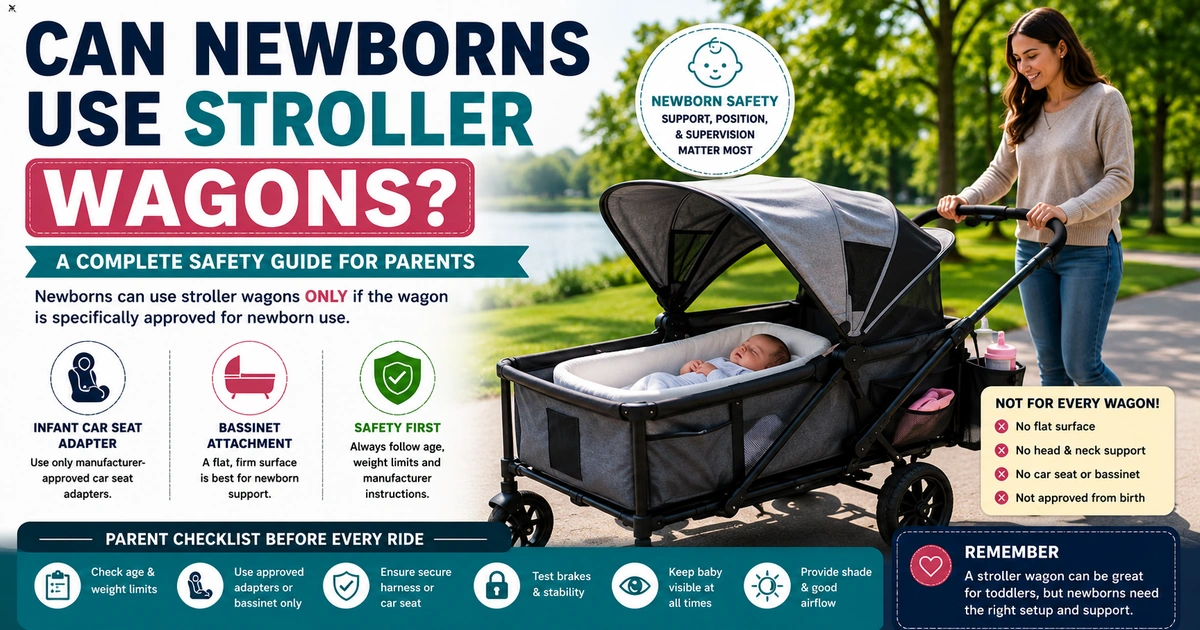
Newborns should not ride directly in a regular stroller wagon seat unless the product is clearly approved for newborn use. Most newborns need a flat or near-flat position and proper head and neck support. Some stroller wagons may allow newborn use with a manufacturer-approved infant car seat adapter or bassinet attachment, but parents must check the manual carefully.
If a stroller wagon does not clearly say it is suitable for newborns, do not assume it is safe from birth. For many families, a bassinet stroller, newborn-approved full-recline stroller, or infant car seat travel system may be a better early-stage option.
Why Newborns Need Special Stroller Support
Newborns have limited head and neck control. They cannot sit upright safely like older babies or toddlers. If a newborn is placed in a seat that is too upright, too soft, too open, or not properly supportive, the baby may slump, slide, or become poorly positioned.
For newborn stroller use, parents should usually look for:
- A flat or near-flat approved position
- Proper head and body support
- A secure harness or safe infant seat attachment
- A stable frame
- Clear newborn age and weight guidance
- Good airflow and shade
- Easy parent visibility
- Manufacturer-approved use from birth
A stroller wagon may look spacious, but space alone does not make it safe for a newborn. The key question is whether the product is designed, tested, and labeled for newborn use.
If you are still learning which stroller types are suitable from birth, read our guide on what type of stroller is safe for newborns.
1. Do Not Place a Newborn Directly in an Open Wagon Seat
A regular stroller wagon seat is often designed for toddlers or older babies who can sit with better support. Newborns usually cannot safely sit in an open wagon seat because they may not have enough body control.
Possible problems with placing a newborn directly in an open wagon seat include:
- The baby may slump forward or sideways.
- The seat may not support the head and neck properly.
- The harness may not fit a newborn correctly.
- The baby may slide into an unsafe position.
- The wagon may not provide a flat newborn-safe surface.
- Loose blankets or padding may create extra risk.
Never add pillows, cushions, or loose blankets to “make” a wagon suitable for a newborn unless the manufacturer specifically approves that setup. Extra padding can affect positioning and may create safety concerns.
2. Check Whether the Stroller Wagon Is Approved from Birth
Some stroller wagons may advertise newborn compatibility, but parents should verify exactly what that means. “Newborn compatible” usually depends on a specific setup, such as a bassinet attachment, infant car seat adapter, or special newborn insert approved by the manufacturer.
Before using a stroller wagon with a newborn, check the manual for:
- Minimum age requirement
- Minimum weight requirement
- Approved newborn mode
- Approved infant car seat brands
- Approved bassinet or carrycot attachment
- Harness instructions
- Warnings about sleep or positioning
- Weight limit for each attachment
If the manual says the wagon is for babies who can sit unassisted, then it is not suitable for a newborn in the regular seat.
3. Use Only Manufacturer-Approved Infant Car Seat Adapters
Some stroller wagons can accept an infant car seat adapter. This may allow parents to use the wagon frame with a compatible infant car seat for short supervised outings. However, the adapter must be made or approved for that exact stroller wagon and car seat combination.
Do not mix random adapters, car seats, and wagon frames. A car seat that does not lock securely into the wagon can be dangerous.
Before using an infant car seat adapter, check:
- Is the adapter approved for your exact stroller wagon model?
- Is your infant car seat listed as compatible?
- Does the car seat click securely into place?
- Can the car seat move, wobble, or detach?
- Does the baby stay at the correct angle?
- Does the setup follow both manuals?
If you use an infant car seat with a stroller or wagon frame, read our stroller and infant car seat safety guide for new parents.
Amazon buying tip: If you want to use a stroller wagon with an infant car seat, search for a stroller wagon that clearly supports a manufacturer-approved car seat adapter for your exact car seat brand. Check stroller wagon car seat adapter options on Amazon.
4. A Bassinet Attachment May Be Safer Than a Regular Wagon Seat
Some stroller wagons may offer a bassinet or carrycot attachment. This can be more suitable for a newborn than an open toddler-style wagon seat, but only if the attachment is approved by the stroller wagon manufacturer and used according to the manual.
A newborn-friendly bassinet setup should usually provide:
- A flat or near-flat position
- Firm support
- Good airflow
- Secure attachment to the wagon frame
- Clear age and weight limits
- No loose pillows or extra padding
- Easy parent visibility
Do not place a separate household bassinet, baby lounger, pillow, or soft insert inside a wagon unless the stroller wagon manufacturer specifically approves it. Newborn gear must be used exactly as intended.
To compare newborn options, read our guide on bassinet stroller vs car seat stroller.
5. Check Stroller Wagon Safety Standards and Product Labels
Parents should check whether the stroller wagon is designed as a child-carrying product and whether it follows applicable stroller or carriage safety requirements. Product labels, manuals, warnings, and manufacturer documentation can help you understand the intended use.
When reviewing a stroller wagon, look for information about:
- Age range
- Weight limit
- Harness system
- Brake system
- Stability warnings
- Folding locks
- Car seat adapter compatibility
- Bassinet compatibility
- Use on slopes or rough terrain
The U.S. Consumer Product Safety Commission provides official guidance for carriages and strollers, including safety areas such as brakes, restraint systems, stability, latches, folding mechanisms, structure, wheels, and openings. You can review the official resource here: CPSC carriages and strollers guidance.
6. Newborns Should Not Use Stroller Wagons for Routine Sleep
Many newborns fall asleep during walks. This can happen in a stroller, car seat, carrier, or wagon setup. However, a stroller wagon should not be used as a regular sleep space for a newborn.
If your baby falls asleep during a short supervised outing, stay close and keep checking the baby’s position, breathing, temperature, and comfort. When you return home or reach a safe place, move the baby to an appropriate firm sleep surface according to safe sleep guidance.
AAP safe sleep guidance says that if a baby falls asleep in a car seat, stroller, swing, infant carrier, or sling, the baby should be moved to a firm sleep surface on their back as soon as possible. You can read the official HealthyChildren.org safe sleep guide here: HealthyChildren.org safe sleep guidance.
7. Avoid Adding Loose Blankets, Pillows, or Soft Inserts
Parents sometimes try to make a wagon more comfortable by adding pillows, thick blankets, rolled towels, soft baby loungers, or extra cushions. This can be risky for newborns because soft items can affect positioning and create unsafe sleep or breathing concerns.
Avoid adding:
- Loose pillows
- Soft baby loungers
- Thick blankets under the baby
- Unapproved inserts
- Extra seat padding
- Loose toys near the face
- Any product not approved by the wagon manufacturer
If a stroller wagon needs extra items to support a newborn, that is a sign it may not be the right product for newborn use.
8. Watch the Baby’s Position Carefully
Newborn positioning matters during any stroller or wagon use. Babies should not slump forward, tilt too far to one side, or have their chin pressed toward the chest. Poor positioning can make breathing harder and should be corrected immediately.
During every outing, check:
- Is the baby’s head supported?
- Is the baby’s chin away from the chest?
- Is the baby’s face visible?
- Is the baby breathing comfortably?
- Is the harness or car seat strap positioned correctly?
- Is the baby too hot or too cold?
- Is the baby sliding or slumping?
Parents should be able to see and check the newborn easily. If a canopy, cover, or accessory blocks your view, adjust it or stop using it.
9. Be Careful with Sun, Heat, and Airflow
Stroller wagons are often used outdoors, so shade and airflow matter. Newborns can become uncomfortable in heat, and parents should avoid creating a closed space around the baby with thick covers.
Sun and heat safety tips:
- Use shade during sunny walks.
- Avoid direct sun on newborns.
- Do not fully cover the wagon with a thick blanket.
- Keep airflow open around the baby.
- Check the baby often for warmth or sweating.
- Choose cooler walking times when possible.
- Use the canopy according to the manual.
If the wagon has a canopy, make sure it does not block airflow or prevent you from checking your baby. Shade is helpful, but ventilation and supervision are just as important.
10. Check the Harness or Infant Car Seat Straps Every Time
If your newborn is using an infant car seat attached to a stroller wagon, the car seat harness should be correctly positioned and snug according to the car seat manual. If the wagon uses a newborn-approved bassinet or stroller seat, follow that product’s restraint instructions carefully.
Before every ride, check:
- Straps are not twisted.
- The buckle clicks securely.
- The baby is positioned correctly.
- The harness is adjusted for the baby’s size.
- The car seat is locked into the adapter.
- The adapter is locked into the wagon frame.
- The setup matches the manufacturer instructions.
If you are unsure about harness use, ask your pediatrician, car seat technician, or product manufacturer for help.
11. Do Not Use a Toddler Wagon Too Early
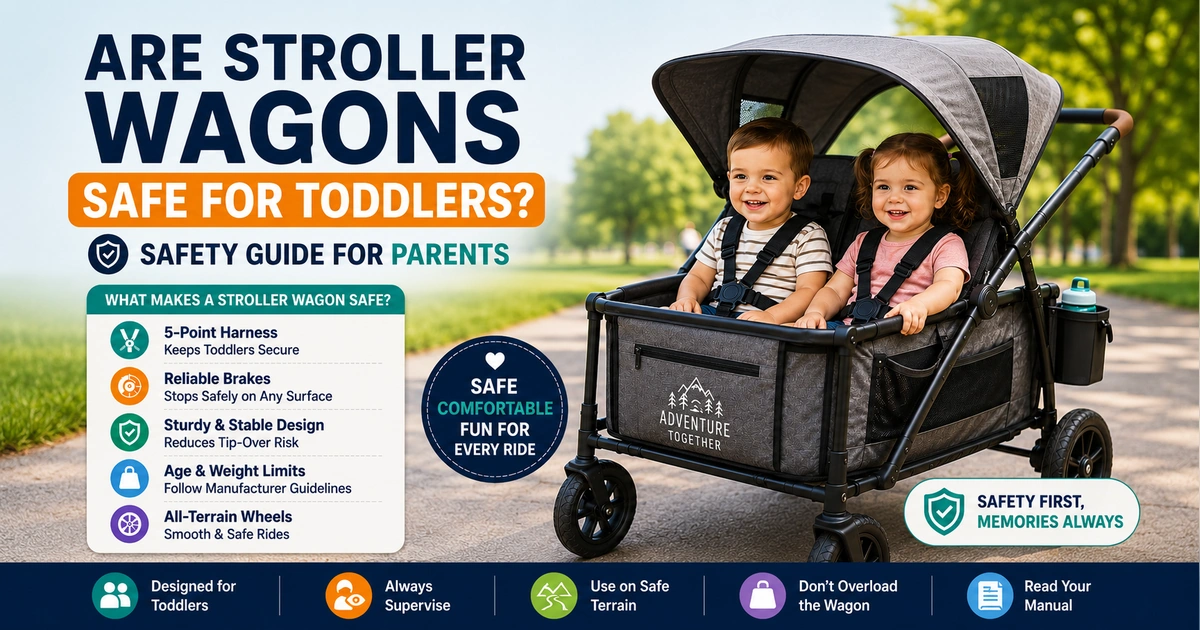
Many stroller wagons are better suited for toddlers than newborns. Toddlers can usually sit with more body control, use a wagon seat more naturally, and fit the harness better.
A stroller wagon may be more appropriate later when your baby:
- Meets the manufacturer’s minimum age
- Meets the minimum weight requirement
- Can sit safely as required by the manual
- Fits the harness correctly
- Can ride without slumping
- Stays seated during movement
If you are planning ahead for toddler use, read our post on are stroller wagons safe for toddlers.
12. Choose a Safer Newborn Stroller Option If Needed
If your stroller wagon is not clearly approved for newborn use, choose a stroller option that is designed for newborns. This may be safer and easier during the early months.
Common newborn-friendly options include:
- Bassinet stroller
- Full-recline stroller approved from birth
- Infant car seat and stroller travel system
- Stroller frame that accepts your infant car seat
- Newborn-approved modular stroller
Amazon buying tip: If you need a stroller from birth, compare bassinet strollers, full-recline strollers, and infant car seat travel systems before choosing a stroller wagon. Check newborn-friendly stroller options on Amazon.
13. Check the Brake and Stability Before Every Ride
Stroller wagons can be larger and heavier than regular strollers, so brake and stability checks are important. Before placing a newborn in any approved wagon setup, lock the brake and make sure the frame is stable.
Before each outing, check:
- The brake works correctly.
- The wagon does not roll when parked.
- The frame is fully open and locked.
- The wheels are attached securely.
- The handle locks properly.
- The car seat adapter or bassinet is attached correctly.
- The wagon does not feel wobbly.
If anything feels loose, unstable, or difficult to control, do not use the wagon with a newborn until the issue is fixed.
14. Be Careful When Buying a Used Stroller Wagon
A used stroller wagon may look like a good deal, but parents should be extra careful before using it with a newborn. A second-hand wagon may have missing parts, damaged adapters, worn brakes, cracked wheels, torn harness straps, or recall issues.
Before buying used, check:
- Brand and model number
- Manufacture date
- Recall status
- Original manual
- Approved newborn attachments
- Car seat adapter condition
- Brake function
- Wheel condition
- Frame stability
- Harness or bassinet condition
- Missing screws or small parts
You can check official stroller-related recalls on the U.S. Consumer Product Safety Commission recall page here: CPSC stroller and car seat recalls.
15. Use a Before-Walk Safety Checklist
Before using a stroller wagon with a newborn-approved setup, take a few minutes to check the product. Newborns need extra care, and small setup mistakes can matter.
Before every walk, check:
- The wagon is approved for newborn use.
- The baby meets the age and weight requirements.
- The bassinet or car seat adapter is manufacturer-approved.
- The attachment is locked securely.
- The brake works.
- The frame is fully open and locked.
- The baby is positioned correctly.
- The baby’s face is visible.
- The canopy allows airflow.
- No loose blankets or pillows are near the baby.
- The outing is short and supervised.
For a broader routine, read our stroller safety checklist before every walk.
When Can a Baby Use a Regular Stroller Wagon Seat?
The right time depends on the stroller wagon manual and your baby’s development. Many regular stroller wagon seats are better for babies who can sit with enough support and meet the manufacturer’s age and weight requirements.
Parents should not switch based only on age. Instead, check:
- Manufacturer’s minimum age
- Manufacturer’s minimum weight
- Baby’s head and neck control
- Ability to sit safely as required
- Harness fit
- Seat support
- Stroller wagon stability
If your baby still slumps, slides, or cannot sit as required by the manual, wait longer and use a newborn-safe stroller option instead.
Newborn Stroller Wagon Safety Checklist
Use this quick checklist before using any stroller wagon setup with a newborn:
- Is the wagon clearly approved for newborn use?
- Does the manual allow your baby’s age and weight?
- Are you using an approved bassinet or infant car seat adapter?
- Is the attachment locked securely?
- Is the baby positioned correctly?
- Is the baby’s face visible at all times?
- Are there no loose blankets, pillows, or soft inserts?
- Does the brake work?
- Is the frame stable and fully locked?
- Is airflow open around the baby?
- Are you supervising the baby closely?
- Have you checked for recalls if buying used?
Stroller Wagon vs Newborn Stroller Options
| Option | Can It Work for Newborns? | What Parents Should Check |
|---|---|---|
| Regular stroller wagon seat | Usually not ideal for newborns | Check if baby can sit as required by manual |
| Stroller wagon with infant car seat adapter | May work if manufacturer-approved | Check exact car seat and adapter compatibility |
| Stroller wagon with bassinet attachment | May work if approved from birth | Check flat support, attachment lock, and weight limits |
| Bassinet stroller | Often suitable from birth if approved | Check firm support, airflow, and manual instructions |
| Full-recline stroller | May be suitable from birth if approved | Check recline angle and newborn guidance |
| Infant car seat travel system | Useful for short supervised trips | Check car seat fit, adapter lock, and time spent in seat |
Best Features to Look for If You Want a Stroller Wagon Later
If your baby is too young for a regular stroller wagon seat now, you can still plan ahead for toddler use. A good stroller wagon for later stages should be safe, stable, and easy for parents to control.
Look for features such as:
- 5-point harness or secure child restraint
- Reliable brake
- Clear age and weight limits
- Stable frame
- All-terrain wheels if needed
- Breathable canopy
- Easy parent visibility
- Fold lock
- Strong handle design
- Good storage without overloading
Amazon buying tip: If you are buying for future toddler use, compare stroller wagons with secure harness seating, strong brakes, stable wheels, and clear age and weight limits. View toddler stroller wagon options on Amazon.
Common Mistakes Parents Should Avoid
Newborn stroller wagon mistakes usually happen when parents assume a wagon is safe because it is large, soft, or comfortable-looking. Try to avoid these mistakes:
- Placing a newborn directly in an open wagon seat
- Using a wagon that is only approved for toddlers
- Adding pillows or loose blankets for support
- Using an unapproved car seat adapter
- Assuming all infant car seats fit all wagons
- Ignoring minimum age and weight limits
- Letting a newborn sleep in the wagon for routine naps
- Using a thick blanket over the wagon in warm weather
- Buying used without checking recalls
- Using the wagon on rough or unstable terrain
- Forgetting to lock the brake when stopped
- Not watching the baby’s position during the ride
FAQ: Can Newborns Use Stroller Wagons?
Can newborns use stroller wagons?
Newborns should only use stroller wagons if the wagon is specifically approved for newborn use, such as with a compatible infant car seat adapter or approved bassinet attachment. A regular open wagon seat is usually not suitable for newborns.
Can I put a newborn directly in a wagon stroller?
No, not unless the wagon stroller manual clearly allows that setup. Most newborns need a flat or near-flat approved position and proper head and neck support.
Is a stroller wagon bassinet safe for newborns?
A stroller wagon bassinet may be safe only if it is made or approved by the stroller wagon manufacturer and used within the listed age and weight limits.
Can I use an infant car seat in a stroller wagon?
You can use an infant car seat in a stroller wagon only if the wagon and adapter are designed for that specific car seat. Always check both the wagon manual and car seat manual.
What is better for a newborn: stroller wagon or bassinet stroller?
For many newborns, a bassinet stroller or newborn-approved full-recline stroller may be more suitable than a stroller wagon, unless the wagon has an approved newborn attachment.
When can my baby sit in a stroller wagon?
The right time depends on the stroller wagon manual and your baby’s development. Many wagon seats are better for babies who can sit with enough support and meet the manufacturer’s age and weight requirements.
Can newborns sleep in stroller wagons?
A stroller wagon should not be used as a regular sleep space. If a newborn falls asleep during a short supervised outing, move the baby to an appropriate firm sleep surface as soon as possible when practical.
Final Thoughts
So, can newborns use stroller wagons? Sometimes, but only with the right approved setup. A newborn should not be placed directly into a regular open stroller wagon seat unless the manufacturer clearly states that it is safe for newborn use.
The safest approach is to check the manual, follow age and weight limits, use only approved infant car seat adapters or bassinet attachments, avoid loose padding, and supervise your baby closely. If the stroller wagon is not clearly newborn-compatible, choose a bassinet stroller, full-recline stroller, or infant car seat travel system instead.
A stroller wagon can be useful later for toddlers and family outings. But during the newborn stage, proper support, positioning, airflow, and manufacturer-approved safety features matter more than storage space or convenience.