

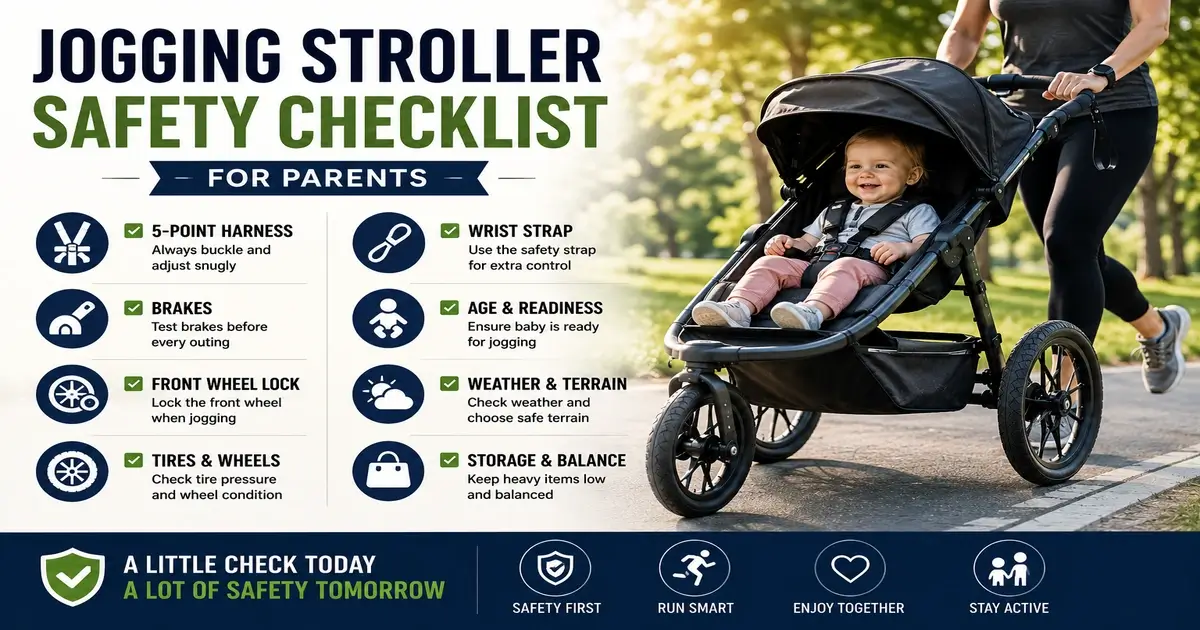
A jogging stroller safety checklist helps parents check the stroller before every walk, jog, or outdoor trip. A jogging stroller can move faster than a regular stroller, so small safety habits matter a lot. Parents often focus on wheels, price, fold, and brand. Those things matter, but safety should come first. The stroller must fit your child, your route, your speed, and your daily routine. This guide provides a simple, parent-friendly checklist. It covers harness use, brakes, tires, wheel lock, wrist strap, terrain, weather, storage, newborn safety, car seat use, and common mistakes to avoid.
Table of Contents
- Quick Jogging Stroller Safety Checklist
- Why Jogging Stroller Safety Matters
- Before Every Walk or Jog
- Check the 5-Point Harness
- Test the Brakes
- Lock the Front Wheel When Needed
- Check Tires and Wheels
- Use the Wrist Strap
- Check Baby Age and Readiness
- Car Seat Safety and Jogging
- Choose Safe Terrain
- Weather and Sun Safety
- Storage and Weight Balance
- Safe Speed and Control
- Maintenance Checklist
- Common Mistakes to Avoid
- Final Pre-Run Checklist
- Final Verdict
- FAQs
Quick Jogging Stroller Safety Checklist
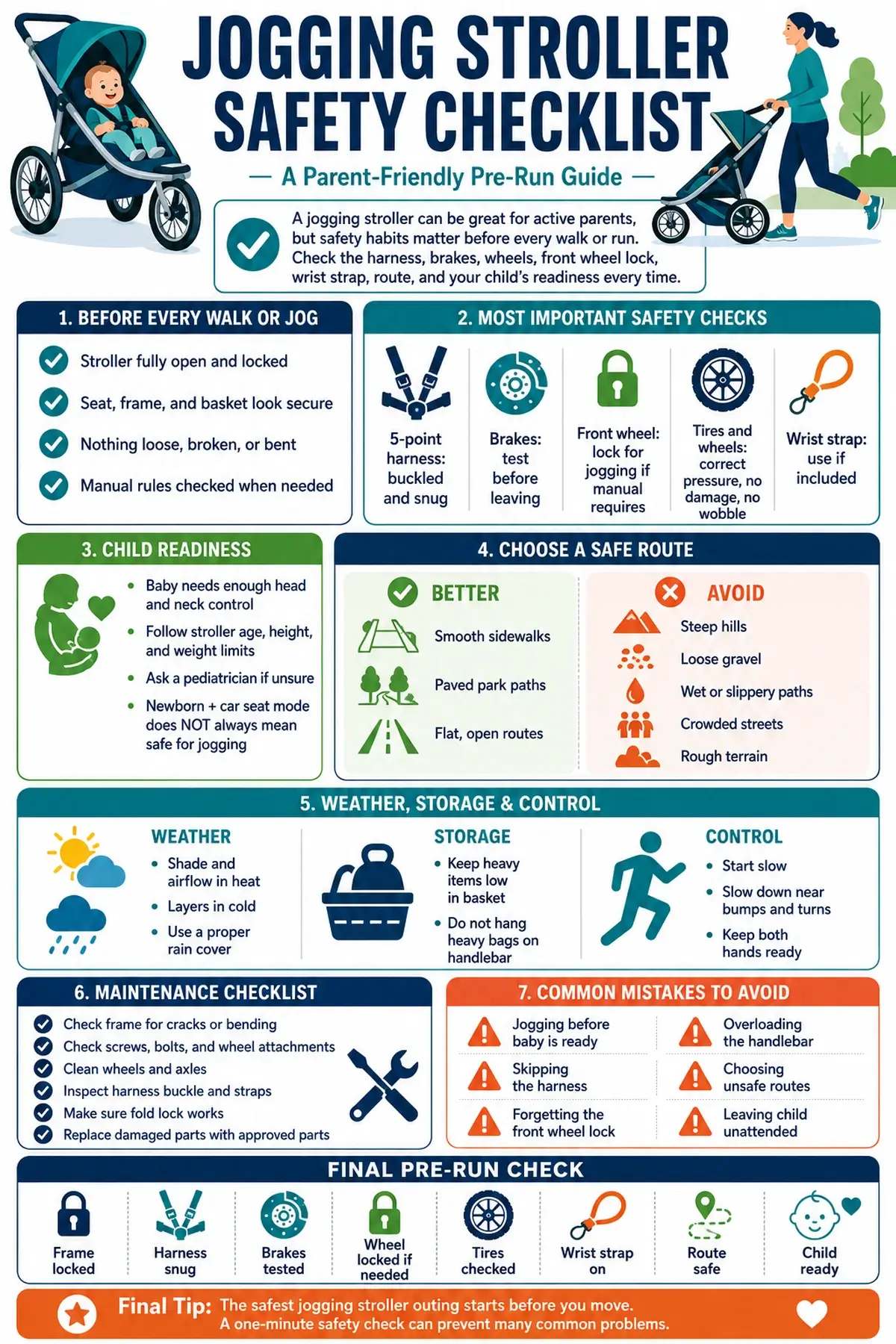
Use this quick checklist before every walk or jog. It takes less than one minute and can help prevent many common stroller safety problems.
- Check that the stroller is fully open and locked.
- Use the 5-point harness every time.
- Make sure the harness fits snugly.
- Test the brakes before leaving.
- Lock the front Wheel before jogging if your manual requires it.
- Check tire pressure and wheel condition.
- Use the wrist strap if your stroller includes one.
- Keep heavy items low in the basket.
- Do not hang heavy bags from the handlebars.
- Check your child’s age, height, and weight limits.
- Avoid rough, crowded, steep, or slippery routes.
- Never leave your child unattended in the stroller.
This checklist is useful for every active parent. It also works well with Thule, BOB, Baby Trend, Graco, Jeep, and other jogging stroller brands.
Why Jogging Stroller Safety Matters
Jogging strollers are different from regular strollers. They are usually built with larger wheels, stronger frames, and better outdoor movement. Many parents use them for parks, sidewalks, light jogging, and daily walks.
Because they can move faster, parents need more control. A loose harness, an unlocked wheel, weak brakes, a low tire, or an overloaded handlebar can pose a risk.
HealthyChildren.org from the American Academy of Pediatrics recommends choosing strollers with easy-to-use brakes, a wide base, and a five-point harness. It also reminds parents not to leave a child unattended in a stroller.
Official source:
AAP / HealthyChildren stroller safety guide
.A jogging stroller can be very helpful for active parents. But safe use depends on good habits before, during, and after every outing.
For choosing the right active stroller, read our Best Jogging Stroller guide.
Understand the difference: If you are not sure whether you actually need a running-focused stroller, read our Jogging Stroller vs Regular Stroller guide before choosing an active stroller.
Before Every Walk or Jog
Before placing your child in the stroller, check that the stroller is fully open. Many strollers have a frame lock or fold latch. Make sure it is secure.
Look at the seat, canopy, handlebars, basket, wheels, and frame. If anything looks loose, broken, or bent, do not use the stroller until the problem is fixed.
Also, check the manual if you are using the stroller for the first time after a long break. Jogging stroller models can have special instructions for wheel lock, tire pressure, recline, car seat use, and folding.
A short safety check is better than rushing. Most stroller safety issues are easier to prevent before the walk starts.
Check the 5-Point Harness.
The harness is one of the most important parts of jogging stroller safety. A five-point harness holds the child at the shoulders, hips, and between the legs.
This matters because a child may lean forward, twist, stand, reach, or slide during movement. A loose harness can allow too much movement inside the seat.
Buckle the harness every time, even for short walks. Adjust the straps so they are snug but not too tight. The harness should sit correctly on your child’s body and should not be twisted.
If your child wears a thick jacket, check the fit again. Bulky clothing can make the harness seem tight even when there is space between the strap and the body.
For more details, read our 5-Point Harness Stroller Safety Guide.
Test the Brakes
Brakes help keep the stroller still when you stop. This is important during stops, on hills, at curbs, in parking lots, at crossings, and during loading or unloading.
Before each outing, press the brake and gently push the stroller. The stroller should not roll. If it moves, the brake may not be fully engaged or may need service.
Use the brake whenever the stroller is stopped. This includes moments when you are adjusting a shoe, answering a phone, giving water, or helping another child.
KidsHealth recommends putting the brakes on when the stroller is not moving. This simple habit can help prevent the stroller from rolling unexpectedly.
Official source:
KidsHealth stroller safety guide
.For a deeper guide, read our Stroller Brake Safety Guide for Parents.
Lock the Front Wheel When Needed
Many jogging strollers have a front wheel that can swivel or lock. A swivel front wheel helps with walking slowly, turning, shopping, and moving through tight spaces.
However, jogging is different. Many stroller manuals tell parents to lock the front Wheel before jogging or walking fast. A locked wheel gives better straight-line control.
Always follow your own stroller manual. Some models are made for jogging with a locked front wheel. Others may have different rules. Do not guess based on brand or looks.
Before jogging, stop and check the wheel lock. Then push the stroller slowly to confirm that it moves straight and feels stable.
Check Tires and Wheels
Jogging stroller tires and wheels affect safety, comfort, and control. A low tire, a damaged wheel, a loose axle, or a stuck swivel can make the stroller harder to control.
If your stroller has air-filled tires, check tire pressure often. Low pressure can make steering harder. Too much pressure can also affect comfort and handling.
Look for cracks, flat spots, sharp objects, loose spokes, or wobbly wheels. Spin each Wheel before heading out. It should move smoothly without shaking.
Clean the wheels after dusty, muddy, or sandy walks. Dirt can build up around the axle and affect movement over time.
For more help, read our Stroller Wheel Safety Guide for Parents.
For air-filled jogging stroller tires, compare compact tire pumps and repair kits that match your stroller’s wheel type.
View jogging stroller tire pumps and repair kits on Amazon.
Use the Wrist Strap
Many jogging strollers include a wrist strap or tether. This strap connects the stroller handle to your wrist while you jog or walk fast.
The wrist strap gives extra control if you trip, slip, or lose grip. It can also help on mild downhill paths where the stroller may pull forward.
Use the strap exactly as the manual explains. Do not tie it to random parts of the stroller. Do not replace it with a homemade strap unless the manufacturer allows it.
The wrist strap does not replace good control. You should still keep both hands ready, slow down near turns, and avoid unsafe terrain.
Check Baby Age and Readiness
A jogging stroller may look sturdy, but that does not mean every baby is ready for a jog. Babies need sufficient head and neck control before using a faster stroller.
Many jogging stroller brands give age guidance in the manual. Some recommend waiting until the baby is at least 6 months old for jogging, but the exact rule depends on the model and your child’s development.
Parents should also talk to a pediatrician before jogging with a young baby. This is especially important if the baby was premature, has low muscle tone, or has any health concerns.
For newborn stroller guidance, read our What Type of Stroller Is Safe for Newborns?
Car Seat Safety and Jogging
Some jogging strollers can accept infant car seats. This is useful for strolling with a younger baby. However, car seat compatibility does not automatically mean jogging safety.
In many stroller systems, infant car seat mode is meant for walking only. Jogging with a newborn in a car seat can create extra movement and may not be allowed by the stroller manual.
Always check the stroller manual, car seat manual, and adapter instructions. Use only approved car seats and approved adapters.
Do not attach a car seat by using extra straps, clips, or homemade solutions. If the seat does not click or attach as the brand instructs, it is not safe to use.
For full details, read our Stroller and Infant Car Seat Safety Guide.
Choose Safe Terrain
Safe terrain is important when using a jogging stroller. Smooth sidewalks, paved park paths, and flat walking trails are usually better than rough surfaces.
Avoid deep sand, wet grass, loose gravel, rocky trails, steep hills, icy paths, and crowded streets. These surfaces can make the stroller harder to control.
Be careful near curbs and road crossings. Slow down before bumps, turns, and uneven sections. Do not rush across streets with a stroller.
Also, avoid jogging in heavy traffic areas. Choose a route with enough space to control the stroller without sudden stops or sharp turns.
Weather and Sun Safety
Weather can affect stroller safety. Heat, cold, wind, rain, and strong sun can all make a stroller outing less safe or less comfortable.
In hot weather, check your child often. Use the canopy for shade, choose cooler times of day, and avoid covering the stroller with thick blankets. A thick cover can reduce airflow and trap heat.
In cold weather, dress your child in layers and check hands, feet, and face often. Make sure blankets or loose items cannot get near the wheels.
In the rain, use only a stroller rain cover that fits your model well. Make sure there is proper airflow and that the cover does not touch your child’s face.
For sun protection, read our How to Protect Baby from Sun in a Stroller.
Storage and Weight Balance
Storage is helpful, but poor weight balance can create safety problems. Heavy bags on the handlebars can make a stroller easier to tip backward.
Keep heavier items low in the basket. Use the storage areas only within the brand’s weight limits. Check the manual for basket, tray, and pocket limits.
Do not hang shopping bags, backpacks, or diaper bags from the handlebars unless the manual says it is safe. Even then, keep weight light and balanced.
A jogging stroller should feel stable before you start moving. If the stroller tips backward or feels hard to control, remove extra weight.
For more help, read our Stroller Storage Basket Safety Guide for Parents.
Safe Speed and Control
Jogging with a stroller is not the same as jogging alone. The stroller adds weight, changes your stride, and requires more stopping distance.
Start slowly. Practice walking first, then jogging lightly on a safe path. Avoid sudden turns, quick stops, and fast downhill movement.
Keep both hands ready, especially near turns, slopes, people, pets, bikes, and traffic. Slow down before every curb or bump.
Do not use headphones at a volume that blocks traffic, cyclists, or people around you. You need to hear your surroundings while pushing a stroller.
Maintenance Checklist
A safe jogging stroller needs regular maintenance. Even a premium stroller can become unsafe if parts are loose, dirty, worn, or damaged.
- Check the frame for cracks or bending.
- Check screws, bolts, and wheel attachments.
- Clean wheels and axles after dirty walks.
- Check tire pressure on air-filled tires.
- Test brakes before every outing.
- Check the condition of the harness buckle and strap.
- Inspect the canopy and seat fabric.
- Make sure the fold lock works correctly.
- Replace damaged parts with approved parts.
- Keep the manual for future checks.
If the stroller has been in an accident, dropped hard, or stored for a long time, inspect it carefully before using it again.
Compare jogging stroller accessories only if they fit your stroller model and do not affect safety or balance.
View jogging stroller accessories on Amazon.
Common Mistakes to Avoid
The first mistake is jogging before the baby is ready. A baby needs proper head and neck control before using a faster stroller. Always check the manual and ask your pediatrician when unsure.
Another mistake is failing to use the harness. Some parents buckle only the waist strap or leave the shoulder straps loose. A full five-point harness is safer.
A third mistake is forgetting the front wheel lock. A swivel wheel can help with walking, but it is unsafe for jogging if your manual requires the Wheel to be locked.
Parents also overload the handlebars with bags. This can affect balance and increase the risk of tipping. Keep the weight low in the basket instead.
Another common mistake is choosing unsafe routes. Busy roads, steep hills, loose gravel, and wet paths can make controlling a stroller harder.
Finally, never leave your child unattended in the stroller. Even a parked stroller can roll, tip, or become unsafe if the child moves suddenly.
Final Pre-Run Checklist
Use this final checklist before every outing with your jogging stroller. It is simple, but it covers the most important safety points.
| Safety Check | What to Confirm |
|---|---|
| Frame | Fully open, locked, and not damaged |
| Harness | 5-point harness buckled and snug |
| Brakes | Brake works and stroller does not roll when stopped |
| Front Wheel | Locked for jogging if manual requires it |
| Tires | Correct pressure, no damage, no wobble |
| Wrist Strap | Used correctly if included |
| Storage | Heavy items low, no overloaded handlebar |
| Weather | Safe temperature, sun protection, good airflow |
| Route | Flat, clear, smooth, and not crowded |
| Child Readiness | Age, weight, height, and development fit the stroller use |
Final Verdict
A jogging stroller can be a great tool for active parents, but safe use depends on daily habits. The most important steps are simple: use the harness, test the brakes, check the wheels, lock the front Wheel when needed, use the wrist strap, and choose a safe route.
Also, check your child’s age, weight, height, and readiness before jogging. Do not jog with a newborn in a car seat setup unless the stroller and car seat manuals clearly allow it.
In simple terms, the best jogging stroller is only safe when it is used correctly. Keep this checklist handy and review it before every active outing.
FAQs About Jogging Stroller Safety Checklist
What should I check before using a jogging stroller?
Check the frame lock, 5-point harness, brakes, front wheel lock, tires, wrist strap, storage weight, weather, route, and your child’s age and size limits.
Do I need to lock the front Wheel when jogging?
Many jogging stroller manuals recommend locking the front Wheel before jogging or walking fast. Always follow your own stroller manual.
Is a 5-point harness necessary in a jogging stroller?
Yes, a 5-point harness is very important. It helps keep the child secure at the shoulders, hips, and between the legs during movement.
Can I jog with a newborn in a jogging stroller?
Usually, parents should not jog with a newborn. Babies need enough head and neck control before jogging. Check the manual and ask your pediatrician.
Can I jog with an infant car seat attached?
Many stroller systems allow infant car seats for strolling only, not jogging. Always check the stroller manual, car seat manual, and adapter instructions.
Are air-filled tires better for jogging strollers?
Air-filled tires can provide a smoother ride on outdoor paths, but they require pressure checks and may require repair if they go flat.
Should I use the wrist strap?
Yes, use the wrist strap if your jogging stroller includes one. It can provide extra control if you slip, trip, or lose grip.
What terrain is safest for jogging strollers?
Smooth sidewalks, paved park paths, and flat trails are safest. Avoid steep hills, loose gravel, deep sand, wet surfaces, and busy roads.
Can I hang a diaper bag from the handlebars?
Avoid hanging heavy bags from the handlebars because it can affect balance. Keep heavier items low in the storage basket.
How often should I inspect my jogging stroller?
Do a quick check before every outing. Also, do a thorough inspection of the tires, brakes, harness, frame, wheels, and folding parts regularly.

Sanat Barua is the founder of Stroller Haven. He researches stroller models, manufacturer specifications, and safety standards to help parents compare options and make confident, informed decisions.
His research draws on official manufacturer documentation and product manuals, publicly available owner feedback, and safety guidance from sources such as the U.S. Consumer Product Safety Commission (CPSC) and the American Academy of Pediatrics (AAP). Stroller Haven is a research-based website: products are not described as physically tested unless an article states that testing took place. Stroller Haven is updated regularly as new models and safety information become available.