

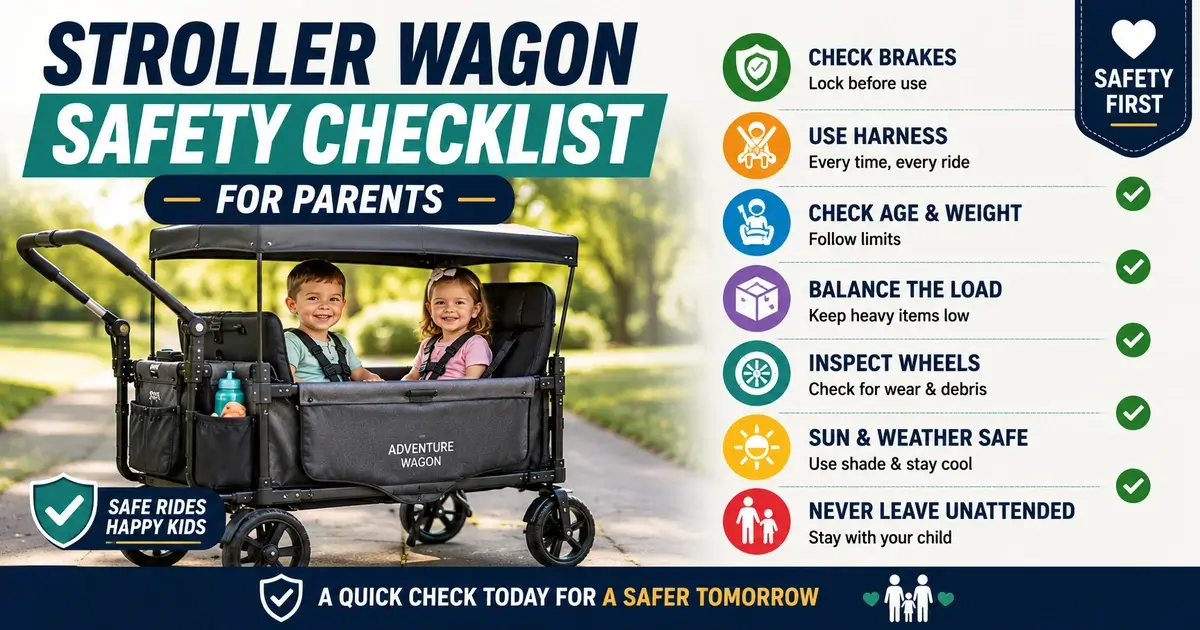
A stroller wagon safety checklist can help parents use a wagon more safely during walks, at parks, on errands, on travel days, and on outdoor family trips. Stroller wagons are useful, but they still need careful setup and daily safety checks. A stroller wagon can carry children, snacks, bags, toys, blankets, and outdoor gear. However, it is larger than many regular strollers, so parents need to check brakes, harnesses, weight limits, wheels, fold locks, and storage balance before each ride. This guide provides a simple, parent-friendly checklist. Use it before walks, park trips, zoo days, beach visits, sports events, and family travel. The goal is not to make stroller wagons scary. The goal is to make every ride more stable, comfortable, and safe for your child.
Table of Contents
- Quick Stroller Wagon Safety Checklist
- Why Stroller Wagon Safety Matters
- Before First Use
- Daily Safety Check Before Every Ride
- Age, Weight, and Child Fit
- Harness and Seating Safety
- Brake Safety
- Wheel and Terrain Safety
- Storage and Bag Safety
- Fold Locks and Frame Safety
- Infant Car Seat Safety
- Newborn Safety in Stroller Wagons
- Weather, Sun, and Airflow Safety
- Crowds, Stores, and Events
- Travel and Car Trunk Safety
- Used Stroller Wagon Safety
- Common Safety Mistakes
- Final Safety Verdict
- FAQs
Quick Stroller Wagon Safety Checklist
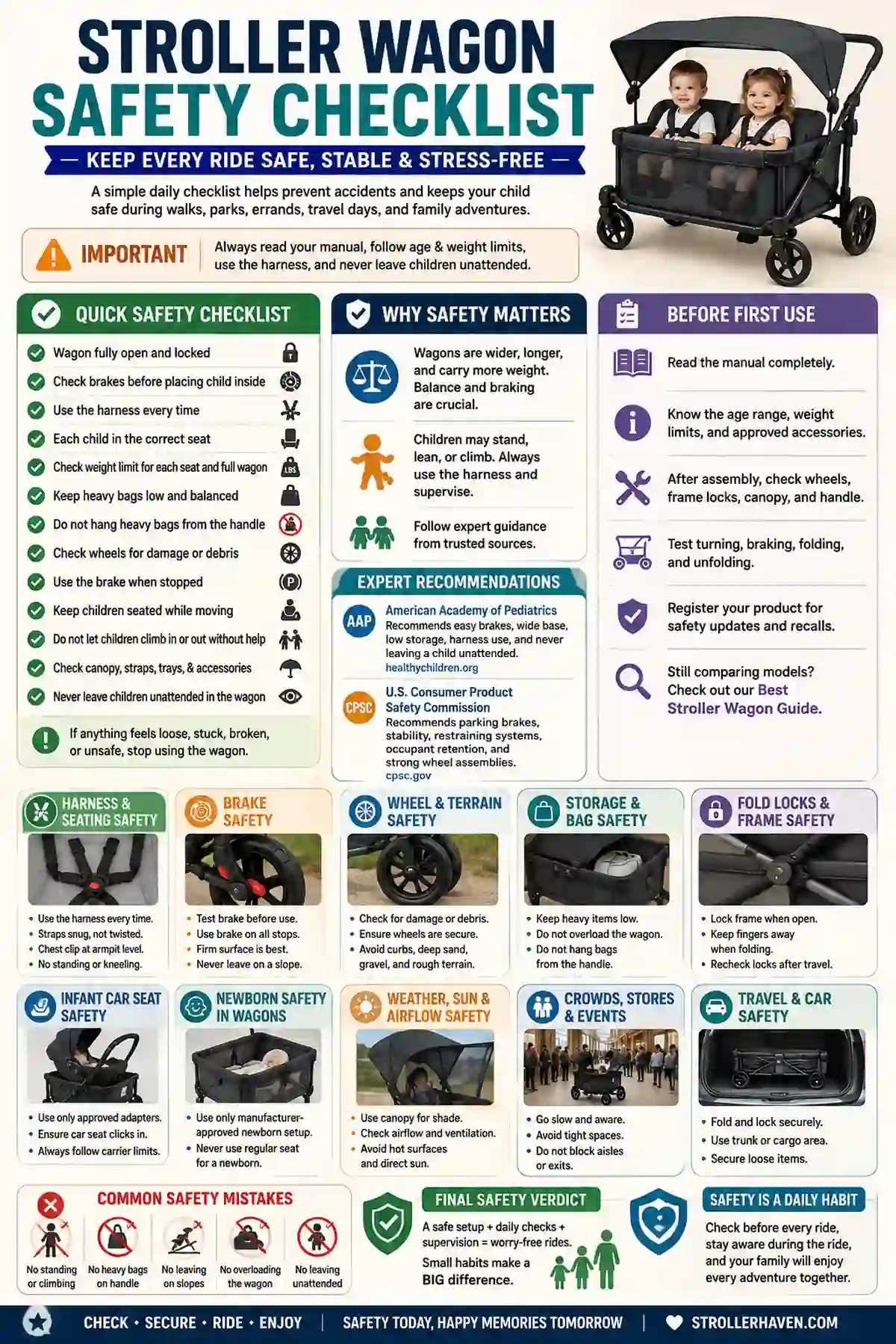
Use this quick checklist before every stroller wagon ride. It only takes a minute, but it can prevent many common problems.
- Check that the wagon is fully open and locked.
- Check the brakes before placing your child inside.
- Use the harness every time your child rides.
- Make sure each child sits in the correct seat.
- Check the weight limit for each seat and the full wagon.
- Keep heavy bags low and balanced.
- Do not hang heavy bags from the handle.
- Check wheels for damage, looseness, or stuck debris.
- Use the brake when stopped.
- Keep children seated while the wagon moves.
- Do not let children climb in or out without help.
- Check canopy, straps, trays, and accessories before moving.
- Never leave children unattended in the wagon.
If one part feels loose, stuck, broken, or unsafe, stop using the wagon until you check the manual or contact the brand.
Why Stroller Wagon Safety Matters
Stroller wagons are different from regular strollers. They are wider, longer, and often carry more weight.
That extra space is helpful for families. However, it also means parents need to think about balance, braking, turning, storage, and child movement.
A child may try to stand up, lean over the side, grab the canopy, or climb out. That is why using a harness and parent supervision are very important.
HealthyChildren.org from the American Academy of Pediatrics recommends easy-to-use brakes, a wide stroller base, safe folding habits, low basket storage, and harness use. It also says parents should never leave a child unattended in a stroller.
Read the official AAP stroller safety guide.
The U.S. Consumer Product Safety Commission also lists stroller and carriage safety areas, including parking brakes, stability, restraining systems, occupant retention, and wheel assemblies.
Read the CPSC stroller and carriage safety information.
This is why a simple stroller wagon safety checklist is useful. It helps you slow down and check the important parts before the ride starts.
Before First Use
Before using a new stroller wagon, read the manual. Do not rely only on product photos, online videos, or quick setup clips.
The manual tells you the correct age range, weight limit, folding method, brake use, harness setup, car seat compatibility, and approved accessories.
After assembly, check every part. Make sure the wheels click in, the frame locks, the canopy is secure, and the handle does not feel loose.
Push the empty wagon around your home or driveway first. Test turning, braking, folding, and unfolding before placing your child inside.
Also, check the model number and registration card. Registering the product can help you receive safety updates or recall notices from the brand.
If you are still comparing wagon models, read our best stroller wagon guide.
Daily Safety Check Before Every Ride
A stroller wagon should be checked before every ride, even if it worked fine yesterday. Small issues can happen during folding, storage, travel, or outdoor use.
Start with the frame. Make sure the wagon is fully open and locked. A half-open frame is not safe.
Next, test the brake. Push the wagon gently while the brake is on. The wagon should not roll.
Then check the harness. Make sure straps are not twisted, loose, broken, or stuck under the seat.
Check the wheels. Remove leaves, rocks, sand, hair, or string that may affect movement.
Finally, check the storage. Heavy items should sit low and balanced, not hanging from the handle.
Age, Weight, and Child Fit
Age and weight limits are not suggestions. They are part of safe stroller wagon use.
Check the manual for the minimum age, seat weight limit, total wagon limit, and cargo limit. Different brands and models can have very different rules.
Some stroller wagons are made for babies who can sit upright with support. Others may work with infant car seats if approved adapters are available.
Do not place a young baby in a regular wagon seat before the baby is ready. Sitting strength, head control, and harness fit matter.
Also, check how your child fits. The harness should sit correctly, the child should not slump, and the child should not be able to climb out easily.
For more details about baby age and stroller wagons, read our “Can Newborns Use Stroller Wagons” guide.
Toddler wagon safety: If your child is already past the newborn stage, read Are Stroller Wagons Safe for Toddlers? for seating, harness, stability, brakes, terrain, and everyday-use guidance.
Harness and Seating Safety
The harness is one of the most important safety features on a stroller wagon. Use it every time your child rides, even for short walks.
A short trip can still include bumps, sudden stops, curbs, uneven sidewalks, or a child trying to stand up.
Make sure the harness fits snugly but not too tightly. It should keep your child seated without pressing hard into the body.
Check for twisted straps. Twisted straps can feel uncomfortable and may not hold your child correctly.
If the wagon has multiple seats, use each seat as the brand designed it. Do not let two children share one seat unless the manual clearly allows it.
Children should sit while the wagon moves. Do not allow standing, jumping, leaning over the side, or climbing while the wagon is moving.
KidsHealth also advises parents never to leave a child unattended in a stroller and always to use the safety harness.
Read the KidsHealth stroller safety notes.
Brake Safety
Brakes are easy to forget, but they matter a lot. Always use the brake when the wagon is stopped.
Use the brake before placing a child inside. Use it again before taking a child out.
Test the brake before each ride. Lock it, then gently push the wagon. If the wagon moves, do not use it until the brake is checked.
Be extra careful on slopes, ramps, driveways, parking lots, and sidewalks near roads. Even a small slope can let a loaded wagon roll.
Do not depend on your hand alone to hold the wagon. Use the brake whenever you stop.
If the brake feels weak, sticky, loose, or hard to engage, check the manual or contact the manufacturer.
Wheel and Terrain Safety
Stroller wagons are often used outdoors. That means wheels and terrain should be checked carefully.
Before every ride, look at each wheel. Check for cracks, loose parts, stuck debris, or uneven movement.
Test the wagon on a smooth surface first. If it pulls to one side, shakes, or feels unstable, stop and check the wheels.
Different surfaces feel different. Pavement is easier than grass. Grass is easier than soft sand. Gravel can feel bumpy.
Slow down on curbs, ramps, uneven sidewalks, grass, and gravel. A loaded wagon can be harder to control than a regular stroller.
For beach trips, check whether your wagon is designed for sand. Soft sand can be difficult for many stroller wagons.
Storage and Bag Safety
Storage is one of the best parts of a stroller wagon. It can carry snacks, diapers, wipes, jackets, toys, blankets, bottles, and small bags.
However, storage can also affect safety. Heavy or poorly balanced items can make a wagon harder to steer.
Keep heavy items low in the wagon or in approved storage spaces. Do not hang heavy diaper bags, shopping bags, or backpacks from the handle.
Hanging bags from the handle can make some strollers or wagons less stable. It can also make the handle harder to control.
Do not exceed cargo limits. A stroller wagon may look roomy, but every model has limits.
Use organizers and storage accessories only as the brand allows. If an accessory changes balance or blocks the brake, remove it.
Compare stroller wagon organizers, storage baskets, snack trays, cup holders, and parent consoles.
View stroller wagon organizers on Amazon.
Fold Locks and Frame Safety
Fold locks keep the stroller wagon open during use. Always check that the wagon is fully locked before your child gets in.
A stroller wagon should not feel loose, half-open, tilted, or shaky. If it does, stop and check the frame.
Keep children away while folding or unfolding. Small fingers can get pinched in hinges, joints, or frame parts.
After unfolding, gently push down on the frame and handle to check stability. It should feel secure.
If the wagon was stored in a car, garage, or travel bag, check it again before use. Folding and transport can shift parts.
Infant Car Seat Safety
Some stroller wagons work with infant car seats. Others do not. Compatibility depends on the wagon model, car seat model, and adapter.
Never place an infant car seat loosely inside a wagon. The car seat must attach with an approved adapter if the brand allows that setup.
Check three things before using a car seat with a stroller wagon:
- The exact stroller wagon model
- The exact infant car seat brand and model
- The official adapter approved for that setup
Do not use random straps, clips, hooks, or homemade solutions. If the brand does not approve the setup, do not use it.
After attaching the car seat, gently check that it is locked in place. Follow both the stroller wagon manual and the car seat manual.
For detailed help, read our stroller and infant car seat safety guide.
Newborn Safety in Stroller Wagons
Newborn safety is different from toddler safety. Newborns need proper head, neck, and airway support.
Most newborns should not sit directly in a regular wagon seat. They usually need a newborn-safe setup, infant car seat, or bassinet-style support if approved by the brand.
Do not use pillows, loose blankets, or soft padding to create your own newborn seat. Soft items can create unsafe positioning.
Also, do not let a newborn sleep unattended in a stroller wagon. A stroller wagon is not a replacement for a safe sleep space unless the manufacturer clearly states that it is safe sleep-approved.
If your baby is very young, ask your pediatrician about safe travel positioning and follow the stroller wagon manual carefully.
Weather, Sun, and Airflow Safety
Weather can affect stroller wagon safety. Sun, heat, cold, wind, and rain all matter.
In hot weather, check airflow. A closed canopy or rain cover can trap heat if used incorrectly.
Use shade, breaks, water, and light clothing when needed. Do not cover the wagon with a thick blanket because it can reduce airflow.
In cold weather, keep children warm without blocking the harness. Bulky clothing can make the harness fit less securely.
In the rain, use only weather covers made for your wagon model. A loose cover can block airflow or interfere with the wheels.
After wet use, dry the wagon before storage. This can help protect fabric, frame parts, and wheels.
Compare stroller wagon weather covers, sun shades, mosquito nets, and rain covers for family trips.
View stroller wagon weather accessories on Amazon.
Crowds, Stores, and Events
Stroller wagons can be wide. They may be harder to move through tight stores, crowds, elevators, and busy sidewalks.
Slow down in crowded areas. Keep both hands near the handle when needed.
Watch corners, displays, doorways, and other people’s feet. A loaded wagon can be harder to stop quickly than a small stroller.
At events, check the rules before bringing a stroller wagon. Some stadiums, theme parks, and venues may limit wagon size or the use of wagons.
If your child gets restless in crowds, stop safely and use the brake before adjusting straps, snacks, toys, or seating.
Travel and Car Trunk Safety
Before traveling, fold the wagon correctly. Make sure the fold lock or latch is secure before lifting.
A stroller wagon can be heavy, so lift carefully. Bend your knees and avoid twisting while lifting it into the trunk.
Keep the wagon secure in the car. Do not stack heavy items on top of parts that can bend, crack, or damage the frame.
After travel, check the frame, wheels, canopy, harness, brake, and accessories before using it again.
If you are comparing larger models, read our complete guide to the WonderFold Wagon and our guide for parents to the Veer Wagon.
Used Stroller Wagon Safety
Buying a used stroller wagon can save money, but safety checks are very important.
First, check the brand, model name, and model number. Then search for recalls or safety notices.
Inspect the frame for cracks, bends, rust, loose screws, broken joints, or missing parts. Check the wheels and brakes carefully.
Look at the harness. Do not use a wagon with missing straps, broken buckles, or damaged seat belts.
Check the canopy, fabric, seat base, fold lock, handle, tray, and storage areas. If something important is missing, contact the manufacturer before use.
Be extra careful with used infant car seat adapters. Make sure the adapter is the correct official part for your wagon and car seat model.
For comparison shopping, read our complete guide to the Keenz Wagon.
Check stroller wagon safety accessories, replacement parts, parent organizers, and approved add-ons before trips.
View stroller wagon safety accessories on Amazon.
Common Safety Mistakes
Many stroller wagon problems come from small habits. The good news is that most are easy to avoid.
Not Using the Harness
A child can lean, stand, or slide even during a short ride. Use the harness every time.
Forgetting the Brake
Use the brake whenever the wagon is stopped. This is especially important on slopes, ramps, driveways, and parking lots.
Hanging Heavy Bags From the Handle
Heavy handle bags can affect balance. Keep weight low and use approved storage areas.
Ignoring Weight Limits
Do not exceed seat limits, cargo limits, or total wagon limits. A wagon can become harder to control when overloaded.
Letting Children Stand
Children should stay seated while the wagon moves. Standing or climbing can increase the risk of falls.
Using the Wrong Car Seat Adapter
Only use approved adapters. Do not guess or create your own car seat setup.
Skipping Wheel Checks
Wheels can collect rocks, sand, leaves, or string. Check wheels before outdoor trips.
Final Safety Verdict
A stroller wagon can be safe and useful when parents follow the manual, use the harness, check the brake, respect weight limits, and keep children seated.
The best safety habit is a quick check before every ride. Look at the frame, wheels, brake, harness, storage, canopy, and accessories before you start moving.
Also, match the wagon to your child’s age and your family routine. A wagon that works for toddlers may not be right for a newborn without an approved infant setup.
In simple terms, the best stroller wagon safety checklist is the one you actually use every time. A one-minute check can make family outings smoother, safer, and less stressful.
FAQs About Stroller Wagon Safety
Are stroller wagons safe for toddlers?
Stroller wagons can be safe for toddlers when used according to the manual. Parents should use the harness, follow weight limits, check brakes, and keep children seated while moving.
Can newborns ride in stroller wagons?
Newborns should only ride in a stroller wagon with an approved newborn-safe setup or compatible infant car seat adapter. Do not place a newborn directly in a regular wagon seat unless the manual clearly allows it.
Should my child wear the harness in a stroller wagon?
Yes. Use the harness every time your child rides. A short walk can still include bumps, turns, curbs, or sudden stops.
Do I need to use the brake every time I stop?
Yes. Use the brake whenever the wagon is stopped. This is especially important on ramps, slopes, driveways, and parking lots.
Can I hang a diaper bag from the wagon handle?
It is better to keep heavy bags low in approved storage areas. Heavy handle bags can affect balance and make the wagon harder to control.
How do I check if a used stroller wagon is safe?
Check the model number, recalls, frame, wheels, brakes, harnesses, canopy, fold lock, and missing parts. Avoid using a wagon with broken safety parts.
Can stroller wagons go on sand?
Some stroller wagons handle sand better than others, but deep, soft sand can be difficult. Check wheel type and brand guidance before beach use.
What should I check before every stroller wagon ride?
Check the frame lock, brake, harness, wheels, storage balance, canopy, accessories, and child fit. Make sure every child is seated and secured before moving.
Are stroller wagons good for parks and zoos?
Yes, stroller wagons can be useful for parks and zoos because they carry children and gear. Still, parents should use harnesses, brakes, and proper storage balance.
What is the most important stroller wagon safety rule?
The most important rule is never to leave children unattended. Always supervise children, use the harness, and use the brake when stopped.

Sanat Barua is the founder of Stroller Haven. He researches stroller models, manufacturer specifications, and safety standards to help parents compare options and make confident, informed decisions.
His research draws on official manufacturer documentation and product manuals, publicly available owner feedback, and safety guidance from sources such as the U.S. Consumer Product Safety Commission (CPSC) and the American Academy of Pediatrics (AAP). Stroller Haven is a research-based website: products are not described as physically tested unless an article states that testing took place. Stroller Haven is updated regularly as new models and safety information become available.