A stroller makes daily life easier for parents. You can use it for walks, shopping, travel, doctor visits, park time, and quick errands. But before every walk, a few small safety checks can make a big difference.
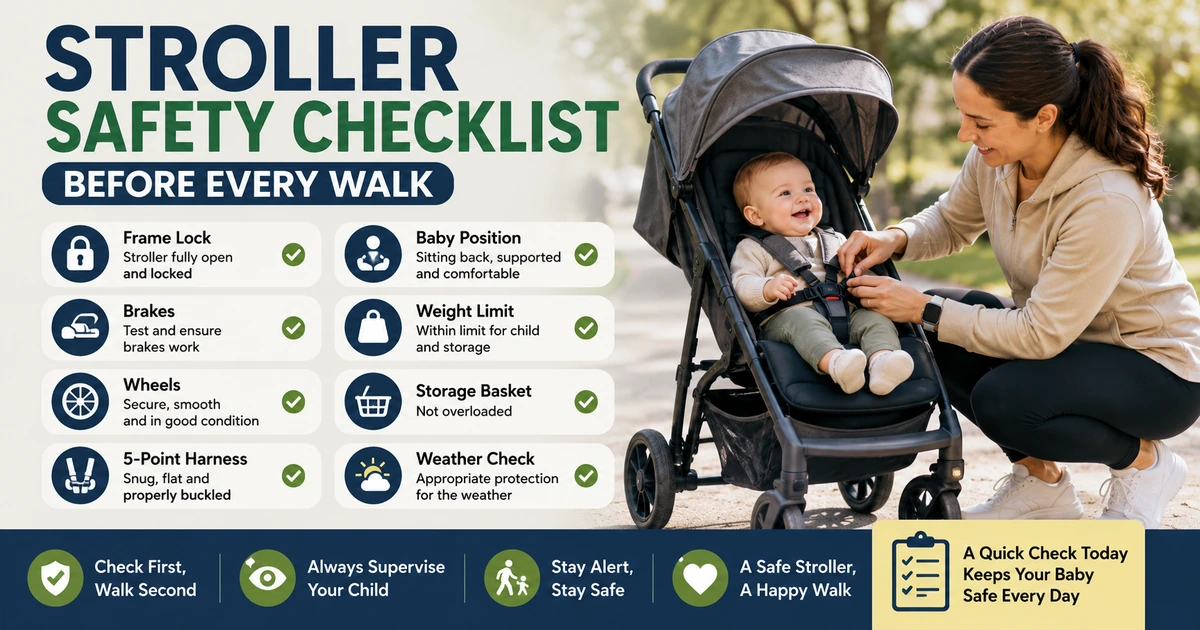
This stroller safety checklist helps parents check the most important things before placing a baby or toddler in a stroller. It covers brakes, wheels, harness, fold lock, weight limit, weather, storage basket, and baby comfort.
The goal is simple: do not wait until something feels wrong during the walk. Check the stroller first, then enjoy the outing with more confidence.
Quick Answer
Before every stroller walk, parents should check that the stroller is fully open and locked, brakes work, wheels are secure, harness is properly fastened, baby is positioned safely, storage is not overloaded, and weather protection is suitable.
| Safety Check | What to Confirm |
|---|---|
| Frame lock | Stroller is fully open and locked before baby sits |
| Brakes | Brake locks properly when stopped |
| Wheels | No loose, cracked, stuck, or wobbling wheels |
| Harness | 5-point harness is snug, flat, and buckled |
| Baby position | Baby is not slumping, sliding, or leaning unsafely |
| Storage basket | Basket is not overloaded |
| Weather | Baby is protected from heat, cold, sun, and wind |
Why a Stroller Safety Checklist Matters
Many stroller accidents happen because parents are in a hurry. A brake is not locked, the stroller is not fully opened, the harness is loose, or a heavy bag makes the stroller unstable.
A simple checklist helps parents build a habit. Before every walk, take one minute to check the stroller. This is especially important for newborns, toddlers, crowded places, slopes, parking lots, and long outings.
Helpful guide: For a wider safety overview, read our Stroller and Infant Car Seat Safety Guide.
1. Check the Stroller Frame First
Before placing your baby in the stroller, make sure the stroller frame is fully open. The frame should not feel loose, half-folded, or unstable.
Check these points:
- The stroller is fully opened.
- The frame lock clicks into place.
- The seat is attached correctly.
- The stroller does not shake strangely.
- No part of the frame looks cracked or bent.
- The stroller feels stable when gently pushed.
If the stroller does not lock properly, do not use it until the problem is fixed.
2. Keep Baby Away While Folding and Unfolding
Stroller hinges can pinch small fingers. When opening or closing the stroller, keep your child away from the folding area.
Safe folding tips:
- Fold and unfold the stroller away from your child.
- Check that little fingers are not near hinges or wheels.
- Make sure the stroller is fully locked before use.
- Do not place baby inside while the stroller is half-open.
- Use the fold lock when carrying or storing the stroller.
This is a small step, but it is very important for daily stroller safety.
3. Test the Brakes Before You Walk
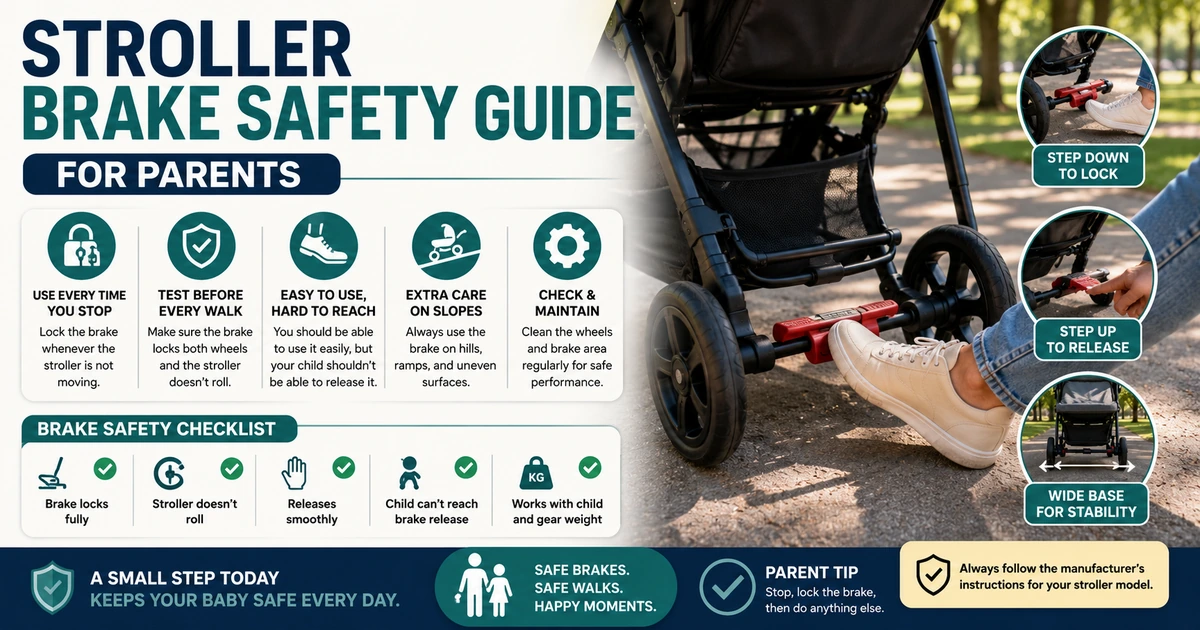
Brakes are one of the most important stroller safety features. Before every walk, press the brake and gently push the stroller to confirm it does not move.
Use the brake whenever:
- You stop walking
- You place baby in the stroller
- You take baby out
- You adjust the harness
- You stop on a slope
- You are near a road or parking lot
- You pause to check your phone, bag, or map
Official source: Parents can read stroller safety guidance from HealthyChildren.org by the American Academy of Pediatrics.
4. Check the Wheels
Wheels affect stroller control. A loose or damaged wheel can make the stroller hard to push, turn, or stop.
Before every walk, check:
- Wheels are attached securely.
- No wheel is wobbling.
- No wheel is cracked or damaged.
- Wheels spin smoothly.
- No stone, string, or dirt is stuck in the wheels.
- Front wheels are locked or unlocked based on your route.
If the stroller pulls to one side or feels unstable, stop and check the wheels before continuing.
5. Secure the 5-Point Harness
A stroller harness helps keep your baby safely seated. A 5-point harness is especially helpful because it secures the shoulders, waist, and between the legs.
Before starting the walk, check:
- Shoulder straps are in the correct position.
- Waist straps are snug.
- The crotch strap is connected properly.
- The buckle clicks fully.
- Straps are flat, not twisted.
- Baby cannot slide down or stand up.
- Harness is not too tight around clothing.
Helpful guide: For more details, read our 5-Point Harness Stroller Safety Guide.
6. Check Baby’s Sitting Position
Even when the harness is buckled, your baby’s position still matters. Babies should not slump forward, slide down, or lean sideways for a long time.
Check baby’s position:
- Head and neck are supported.
- Baby’s chin is not pressed to the chest.
- Baby is not sliding down in the seat.
- Arms and legs are not trapped.
- Face is visible and uncovered.
- Seat recline matches baby’s age and ability.
For long walks, check your baby’s position several times, not only before starting.
7. Check Newborn Recline and Support
Newborns need extra support because they do not have strong head and neck control. If the stroller is for a newborn, make sure the stroller seat reclines properly or uses an approved bassinet or infant car seat setup.
Newborn stroller checklist:
- Stroller is approved for newborn use.
- Seat is flat or near-flat if required.
- Baby’s head and neck are supported.
- Baby is not sitting too upright.
- Harness fits correctly even in recline mode.
- No loose pillow or soft bedding is added.
Helpful guide: If you are buying for a newborn, read our What Type of Stroller Is Safe for Newborns? guide.
8. Check the Weight Limit
Every stroller has a weight limit. Using a stroller beyond the recommended child weight can affect stability, braking, frame strength, and wheel performance.
Before using the stroller, check:
- Child weight limit
- Child height limit
- Basket weight limit
- Accessory weight limit
- Ride-on board limit if used
- Double stroller seat-specific limits
Helpful guide: For weight and height details, read our Stroller Weight Limit Guide for Parents.
9. Do Not Overload the Basket
Stroller storage baskets are useful, but they are not designed to carry unlimited weight. Overloading the basket can make the stroller harder to push and may damage the stroller.
Basket safety tips:
- Follow the basket weight limit.
- Keep heavier items low and centered.
- Do not force large bags into a small basket.
- Check that items do not touch the wheels.
- Remove loose items that can fall out.
A stroller should carry your child safely first. Storage is helpful, but it should not affect balance or control.
10. Avoid Hanging Heavy Bags From the Handlebar
Hanging heavy bags from the handlebar can make a stroller tip backward. This is one of the most common mistakes parents make.
Safer options:
- Use the lower storage basket.
- Carry a backpack yourself.
- Use a small organizer only for light items.
- Keep heavy items off the handlebar.
- Remove bags before taking baby out.
This is especially important when the stroller seat is reclined or when your child moves around.
11. Check the Canopy and Weather Protection
Weather can change stroller safety and comfort. Before every walk, check whether your baby needs sun shade, airflow, warm clothing, or rain protection.
| Weather | Safety Check |
|---|---|
| Sunny day | Use canopy and avoid direct sun exposure |
| Hot day | Keep airflow open and check overheating |
| Cold day | Use layers but keep baby’s face uncovered |
| Windy day | Secure covers and avoid loose blankets near the face |
| Rainy day | Use a stroller rain cover as instructed |
Never fully cover the stroller with a thick blanket in hot weather because airflow can become poor.
12. Check Baby Comfort During Longer Walks
A stroller may feel safe at the beginning, but babies can become uncomfortable during longer outings. Parents should check comfort regularly.
Watch for:
- Fussing or crying
- Sweating
- Cold hands or feet
- Slumping
- Pressure marks from straps
- Dirty diaper
- Hunger or thirst
- Sleepiness or poor nap position
Helpful guide: For stroller time and breaks, read our How Long Can a Baby Stay in a Stroller? guide.
13. Check the Route Before Walking
The stroller may be safe, but the walking route may still create problems. Check your route before starting, especially with a newborn or toddler.
Look for:
- Broken sidewalks
- Steep slopes
- Busy roads
- Wet or slippery paths
- Construction areas
- Stairs without ramp access
- Very crowded places
- Uneven park paths
If the route is rough, slow down and keep both hands on the stroller handle.
14. Parking Lot Safety
Parking lots can be risky because cars may move suddenly and drivers may not see a stroller clearly. Always stay alert.
Parking lot checklist:
- Use the brake before placing baby in the stroller.
- Keep stroller close to your body.
- Do not leave stroller behind the car.
- Load baby before loading shopping bags.
- Keep one hand on the stroller when possible.
- Do not let older children push the stroller near cars.
When in doubt, slow down and focus only on baby safety first.
15. Toddler Stroller Safety Check
Toddlers move more than babies. They may lean, twist, stand, kick, or try to climb out. So toddler stroller safety needs extra attention.
Before walking with a toddler, check:
- Harness is still snug.
- Toddler cannot unbuckle easily.
- Seat is not too small.
- Feet are placed safely on footrest.
- Hands are away from wheels.
- Weight limit is still safe.
- Toddler is not carrying sharp or heavy items.
Helpful guide: If your child is older, read our How to Choose a Stroller for a Toddler guide.
16. Used Stroller Safety Check
If you use a second-hand stroller, check it carefully before every walk. A used stroller may have missing parts, weak brakes, damaged wheels, or old recall issues.
Used stroller checklist:
- Check the brand and model number.
- Look for recall information.
- Make sure the manual is available.
- Check the harness is complete.
- Check the brake works properly.
- Check the frame is not cracked.
- Check wheels are secure.
- Do not use a stroller with missing safety parts.
Official source: Parents can check product safety warnings through the U.S. Consumer Product Safety Commission recalls page.
Printable Stroller Safety Checklist
You can use this simple checklist before every walk:
| Before You Walk | Done? |
|---|---|
| Stroller frame fully open and locked | Yes / No |
| Brakes tested and working | Yes / No |
| Wheels secure and moving smoothly | Yes / No |
| Harness buckled and snug | Yes / No |
| Baby positioned safely | Yes / No |
| Weight limit checked | Yes / No |
| Basket not overloaded | Yes / No |
| No heavy bags on handlebar | Yes / No |
| Weather protection ready | Yes / No |
| Route looks safe | Yes / No |
Common Stroller Safety Mistakes
Parents are busy, and mistakes can happen. But these common stroller mistakes are easy to avoid with a quick checklist.
- Not using the harness
- Leaving baby unattended
- Forgetting to lock brakes when stopped
- Hanging heavy bags from the handlebar
- Using a stroller beyond the weight limit
- Not checking wheels before walking
- Folding the stroller near baby’s fingers
- Using a damaged or recalled stroller
- Covering stroller fully in hot weather
- Letting toddlers stand or climb in the stroller
Amazon Buying Tips
If you are buying a stroller on Amazon, do not only look at color, style, or price. Look for safety features that make daily walks easier and safer.
Before buying, check:
- 5-point harness
- Reliable brake system
- Stable frame and wide base
- Clear weight limit
- Good wheel quality
- Safe fold lock
- Comfortable seat
- Canopy and ventilation
- Storage basket limit
- Recent parent reviews
Check Safety-Friendly Stroller Options on Amazon
Final Verdict: Stroller Safety Checklist Before Every Walk
A stroller safety checklist does not need to be complicated. Before every walk, check the frame lock, brakes, wheels, harness, baby position, weight limit, storage, weather, and route.
These small checks can help prevent common stroller problems and make daily outings safer for babies, toddlers, and parents.
Best rule: Check first, walk second. A one-minute stroller safety check is always worth it.
Frequently Asked Questions
What should I check before using a stroller?
Check the frame lock, brakes, wheels, harness, baby position, storage basket, weight limit, weather protection, and walking route before using a stroller.
Should I use the stroller brake every time I stop?
Yes. Use the brake whenever you stop, especially when placing baby in the stroller, taking baby out, adjusting the harness, or stopping on a slope.
Is a 5-point harness important in a stroller?
Yes. A 5-point harness helps secure the shoulders, waist, and between the legs, which can help keep your child safely seated.
Can I hang a diaper bag from the stroller handle?
It is better not to hang heavy bags from the handlebar because it can make the stroller unstable. Use the lower basket or carry a backpack.
How do I know if a stroller is unsafe?
A stroller may be unsafe if the brake does not work, wheels wobble, frame is cracked, harness is missing, fold lock is broken, or the stroller has an active recall.
Should I check stroller recalls?
Yes, especially for used strollers. Check the stroller brand and model number on official recall pages before use.
Is it safe to cover a stroller with a blanket?
A light cover may be used carefully, but do not fully cover the stroller with a thick blanket in hot weather because airflow can become poor.
How often should I check the stroller during a long walk?
Check your baby regularly during long walks, especially for harness fit, body position, temperature, diaper needs, and comfort.