Many parents use a stroller every day for walks, shopping, travel, doctor visits, parks, and family outings. But one common question is: how long can a baby stay in a stroller safely?
The honest answer is that there is no one perfect time limit for every baby. It depends on your baby’s age, stroller type, recline position, weather, comfort, feeding needs, sleep needs, and how well your baby is supported.
As a general rule, babies should not stay in the same stroller position for too long without breaks. Parents should check the baby often, give breaks during longer outings, avoid unsafe sleep situations, and always follow the stroller manufacturer’s instructions.
Quick Answer
A baby can stay in a stroller for short daily walks or errands as long as the baby is comfortable, properly harnessed, well supported, and supervised. For longer outings, parents should take regular breaks, change the baby’s position, check temperature, and avoid letting infants sleep for long periods in a stroller that is not designed for safe sleep.
| Situation | Parent Safety Tip |
|---|---|
| Short walk | Usually fine if baby is comfortable and safely harnessed |
| Long outing | Take regular breaks and check baby often |
| Newborn use | Use proper recline, bassinet mode, or approved newborn setup |
| Baby falls asleep | Move baby to a safe sleep space when possible |
| Hot weather | Check overheating, shade, airflow, and hydration needs |
| Cold weather | Check warmth, airflow, and avoid heavy loose blankets near the face |
| Baby looks uncomfortable | Stop, check harness, diaper, temperature, hunger, and position |
Is There a Fixed Time Limit for Stroller Use?
There is no single fixed stroller time limit that works for every baby. A newborn, a 6-month-old baby, and a toddler all have different needs.
Instead of following only the clock, parents should watch these things:
- Baby’s age
- Baby’s head and neck control
- Stroller recline position
- Harness fit
- Weather condition
- Baby’s comfort level
- Feeding and diaper needs
- Whether baby is sleeping safely
- How long baby has stayed in one position
If your baby seems uncomfortable, sweaty, cold, hungry, sleepy, or fussy, it is time to stop and check them.
How Long Can a Newborn Stay in a Stroller?
Newborns need extra care because they do not have strong head and neck control. They should ride in a stroller setup that supports a flat or near-flat recline, bassinet mode, or an infant car seat setup approved by the stroller manufacturer.
For newborns, parents should avoid long periods in a seated or semi-upright position unless the product is designed and approved for that use. During longer outings, stop regularly and check breathing, head position, temperature, and comfort.
Helpful guide: If you are buying for a newborn, read our What Type of Stroller Is Safe for Newborns? guide.
How Long Can an Older Baby Stay in a Stroller?
Older babies who can hold their head up and sit with support may tolerate stroller rides better than newborns. Still, they should not stay in one position for too long without breaks.
For older babies, check:
- Is the baby sitting comfortably?
- Is the harness snug but not too tight?
- Is the baby’s head supported during naps?
- Is the baby getting too hot or too cold?
- Does the baby need feeding or diaper change?
- Is the baby trying to slide down or twist sideways?
Helpful guide: If you are unsure when your baby is ready for a more upright stroller seat, read our When Can a Baby Sit in a Stroller? guide.
Can a Baby Nap in a Stroller?
Many babies fall asleep in strollers. A short supervised nap during a walk can happen, but parents should be careful. A stroller is not always the same as a safe sleep space.
For infants, safe sleep usually means a firm, flat, non-inclined sleep surface without soft bedding. If your baby falls asleep in a stroller, car seat, swing, or carrier, move the baby to a safe sleep space when possible.
Official source: Parents can read safe sleep guidance from HealthyChildren.org by the American Academy of Pediatrics.
Stroller Nap Safety Tips
If your baby falls asleep in the stroller during a walk or outing, follow basic safety checks.
- Keep the baby supervised.
- Make sure the harness is correctly fastened.
- Check that the baby’s chin is not pushed down to the chest.
- Keep the face uncovered.
- Do not add loose pillows, thick blankets, or soft padding.
- Use the stroller recline correctly.
- Move baby to a safe sleep surface when possible.
- Do not use a stroller as a regular crib replacement.
If your baby often naps during outings, a bassinet stroller may be more suitable than a basic upright stroller.
Bassinet Stroller vs Regular Seat for Longer Use
A bassinet stroller can be helpful for newborns because it allows a flatter position. A regular stroller seat may be better for older babies and toddlers who can sit with support.
| Stroller Setup | Better For | Important Note |
|---|---|---|
| Bassinet stroller | Newborns and younger babies | Check manufacturer approval for sleep and use |
| Fully reclining stroller seat | Young babies if approved for age | Must support head, neck, and body properly |
| Infant car seat stroller setup | Short trips and car-to-stroller convenience | Not ideal for long unsupervised sleep |
| Upright stroller seat | Older babies and toddlers | Baby should have enough sitting control |
Helpful guide: To compare newborn stroller setups, read our Bassinet Stroller vs Car Seat Stroller guide.
How Often Should Parents Take Breaks?
For longer stroller outings, parents should take regular breaks. Breaks help you check your baby’s comfort, temperature, diaper, feeding needs, and position.
During a break, you can:
- Take baby out safely if needed
- Check diaper
- Feed baby if needed
- Check body temperature
- Adjust clothing
- Check harness marks
- Allow gentle movement
- Change baby’s position
Breaks are especially important for newborns, young babies, long travel days, hot weather, and stroller naps.
Signs Your Baby Has Been in the Stroller Too Long
Your baby may show signs that they need a break. Do not ignore these signs during longer outings.
- Baby is crying or fussy
- Baby is sweating
- Baby feels too cold
- Baby’s face is red or flushed
- Baby is slumping forward or sideways
- Baby keeps trying to escape the harness
- Baby has pressure marks from straps
- Baby seems hungry or thirsty
- Baby needs a diaper change
- Baby looks unusually sleepy or uncomfortable
If something feels wrong, stop and check your baby immediately.
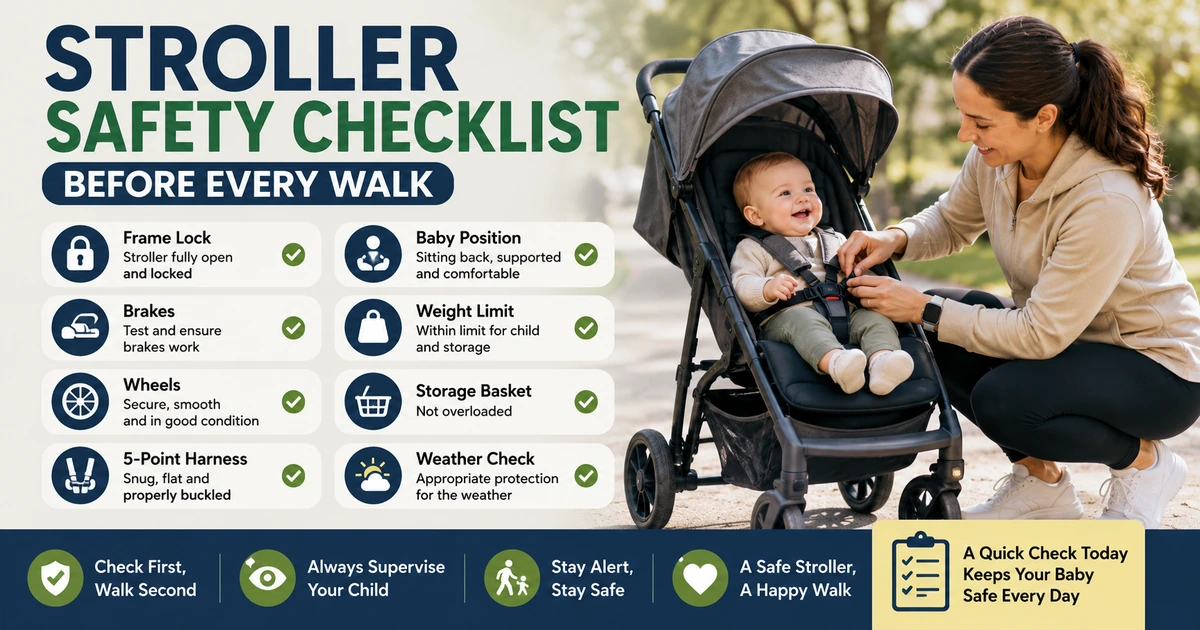
Harness Safety During Longer Stroller Use
A baby should always be properly secured in the stroller. The harness should be snug, but not painfully tight.
Check the harness before and during long outings:
- Shoulder straps sit correctly
- Waist straps are secure
- Buckle is fully clicked
- Straps are not twisted
- Baby cannot slide down
- Baby cannot stand or climb out
- Harness still fits after clothing changes
Helpful guide: For more details, read our 5-Point Harness Stroller Safety Guide.
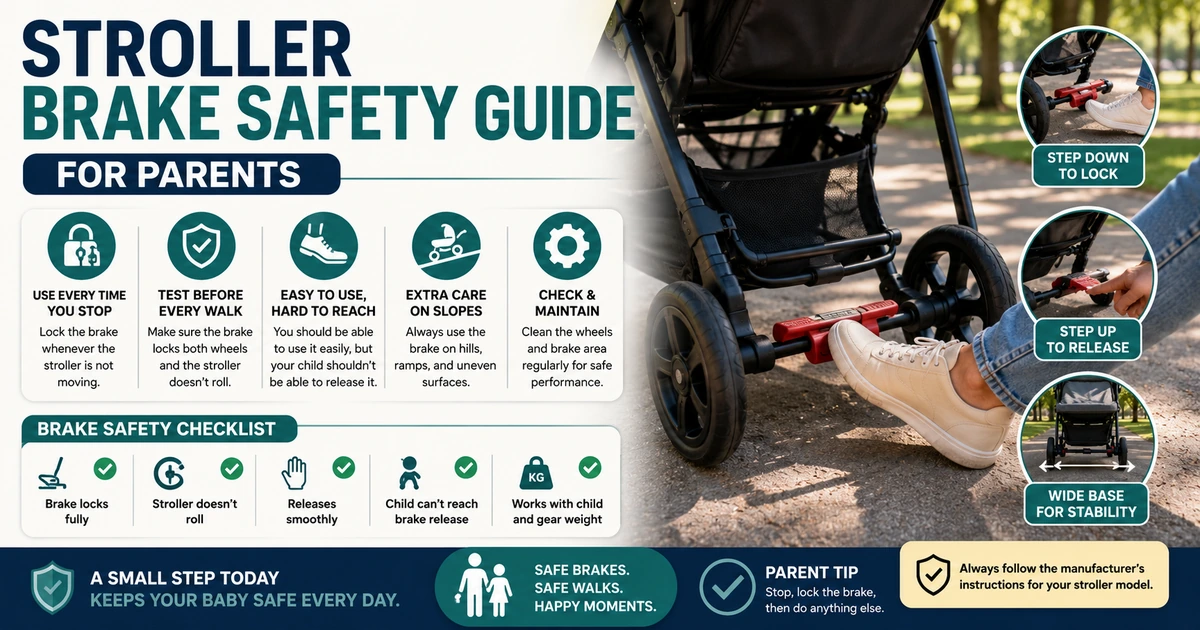
Brake Safety When Stopping for Breaks
Whenever you stop the stroller, use the brake. This is important during breaks, feeding, diaper checks, parking lots, slopes, and busy areas.
Use the brake when:
- You stop walking
- You adjust the harness
- You check the diaper
- You feed baby
- You take baby out
- You place baby into the stroller
- You stop near a road or parking area
Official source: Parents can read stroller safety tips from HealthyChildren.org stroller safety guidance by the American Academy of Pediatrics.
Weather Matters: Hot Days
Hot weather can make stroller use risky if parents are not careful. Babies can get warm quickly, especially if the stroller has poor airflow.
Hot weather tips:
- Use the canopy for shade.
- Do not fully cover the stroller with thick blankets.
- Keep airflow open.
- Check baby’s neck, chest, and back for sweating.
- Avoid the hottest part of the day when possible.
- Offer feeding or fluids based on baby’s age and doctor guidance.
- Take breaks indoors or in shade.
If your baby looks overheated, stop the outing and cool them safely.
Weather Matters: Cold Days
Cold weather also needs care. Babies may feel cold faster than adults, but too many thick layers can also make them uncomfortable.
Cold weather tips:
- Dress baby in comfortable layers.
- Keep the face uncovered.
- Avoid loose blankets near the face.
- Check hands, feet, neck, and chest.
- Use stroller covers only as instructed.
- Make sure airflow is not fully blocked.
- Take indoor breaks during long outings.
Always check your baby’s real comfort, not only the outside temperature.
Can a Baby Stay in a Stroller During Travel?
During travel, babies may spend more time in a stroller than usual. Airports, theme parks, shopping centers, and family trips can make stroller use longer.
For travel days, plan breaks before the baby becomes uncomfortable.
- Give baby time out of the stroller when safe.
- Check diaper often.
- Plan feeding breaks.
- Use the recline properly.
- Keep essentials nearby.
- Watch for overheating indoors and outdoors.
- Do not let stroller naps replace safe sleep for long periods.
Travel strollers are convenient, but comfort and safety checks still matter.
Can a Baby Stay in a Car Seat Stroller for a Long Time?
A car seat stroller setup is convenient for short trips, but it is not the best choice for long stroller use or long sleep. Infant car seats are mainly designed for car travel, not as a regular sleep space or long stroller seat.
If you use a car seat stroller setup:
- Keep baby supervised.
- Make sure the car seat clicks securely into the stroller.
- Check baby’s head and neck position.
- Avoid long unnecessary periods in the seat.
- Move baby to a safe sleep surface when possible.
- Follow the car seat and stroller manuals.
Helpful guide: For car seat and stroller use, read our Stroller and Infant Car Seat Safety Guide.
Is It Okay to Use a Stroller Every Day?
Yes, many families use a stroller every day. Daily stroller use can be safe and helpful when parents use the stroller correctly, follow the manual, keep the baby supervised, and take breaks during longer outings.
Daily stroller use is common for:
- Walking
- Shopping
- Daycare drop-off
- Travel
- Appointments
- Outdoor family time
- Public transport
The goal is not to avoid the stroller. The goal is to use it safely and avoid keeping baby in one position for too long.
Safety Checklist for Longer Stroller Outings
| Check | What Parents Should Do |
|---|---|
| Harness | Fasten correctly and check fit |
| Brakes | Use whenever stopped |
| Position | Make sure baby is not slumping |
| Sleep | Move baby to safe sleep space when possible |
| Weather | Check overheating or cold exposure |
| Diaper | Check during longer outings |
| Feeding | Plan breaks based on baby’s age and routine |
| Comfort | Look for fussiness, pressure marks, or poor posture |
Common Mistakes Parents Should Avoid
Most stroller problems happen because parents become busy and forget small safety checks.
- Leaving baby in the stroller without supervision
- Letting baby sleep too long in a non-sleep stroller setup
- Not using the harness
- Using the wrong recline for a newborn
- Covering the stroller fully in hot weather
- Ignoring fussiness or sweating
- Hanging heavy bags from the handlebar
- Not using brakes during stops
- Using a stroller beyond weight or age guidance
- Not reading the stroller manual
Amazon Buying Tips
If you are buying a stroller for longer walks or daily outings, choose comfort and safety features carefully. Do not buy only based on style or low price.
Before buying on Amazon, check:
- Age and weight recommendation
- Newborn compatibility
- Recline positions
- Seat padding
- 5-point harness
- Brake system
- Canopy size
- Ventilation
- Storage basket limit
- Recent parent reviews
Check Comfortable Stroller Options for Long Walks on Amazon
Final Verdict: How Long Can a Baby Stay in a Stroller?
A baby can stay in a stroller for normal walks and outings when the stroller is used safely, the baby is comfortable, and parents check the baby often. But babies should not stay in one stroller position for too long without breaks.
For newborns, proper support and recline are very important. For older babies, comfort, harness fit, posture, weather, and regular breaks matter. If baby falls asleep in the stroller, move them to a safe sleep space when possible.
Best rule: Use the stroller as a safe travel tool, not as a regular sleep space or all-day seat.
Frequently Asked Questions
How long can a baby stay in a stroller?
There is no single fixed time for every baby. Short walks and errands are usually fine when baby is comfortable, supervised, properly harnessed, and positioned safely. For longer outings, take regular breaks.
Can a newborn stay in a stroller for a long walk?
A newborn should use a stroller setup with proper recline, support, or bassinet mode approved for newborns. During long walks, parents should stop regularly and check breathing, comfort, temperature, and position.
Can a baby sleep in a stroller?
A baby may fall asleep in a stroller during an outing, but a stroller should not replace a safe sleep space. Move baby to a firm, flat safe sleep surface when possible.
How often should I take my baby out of the stroller?
During longer outings, take regular breaks to check diaper, feeding needs, temperature, comfort, harness fit, and body position.
Is it safe to use a stroller every day?
Yes, daily stroller use can be safe when parents follow the manual, use the harness, use brakes when stopped, supervise the baby, and take breaks during longer use.
What signs show my baby needs a stroller break?
Crying, sweating, cold hands or feet, slumping, pressure marks, fussiness, hunger, dirty diaper, or trying to escape the harness can all mean baby needs a break.
Can I leave my baby sleeping in the stroller after coming home?
It is better to move your baby to a safe sleep surface when possible, especially for longer sleep.
Should I use a bassinet stroller for longer newborn outings?
A bassinet stroller can be a better option for newborn comfort if it is approved by the manufacturer and used correctly.