A stroller sun shade can be very helpful during sunny walks, park visits, beach trips, travel days, and hot-weather errands. It can help protect your baby from direct sunlight, reduce glare, and make outdoor stroller time more comfortable.
Quick Answer: Are Stroller Sun Shades Safe?
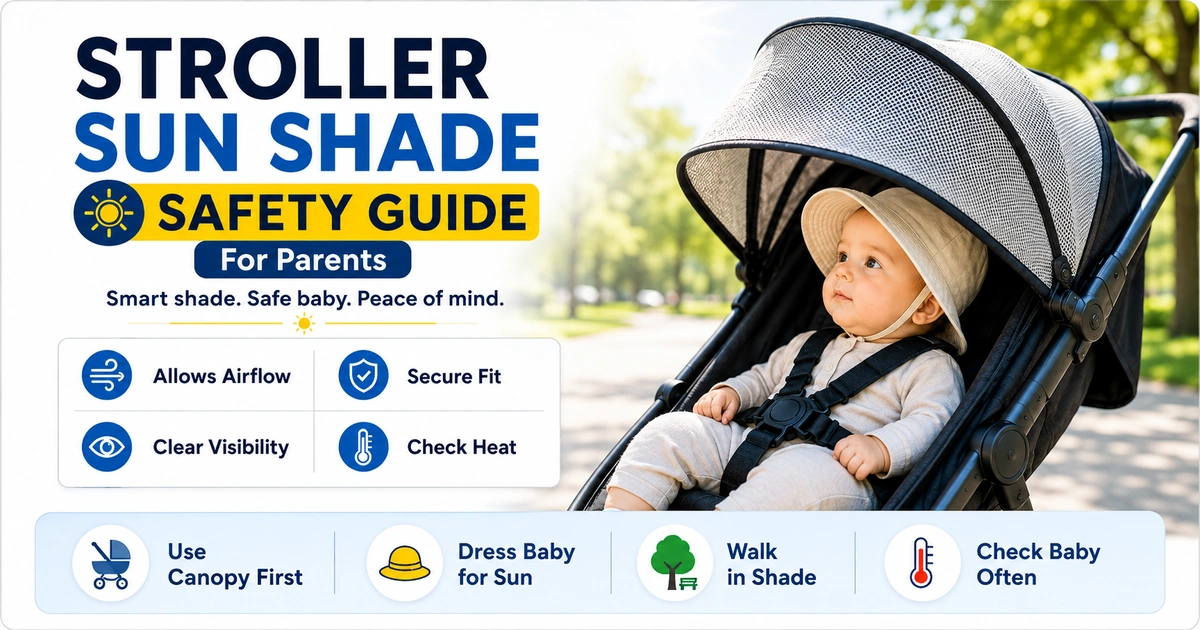
Stroller sun shades can be safe when they fit securely, allow airflow, do not cover the baby’s face, do not interfere with the harness, and do not touch the wheels or folding parts. A safe stroller sun shade should reduce direct sun exposure while still letting parents see and check the baby often.
Parents should avoid using thick blankets or covers that fully close the stroller, especially in warm weather. Shade is important, but airflow and temperature checks are just as important.
Why Stroller Sun Shade Safety Matters
Babies have sensitive skin and can become uncomfortable in sun and heat faster than adults. A stroller sun shade can help, but only if it is used correctly. Poorly fitted or poorly ventilated covers may block air, trap heat, or make it harder to see your baby.
Good stroller sun shade safety can help parents:
- Reduce direct sunlight on the baby
- Protect the baby’s face, arms, and legs from harsh sun
- Improve comfort during outdoor walks
- Reduce glare during naps or travel
- Keep the stroller seat more comfortable
- Check the baby easily during the walk
- Avoid unsafe cover and airflow mistakes
A stroller sun shade should support safe stroller use. It should never make it harder to supervise your baby.
1. Choose a Sun Shade That Fits Your Stroller Properly
The first safety rule is fit. A stroller sun shade should attach securely to your stroller without slipping, sagging, dragging, or blocking important stroller parts.
Before buying or using a stroller sun shade, check:
- Does it fit your stroller model or stroller type?
- Does it attach securely to the frame or canopy?
- Does it stay away from the wheels?
- Does it avoid the brake area?
- Does it stay away from the baby’s face?
- Does it allow enough airflow?
- Can you still see your baby?
- Does it affect folding or storage?
Universal stroller sun shades can be useful, but “universal” does not always mean perfect for every stroller. Check the product size, attachment style, and parent reviews before buying.
Amazon buying tip: When choosing a stroller sun shade, compare breathable designs, secure attachment points, UPF-rated fabric, and compatibility with your stroller type. Check stroller sun shade options on Amazon.
2. Do Not Use a Thick Blanket as a Stroller Sun Shade
Many parents use a blanket to create quick shade, but this can be risky in warm weather. A thick blanket may block airflow and make the inside of the stroller feel hotter, even if the baby is no longer in direct sunlight.
Instead of a thick blanket, use safer shade options such as:
- Built-in stroller canopy
- Breathable stroller sun shade
- Canopy extender
- Clip-on stroller umbrella
- Lightweight baby sun hat
- Shaded walking route
- Tree shade or covered pathway
If you use any stroller cover, make sure air can move around the baby and that you can check your baby easily. Shade should never create a closed hot space.
For more complete sun protection tips, read our guide on how to protect baby from sun in a stroller.
3. Keep Babies Under 6 Months Out of Direct Sunlight
For babies under 6 months, shade is especially important. Young babies have delicate skin, and parents should avoid direct sunlight as much as possible. A stroller canopy or stroller sun shade can help, but parents should also choose shaded routes and cooler times of day.
For young babies, try to:
- Stay in shade whenever possible
- Use the stroller canopy correctly
- Avoid long walks in strong sun
- Dress baby in lightweight protective clothing
- Use a brimmed baby hat when needed
- Check baby often for heat discomfort
HealthyChildren.org from the American Academy of Pediatrics recommends keeping babies under 6 months out of direct sunlight and moving them to shade under a tree, umbrella, or stroller canopy. You can read the official guidance here: HealthyChildren.org sun safety tips.
4. Make Sure the Sun Shade Allows Airflow
Airflow is one of the most important stroller sun shade safety factors. A shade may block sunlight, but if it also blocks fresh air, your baby may become too warm inside the stroller.
Look for stroller sun shade features such as:
- Breathable mesh panels
- Open side airflow
- Adjustable coverage
- Lightweight fabric
- Secure but not airtight attachment
- Easy access to check the baby
Avoid fully covering the stroller in a way that blocks airflow from all sides. During hot weather, stop regularly and check your baby’s neck, back, face, and overall comfort.
The CDC advises parents to dress infants and children in loose, lightweight, light-colored clothing during hot weather and to take steps to prevent heat-related illness. You can read the official CDC heat guidance here: CDC heat safety for infants and children.
5. Check That the Shade Does Not Touch Your Baby’s Face
A stroller sun shade should never press against your baby’s face, mouth, or nose. It should create shade from a safe distance while keeping the baby’s breathing space open and comfortable.
Before every walk, check:
- The shade is not sagging into the seat.
- The fabric is not touching the baby’s face.
- The baby can move comfortably.
- The harness is still positioned correctly.
- The shade does not push the baby’s head forward.
- You can easily open or move the shade if needed.
If the shade becomes loose or starts falling inward, stop using it until it is fixed or replaced.
6. Use the Built-In Canopy First
Many strollers already come with a canopy. In most cases, the built-in canopy should be your first sun protection tool because it is designed for that stroller. A sun shade or canopy extender can be added when the built-in canopy is too small or does not block side sunlight.
Use your stroller canopy properly by:
- Extending it fully when needed
- Adjusting it as the sun direction changes
- Checking side sunlight
- Using mesh windows if available
- Keeping the canopy away from the baby’s face
- Making sure it does not block your view completely
If your stroller canopy is damaged, loose, or too short, check whether the manufacturer offers a replacement or compatible extension.
For more details, read our stroller canopy safety guide for parents.
7. Watch for Side Sunlight
One common mistake is checking only the top shade. Sunlight often comes from the side, especially during morning and late afternoon walks. A stroller may look shaded from above, but the baby’s face, legs, or arms may still be in direct sun.
During a walk, check:
- Is sunlight hitting the baby’s face?
- Are the legs or arms exposed?
- Is the sun coming from behind the stroller?
- Does the shade need to be adjusted?
- Would a different route give better shade?
A good stroller sun shade should be adjustable enough to handle changing sun angles without fully closing the stroller.
8. Choose UPF-Rated Fabric When Possible
Some stroller sun shades and canopies are made with UPF-rated fabric. UPF stands for Ultraviolet Protection Factor, and it helps describe how much UV radiation the fabric blocks. UPF-rated fabric can be useful for stroller sun protection, especially during bright outdoor walks.
When shopping, check the product description for:
- UPF 30 or UPF 50+ rating
- Breathable material
- Secure attachment method
- Compatibility with your stroller
- Wash or cleaning instructions
- Parent reviews about fit and airflow
UPF fabric is helpful, but it should not replace shade planning, airflow checks, and regular baby monitoring.
9. Be Careful with Sunscreen and Young Babies
A stroller sun shade is useful because it can reduce the need for direct sun exposure. This is especially important for young babies. For babies under 6 months, parents should focus first on shade, clothing, and avoiding direct sun.
For older babies, sunscreen may be used according to the product label and pediatric guidance. However, sunscreen should not be the only protection during strong sun. Shade, clothing, timing, and airflow still matter.
General sunscreen safety tips:
- Ask your pediatrician before using sunscreen on babies under 6 months.
- Use shade and clothing first for young infants.
- Choose baby-friendly broad-spectrum sunscreen for older babies.
- Follow the product label for application and reapplication.
- Avoid getting sunscreen in the baby’s eyes or mouth.
- Do not rely on sunscreen alone during strong sun.
The U.S. Food and Drug Administration says sunscreen is not recommended for infants under 6 months and recommends keeping infants in shade as the best protection. You can read the official FDA guidance here: FDA guidance on sunscreen for infants.
10. Avoid Loose Strings, Straps, or Clips Near the Baby
Some stroller sun shades use straps, hooks, clips, or elastic bands to attach to the stroller. These parts should stay secure and away from the baby’s hands, neck, and face.
Before using a shade, check:
- Are clips attached firmly?
- Are loose straps tucked away?
- Can the baby pull the shade down?
- Are strings or cords near the baby?
- Does the shade move into the wheels?
- Does it interfere with the harness?
The U.S. Consumer Product Safety Commission has stroller safety guidance covering important areas such as stability, brakes, restraint systems, latches, folding mechanisms, wheels, and other safety requirements. You can review the official guidance here: CPSC carriages and strollers guidance.
11. Do Not Let the Sun Shade Interfere with the Harness
The stroller harness should always remain easy to use. A sun shade should not cover the buckle, twist the straps, push the shoulder straps out of place, or make it harder to secure your baby.
After attaching the shade, check:
- The 5-point harness still fits properly.
- The buckle clicks securely.
- Straps are not twisted.
- The shade does not pull on the harness.
- You can reach the buckle quickly if needed.
If a sun shade makes harness use difficult, it is not a good fit for your stroller setup.
12. Check Baby Often During Sunny Walks
Even with a good stroller sun shade, parents should check the baby often. Shade can shift, the weather can change, and babies can become uncomfortable quickly in warm conditions.
During sunny stroller walks, check for:
- Flushed skin
- Sweating
- Unusual fussiness
- Very warm neck or back
- Sleepiness that seems unusual
- Fast breathing
- Dry lips
- Fewer wet diapers
- Sunlight hitting the baby’s face or legs
If your baby seems too hot, move to shade or a cooler indoor area, remove extra layers, offer feeding as appropriate for age, and seek medical advice if symptoms worry you.
For a before-walk safety routine, read our stroller safety checklist before every walk.
13. Use a Baby Sun Hat with the Stroller Shade
A stroller sun shade can help, but a baby sun hat can add extra protection for the face, ears, and neck. A wide-brimmed hat is usually more helpful than a small cap because it covers more areas.
When choosing a baby sun hat, look for:
- Wide brim
- Lightweight fabric
- Breathable design
- Comfortable fit
- Neck coverage if needed
- Soft chin strap that is safe and not too tight
A hat should be comfortable enough for your baby to wear without overheating. Check your baby often and remove or adjust clothing if the baby seems too warm.
Amazon buying tip: For sunny stroller walks, compare lightweight baby sun hats with wide brims, breathable fabric, and comfortable fit. View baby sun hats on Amazon.
14. Be Careful with Stroller Fans
A stroller fan can help with comfort in warm weather, but it should be used carefully. It should attach securely, stay out of your baby’s reach, and have covered blades. Loose clips, cords, or small parts can create problems.
Before using a stroller fan, check:
- Does it attach securely?
- Are the blades fully covered?
- Can the baby reach it?
- Are there loose cords or small parts?
- Does it block the sun shade or canopy?
- Does it stay stable when the stroller moves?
A fan should not replace shade, cooler walking times, or regular baby checks. It is only one comfort tool.
Amazon buying tip: If you walk in hot weather, compare clip-on stroller fans with covered blades, secure grips, and rechargeable batteries. Compare stroller fans on Amazon.
15. Do Not Use Rain Covers as Sun Shades
A stroller rain cover is designed for rain, wind, or wet weather protection, not as the main sun shade in warm weather. A plastic rain cover can reduce airflow and may make the stroller warmer inside if used in sunny conditions.
Use a rain cover only according to the product instructions and weather needs. For sun protection, use a breathable canopy, sun shade, stroller umbrella, shaded route, and appropriate clothing.
For more details about cover safety, read our stroller rain cover safety guide for parents.
16. Limit Long Stroller Time in Strong Sun
A stroller sun shade can make outdoor time safer, but it does not mean babies should stay in strong sun for too long. Long stroller time in heat can still make babies uncomfortable or too warm.
During hot or sunny weather:
- Choose shorter walks.
- Walk early morning or late afternoon when possible.
- Take breaks in shade.
- Use indoor cooling stops when needed.
- Check baby’s temperature often.
- Avoid strong midday sun when possible.
For more guidance, read our post on how long a baby can stay in a stroller.
Stroller Sun Shade Buying Checklist
Before buying a stroller sun shade, use this checklist:
- Fits your stroller type
- Attaches securely
- Does not touch baby’s face
- Allows airflow
- Does not block the harness
- Does not touch the wheels
- Adjustable for different sun angles
- Easy for parents to open and check baby
- Lightweight and breathable
- UPF-rated fabric if available
- Easy to clean
- Does not affect folding unless removed first
Stroller Sun Shade Safety Comparison Table
| Shade Option | Best For | Safety Check |
|---|---|---|
| Built-in canopy | Everyday sun protection | Adjust as sun direction changes |
| Canopy extender | Extra shade when canopy is short | Make sure it fits securely |
| Breathable sun shade | Blocking side sun and glare | Check airflow and baby visibility |
| Clip-on umbrella | Adjustable shade angle | Attach firmly and keep away from baby |
| Thick blanket | Not recommended in warm weather | May block airflow and trap heat |
| Rain cover | Rain protection | Do not use as a sun shade in hot weather |
Common Stroller Sun Shade Mistakes to Avoid
Many stroller sun shade mistakes happen because parents are trying to protect the baby quickly. Try to avoid these common mistakes:
- Using a thick blanket as a full stroller cover
- Blocking airflow completely
- Choosing a shade that does not fit the stroller
- Letting the shade touch the baby’s face
- Allowing loose straps or clips near the baby
- Blocking your view of the baby
- Forgetting to check side sunlight
- Using a rain cover as a sun shade in warm weather
- Walking too long in strong sun
- Relying only on the shade without checking baby’s comfort
A safe stroller sun shade should protect from sun without reducing supervision, airflow, or comfort.
FAQ: Stroller Sun Shade Safety
Is a stroller sun shade safe for babies?
A stroller sun shade can be safe when it fits securely, allows airflow, stays away from the baby’s face, does not interfere with the harness, and lets parents check the baby often.
Can I cover a stroller with a blanket for shade?
It is better not to fully cover a stroller with a thick blanket, especially in warm weather. A blanket can reduce airflow and may trap heat inside the stroller.
What is the best stroller sun shade?
The best stroller sun shade is one that fits your stroller securely, offers good shade coverage, allows airflow, has UPF-rated fabric if possible, and does not block your view of the baby.
Can babies under 6 months use a stroller sun shade?
Yes, a stroller sun shade can help keep babies under 6 months out of direct sunlight. Parents should still use shade, lightweight clothing, and pediatric guidance for sun protection.
Should a stroller sun shade have mesh?
Mesh can help with airflow and visibility, but parents should make sure the mesh still gives enough shade and does not expose the baby to direct sunlight.
Can I use a stroller rain cover as a sun shade?
A rain cover is not ideal as a sun shade in warm weather. Plastic covers can reduce airflow and may make the stroller warmer inside. Use a breathable sun shade instead.
How do I know if my baby is too hot in the stroller?
Check for flushed skin, sweating, unusual fussiness, very warm neck or back, fast breathing, or unusual sleepiness. Move to shade or a cooler place if your baby seems too warm.
Final Thoughts
A stroller sun shade can be a helpful baby safety accessory when used correctly. It can reduce direct sunlight, improve comfort, and make outdoor stroller walks easier for parents.
The safest approach is to choose a shade that fits properly, allows airflow, stays away from your baby’s face, and does not interfere with the harness, brake, wheels, or folding parts. Parents should also use the stroller canopy, baby sun hat, shaded routes, cooler walking times, and regular baby checks.
Remember, stroller sun shade safety is not only about blocking sunlight. It is about balancing shade, airflow, visibility, comfort, and supervision every time you go outside.