Buying a stroller looks easy at first. You choose a model, check the price, pick a color, and bring it home. But after a few real-life uses, many first-time parents realize that a stroller is not just another baby product. It affects daily walks, car trips, shopping, doctor visits, naps on the go, and overall baby comfort.
Quick Answer: What Is the Biggest Stroller Mistake New Parents Make?
The biggest stroller mistake first-time parents make is buying a stroller without matching it to the baby’s age, safety needs, daily routine, car trunk space, and lifestyle. A stroller that looks perfect online may not be safe for a newborn, easy to fold, comfortable for long walks, or practical for small cars.
A good stroller should fit your baby first, your lifestyle second, and your budget third.
1. Choosing a Stroller Only Because It Looks Good
Many first-time parents fall in love with a stroller because it looks premium, stylish, or popular on social media. Design matters, but appearance should never be the main reason to buy a stroller.
A beautiful stroller can still be difficult to fold, too heavy to lift, uncomfortable for the baby, or missing important safety features. Some strollers look luxurious but may not fit well in small apartments, narrow doorways, or compact car trunks.
Before buying, ask yourself:
- Is the stroller suitable for my baby’s age?
- Does it have a secure harness?
- Does it recline properly?
- Is the brake easy to use?
- Can I fold and lift it easily?
- Will it fit in my car trunk?
- Can I use it comfortably every day?
A stroller should make parenting easier, not just look good in photos.
2. Buying a Stroller That Is Not Suitable for a Newborn
One of the most serious stroller mistakes is using the wrong type of stroller for a newborn. Newborn babies do not have strong head and neck control, so they usually need a stroller that supports a flat or near-flat position, depending on the stroller manufacturer’s instructions.
For newborns, parents usually look for one of these stroller options:
- A bassinet stroller
- A stroller seat with a full recline approved for newborn use
- A compatible infant car seat and stroller travel system for short trips
- A stroller specifically labeled suitable from birth
Do not assume every stroller is newborn-friendly. Some lightweight or umbrella strollers are better for older babies who can sit with proper support. For a deeper explanation, read our guide on what type of stroller is safe for newborns.
Before buying, check the product manual or product page for phrases like “suitable from birth,” “newborn compatible,” “bassinet compatible,” or “full recline seat.” If the stroller does not clearly support newborn use, it may be better for later months.
Amazon buying tip: If your baby is under 6 months, compare newborn-friendly strollers with full recline, bassinet support, or infant car seat compatibility before buying. Check newborn-friendly stroller options on Amazon.
3. Ignoring the 5-Point Harness
A stroller harness is not optional. Some parents think the harness is only needed on busy roads or during long walks, but a baby can lean, wiggle, slide, or suddenly move even during a short trip.
A 5-point harness usually includes straps over both shoulders, around the waist, and between the legs. This helps keep the baby properly positioned in the stroller seat.
Common harness mistakes include:
- Leaving the shoulder straps loose
- Using only the waist strap
- Not buckling the baby for short walks
- Letting the baby stand in the stroller
- Not adjusting the harness as the baby grows
Every time your baby rides in the stroller, buckle the harness properly. It takes only a few seconds, but it can help reduce the risk of slips, falls, and sudden movements. You can also read our detailed 5-point harness stroller safety guide.
For additional safety guidance, the American Academy of Pediatrics also recommends using stroller harness straps as described in the stroller instructions. You can read the AAP safety tips here: AAP stroller safety tips.
4. Forgetting to Lock the Brakes
Many stroller accidents happen when parents stop for a moment and forget to lock the brake. This can happen outside a shop, near a car, at the park, on a driveway, or even inside the home.
The stroller brake should be used whenever the stroller is stopped, even on flat ground. A stroller can roll unexpectedly if the surface is slightly uneven or if someone bumps into it.
Before buying a stroller, check:
- Is the brake easy to press?
- Does it lock securely?
- Can you use it while wearing shoes?
- Is it difficult for a child to reach?
- Does it lock one wheel or both wheels?
A good brake system is one of the most important stroller safety features. Parents should make it a habit: stop, brake, then release hands.
5. Hanging Heavy Bags on the Handlebar
This is one of the most common stroller mistakes. Parents often hang diaper bags, shopping bags, handbags, or grocery bags from the stroller handlebar. It seems convenient, but it can make the stroller unstable.
Heavy bags on the handlebar can pull the stroller backward and increase the risk of tipping. This is especially risky if the baby is small, the seat is reclined, or the stroller has a lightweight frame.
Use the storage basket instead, but follow the basket’s weight limit. If you need extra storage, choose a stroller with a strong, low-positioned basket instead of relying on handlebar hooks.
A stroller with good under-seat storage is often more practical for parents than a stroller that only looks stylish.
6. Overloading the Storage Basket
The storage basket is useful, but it is not unlimited. Every stroller has a maximum storage basket weight limit. Overloading the basket can affect balance, wheel movement, frame durability, and folding.
Do not use the basket as a shopping cart. Heavy groceries, large bags, or too many items can make the stroller harder to push and less stable.
Before using the basket, check:
- The basket weight limit
- Whether items touch the wheels
- Whether the basket blocks folding
- Whether heavy items shift while walking
If you often carry many items, look for a stroller with a large, easy-access basket and strong frame.
7. Ignoring the Stroller Weight Limit
Every stroller has a child weight limit. Some parents continue using a stroller after the child has outgrown the recommended limit because the stroller still “looks fine.” This can be risky.
Exceeding the weight limit may affect:
- Frame strength
- Wheel performance
- Brake reliability
- Seat support
- Folding mechanism
- Overall stability
Always check both the minimum and maximum weight recommendations. If your toddler is getting bigger, choose a stroller designed for higher weight capacity. For more details, read our stroller weight limit guide for parents.
This is especially important for toddler strollers, jogging strollers, and stroller wagons.
8. Buying a Heavy Stroller Without Testing Daily Use
Some full-size strollers are comfortable and feature-rich, but they can also be heavy. A heavy stroller may be fine for neighborhood walks, but it can become frustrating if you need to lift it into a car trunk several times a day.
Before buying, think about your daily routine:
- Do you live in an apartment?
- Do you use stairs?
- Do you drive often?
- Do you travel alone with the baby?
- Do you need to lift the stroller frequently?
- Is your car trunk small?
A heavy stroller is not always bad. In fact, many heavier strollers feel stable and smooth. But if you need portability, a lightweight stroller or compact travel stroller may be more practical.
Amazon buying tip: For small cars, apartments, and frequent travel, compare stroller weight and folded dimensions before ordering. Check lightweight stroller options on Amazon.
9. Not Checking Whether the Stroller Fits in the Car Trunk
Many parents buy a stroller online and later discover that it does not fit easily in their car trunk. This is a frustrating and avoidable mistake.
Before buying, check the folded dimensions of the stroller and compare them with your car trunk space. If possible, test the stroller in person.
Important things to check:
- Folded height
- Folded width
- Folded depth
- Whether wheels need to be removed
- Whether the stroller stands when folded
- Whether there is still room for groceries or luggage
For small cars, compact fold matters more than extra luxury features. A stroller that fits easily in your car will save time and stress. If your car trunk is small, read our guide on how to choose a stroller for small car trunks.
10. Using the Wrong Stroller for Jogging
A regular stroller is not the same as a jogging stroller. Some parents try to jog or run with a standard stroller, but regular strollers are not designed for running speed, uneven paths, or stronger impact.
A proper jogging stroller usually has:
- Three large air-filled or all-terrain wheels
- Better suspension
- A lockable front wheel
- Strong frame stability
- Wrist strap
- Reliable brake system
Even with a jogging stroller, parents should follow the manufacturer’s age guidance before running with a baby. Many parents wait until the baby has better head and neck control, but the exact timing should follow product instructions and pediatric advice.
For active parents, a jogging stroller can be a smart investment. But for everyday shopping and travel, a regular stroller may be easier to use.
Amazon buying tip: If you plan to run or walk on rough paths, compare true jogging strollers with large wheels, suspension, wrist strap, and a lockable front wheel. Compare jogging stroller options on Amazon.
11. Moving Baby to a Sitting Stroller Too Early
Another common mistake is using an upright stroller seat before the baby is ready. Babies develop head, neck, and upper body control gradually, so not every baby is ready for a sitting stroller at the same age.
If your baby still needs strong support or cannot sit with stability, choose a stroller position that supports safer posture. You can read our guide on when a baby can sit in a stroller to understand this topic better.
When in doubt, follow your stroller manual and ask your pediatrician for guidance based on your baby’s development.
12. Folding or Unfolding the Stroller Near the Baby’s Fingers
Strollers have hinges, locks, and folding joints. These parts can pinch small fingers if parents are not careful.
Before folding or unfolding, keep your child away from the frame. Make sure the stroller is fully locked open before placing the baby inside.
Common folding mistakes include:
- Folding while the child is too close
- Not checking frame locks
- Placing the baby inside before the stroller clicks open
- Letting an older child play with the folding mechanism
- Rushing the fold in parking lots or busy places
A one-hand fold is convenient, but safety still comes first. Always check that the frame is locked before use.
The U.S. Consumer Product Safety Commission explains that stroller safety regulations address areas such as stability, brakes, restraint systems, latches, folding mechanisms, structure, cords, wheels, and openings. You can review the official CPSC guidance here: CPSC carriages and strollers guidance.
13. Using Unsafe Stroller Accessories
Stroller accessories can be helpful, but not every accessory is safe or suitable for every stroller. Universal cup holders, snack trays, stroller hooks, fans, toys, rain covers, and sun shades should be used carefully.
Avoid accessories that:
- Block airflow
- Interfere with the harness
- Add too much weight to the handlebar
- Touch the wheels
- Create loose straps or cords
- Stop the stroller from folding correctly
- Are not recommended by the manufacturer
If you use a stroller fan, make sure the fan is securely attached and the baby cannot reach the blades or small parts. If you use a rain cover, make sure there is proper ventilation.
Accessories should improve comfort, not create new risks.
14. Using Car Seat and Stroller Travel Systems Incorrectly
Travel systems are useful for short trips, especially when moving a baby from the car to the stroller. However, parents should make sure the infant car seat clicks securely into the stroller frame and is compatible with that stroller model.
Do not mix random car seats and stroller frames unless the manufacturer clearly confirms compatibility. A poorly fitted car seat can create safety concerns.
If you are using a car seat with a stroller, read our stroller and infant car seat safety guide for new parents before daily use.
Also remember that infant car seats are mainly designed for car travel. If your baby falls asleep in a car seat or stroller, stay close, supervise carefully, and follow safe sleep guidance from your pediatrician.
15. Letting the Baby Sleep in the Stroller for Too Long
Many babies fall asleep during walks. A short supervised stroller nap may happen naturally, but a stroller should not replace a safe sleep space.
If your baby falls asleep in the stroller, keep the baby supervised, properly harnessed, and positioned according to the stroller instructions. Avoid adding pillows, loose blankets, or extra padding.
When possible, move the baby to a safe sleep surface after returning home. Parents should be extra careful with infants, inclined positions, and soft items.
A stroller is made for transportation and supervised use. It is not a crib.
16. Not Protecting the Baby from Sun and Heat
Some parents focus only on stroller comfort and forget sun protection. Babies can become uncomfortable quickly in direct sun, especially during warm weather.
Look for a stroller with:
- Large adjustable canopy
- UPF-rated fabric if available
- Mesh ventilation
- Peekaboo window
- Good airflow
- Smooth shade coverage
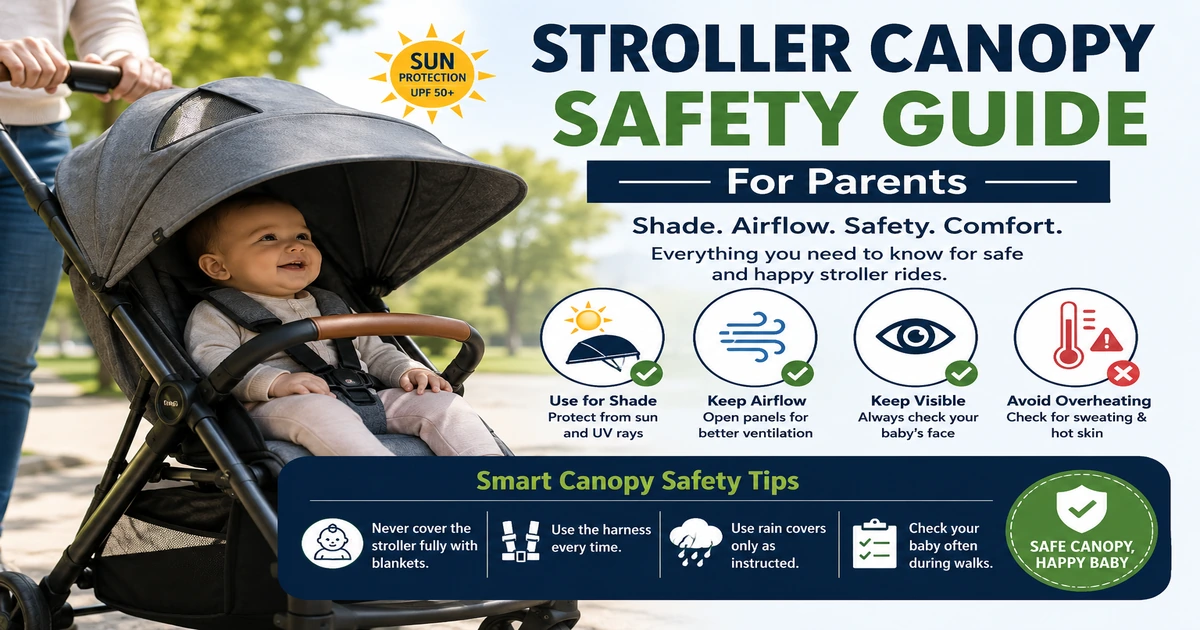
Avoid fully covering the stroller with thick blankets, because this can reduce airflow and make the inside hotter. Instead, use a proper stroller sun shade or canopy extension designed for ventilation.
For hot weather, choose shaded routes, avoid peak sun hours, and check your baby often.
17. Buying a Second-Hand Stroller Without Checking Safety
Second-hand strollers can save money, but parents should inspect them carefully before use. A used stroller may have missing parts, old recalls, worn wheels, damaged brakes, loose screws, torn fabric, or missing instructions.
Before buying a used stroller, check:
- Brand and model number
- Manufacture date
- Recall status
- Brake function
- Harness condition
- Folding lock
- Wheel condition
- Frame stability
- Seat fabric
- Missing screws or parts
- Original manual availability
A second-hand stroller is only a good deal if it is safe, complete, and suitable for your child.
Before using a second-hand stroller, it is smart to check whether that model has been recalled. You can search stroller recalls on the official CPSC recall page: CPSC stroller recalls.
18. Not Reading the Manual
Many parents skip the stroller manual because the stroller looks easy to use. But the manual includes important safety details, such as:
- Age suitability
- Weight limits
- Folding instructions
- Cleaning guidance
- Car seat compatibility
- Bassinet attachment rules
- Brake use
- Recline positions
- Maintenance instructions
Reading the manual can prevent many mistakes. It also helps parents understand what the stroller can and cannot do.
A stroller is a baby safety product, not just a convenience item. Treat the manual as part of the product.
19. Choosing the Cheapest Stroller Without Checking Long-Term Value
Budget matters, but the cheapest stroller is not always the best value. A very cheap stroller may be fine for occasional use, but it may not offer the comfort, durability, storage, recline, or wheel quality needed for daily use.
Instead of looking only at price, compare value:
- How long can the baby use it?
- Does it support newborn use?
- Is it comfortable for toddlers?
- Are the wheels durable?
- Is the basket useful?
- Does it fold easily?
- Is the seat washable?
- Does it fit your lifestyle?
Sometimes spending a little more on the right stroller can save money because you avoid replacing it later.
20. Not Matching the Stroller to Your Lifestyle
There is no single best stroller for every family. A stroller that is perfect for one parent may be wrong for another.
For city parents, compact size and easy steering may matter most. For suburban parents, a travel system may be more useful. For active parents, a jogging stroller may be better. For frequent travelers, a lightweight travel stroller may be the best choice.
Think about your lifestyle before buying:
- Daily walks or occasional use?
- City sidewalks or rough paths?
- Small car or large SUV?
- One child or future second child?
- Travel often or mostly stay local?
- Need bassinet or car seat compatibility?
- Need compact fold or large storage?
The right stroller should match your real life, not just the product photos.
Stroller Mistake Checklist for First-Time Parents
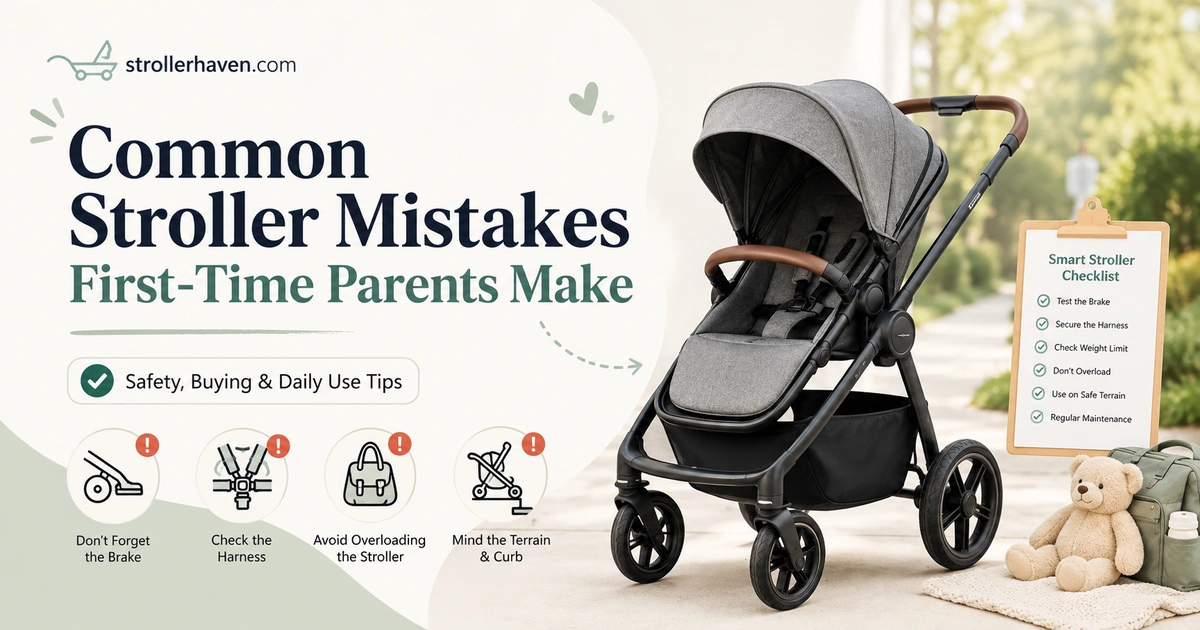
Before buying or using a stroller, check this quick list:
- Is it suitable for your baby’s age?
- Does it have a secure 5-point harness?
- Are the brakes easy to use?
- Does the stroller have a stable frame?
- Can it recline properly?
- Does it fit your car trunk?
- Is it easy to fold and lift?
- Is the storage basket strong enough?
- Are the wheels suitable for your walking surface?
- Does it match your lifestyle?
- Have you read the manual?
- Have you checked weight limits?
- Are accessories safe and properly attached?
- Is the baby always supervised?
If you can answer yes to most of these questions, you are much closer to choosing a safe and practical stroller.
Common Stroller Mistakes: Comparison Table
| Common Mistake | Why It Matters | Better Choice |
|---|---|---|
| Buying only for looks | May not fit real daily needs | Check safety, comfort, fold, and lifestyle |
| Ignoring newborn support | Newborns need proper positioning | Choose bassinet, full recline, or travel system |
| Not using harness | Baby may slide or lean out | Use 5-point harness every ride |
| Forgetting brakes | Stroller can roll unexpectedly | Lock brakes whenever stopped |
| Hanging bags on handlebar | Can cause tipping | Use under-seat basket |
| Ignoring weight limits | Can affect stability and durability | Follow manual limits |
| Buying too heavy | Hard to lift and transport | Match stroller weight to daily routine |
| Wrong stroller for jogging | Regular strollers are not for running | Use a true jogging stroller |
| Unsafe accessories | Can affect airflow or balance | Use compatible and secure accessories |
| Skipping the manual | Misses important safety instructions | Read the manual before first use |
FAQ: Common Stroller Mistakes
What is the most common stroller mistake new parents make?
The most common mistake is buying a stroller without checking whether it fits the baby’s age, daily routine, car trunk space, and safety needs. A stroller should match your lifestyle and your child’s stage of development.
Is it safe to hang a diaper bag on a stroller handle?
It is better not to hang heavy bags on the stroller handlebar because it can make the stroller unstable. Use the storage basket instead and follow the basket weight limit.
Should I use the stroller harness every time?
Yes. The stroller harness should be used every time your baby rides in the stroller, even for short walks. A properly adjusted 5-point harness helps keep the child secure.
Can a newborn use any stroller?
No. Not every stroller is suitable for newborns. Newborns usually need a bassinet, full recline seat approved for newborn use, or compatible infant car seat system. Always check the manufacturer’s age guidance.
Are lightweight strollers good for everyday use?
Lightweight strollers can be great for travel, errands, and small cars. However, parents should check recline, storage, wheel quality, weight limit, and comfort before using one as the main everyday stroller.
Is a jogging stroller necessary?
A jogging stroller is useful for parents who want to run or walk on rougher paths. Regular strollers are not designed for jogging. If you plan to run, choose a stroller specifically made for jogging and follow the manufacturer’s age guidelines.
Is a second-hand stroller safe?
A second-hand stroller can be safe if it has not been recalled, has all parts, includes instructions, and passes a careful inspection. Check the brakes, harness, wheels, frame, folding lock, and model information before use.
Final Thoughts
First-time parents do not need the most expensive stroller. They need the right stroller. Most stroller mistakes happen when parents buy too quickly, ignore safety details, or choose a model that does not match their daily life.
Before buying, focus on your baby’s age, stroller safety features, comfort, fold size, weight limit, storage, and real-world use. Before every walk, use the harness, lock the brakes when stopped, avoid handlebar overload, and keep your baby supervised.
A good stroller should make your life easier while keeping your baby comfortable and secure. When you choose carefully and use it correctly, your stroller becomes one of the most helpful baby products you own.