Why Newborn Stroller Safety Matters
Newborns are different from toddlers or older babies. Their neck muscles are still weak, their body needs proper support, and they can easily slide into an uncomfortable or unsafe position if the stroller seat is not suitable.
A safe newborn stroller setup usually includes one of these options:
- A bassinet stroller approved for newborn use
- A stroller seat with a near-flat or full recline position
- A travel system that securely accepts an infant car seat
- A stroller that clearly says it is suitable from birth
Before using any stroller, always check the product manual for age, weight, recline, attachment, and harness instructions. The U.S. Consumer Product Safety Commission has stroller safety standards covering important areas such as brakes, stability, restraint systems, folding mechanisms, wheels, and car seat attachment safety. You can read more from the official CPSC stroller guidance here: CPSC Carriages and Strollers Guidance.
For more basic newborn stroller guidance, you may also find our stroller and infant car seat safety guide for new parents helpful.
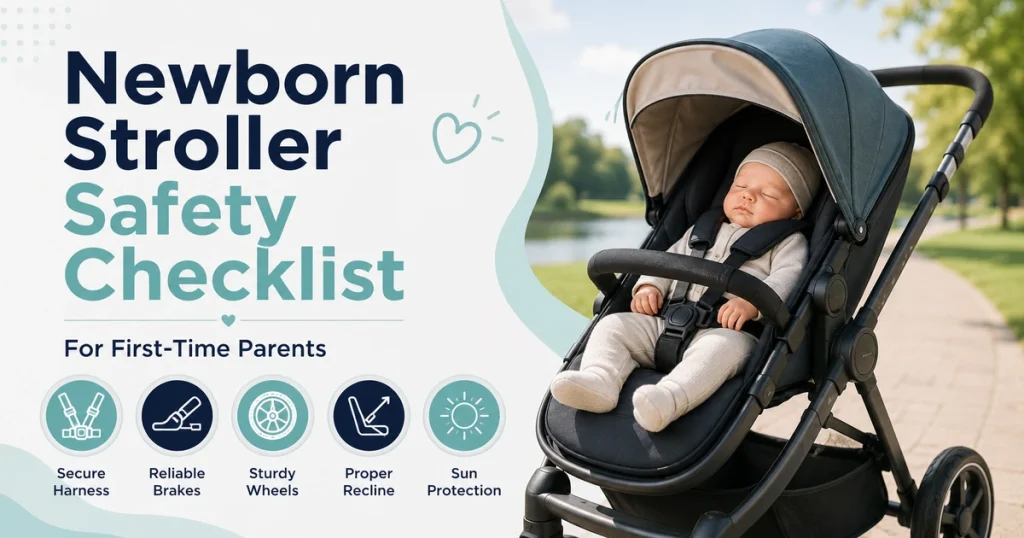
Newborn Stroller Safety Checklist Before Every Walk
Before you take your newborn outside, take one or two minutes to inspect the stroller. This quick habit can help prevent many common stroller problems, especially for first-time parents.
The goal is simple: make sure the stroller is stable, locked, clean, comfortable, and suitable for your baby’s age and weight.
1. Use a Newborn-Approved Stroller
Not every stroller is safe for a newborn. Some stroller seats are made for babies who can already sit with support. If the stroller seat is too upright, a newborn may not get enough head and neck support.
Before using a stroller for a newborn, check:
- The minimum age recommendation
- The minimum and maximum weight limit
- Whether the stroller is suitable from birth
- Whether the seat reclines enough for a newborn
- Whether a bassinet or infant car seat attachment is required
- Whether the attachment clicks securely into the stroller frame
If the stroller manual says the seat is not for newborns, do not use it until your baby reaches the recommended age and developmental stage.
If you are comparing newborn-friendly stroller options, check bassinet strollers and travel systems here: View newborn bassinet strollers on Amazon.
2. Check the Recline Position
A newborn stroller should support your baby’s head, neck, and body properly. A seat that keeps your newborn too upright may cause the baby’s head to fall forward, which can be uncomfortable and potentially unsafe.
Before every walk, make sure:
- The seat recline is suitable for newborn use
- The recline setting is locked
- The baby’s head is not falling forward
- The baby’s chin is not pushed down toward the chest
- The baby’s body is not slouching or sliding down
- The baby’s face stays visible at all times
If you are confused between a bassinet stroller and a car seat stroller, read our comparison guide: Bassinet Stroller vs Car Seat Stroller: Which Is Better?
3. Make Sure the Frame Is Fully Locked
Many strollers fold and unfold quickly, but that also means parents must check the frame lock carefully. Never place your newborn in a stroller if the frame is not fully open and locked.
Check these points before placing baby inside:
- The stroller frame is fully opened
- The folding lock is engaged
- The seat, bassinet, or car seat attachment is securely attached
- The handlebar feels stable
- The stroller does not wobble unusually
- There are no loose parts or broken clips
HealthyChildren, from the American Academy of Pediatrics, also recommends making sure the stroller is securely locked open before placing a child in it. You can read their official stroller safety tips here: How to Choose a Safe Baby Stroller.
4. Use the 5-Point Harness Correctly
A 5-point harness helps keep your baby secure with straps over the shoulders, around the hips, and between the legs. For newborns, the harness should be snug enough to prevent sliding but not so tight that it causes discomfort.
Before moving the stroller, check:
- The harness buckle clicks properly
- The straps are not twisted
- The shoulder straps are at the right height
- The baby cannot slide down in the seat
- The harness is not rubbing against the baby’s neck
- No thick blanket or bulky clothing is under the straps
For a deeper guide, read our 5-point harness stroller safety guide. This is one of the most important safety topics for both newborns and toddlers.
5. Test the Stroller Brakes
Stroller brakes are not only for hills. You should use the brakes every time the stroller is stopped, even on flat ground.
Always set the brakes when:
- You are putting your newborn into the stroller
- You are taking your baby out
- You stop beside a road or driveway
- You are adjusting the canopy or storage basket
- You stop to talk, shop, or check your phone
- You are on a slope, ramp, or uneven surface
After setting the brake, gently push the stroller to make sure it does not roll. If the stroller moves, do not use it until the brake problem is fixed.
For more details, visit our stroller brake safety guide for parents.
6. Check the Wheels Before Walking
Wheels affect stroller control, balance, and comfort. A damaged or loose wheel can make the stroller harder to push, especially when carrying a newborn.
Before each walk, check:
- All wheels are attached securely
- No wheel feels loose or shaky
- The front wheel turns smoothly
- The wheel lock works if your stroller has one
- No stones, hair, thread, or dirt are stuck in the wheels
- The tires are not cracked, flat, or damaged
For newborns, try to choose smooth walking paths. Avoid broken sidewalks, steep slopes, rough trails, and high curbs when possible.
You can also read our full stroller wheel safety guide for parents for more wheel care tips.
7. Use the Storage Basket Safely
It is tempting to hang a diaper bag or shopping bag from the stroller handlebar, but this can make some strollers tip backward. This is especially risky with lightweight strollers.
Instead, use the storage basket under the stroller and follow the weight limit in the manual.
Avoid these storage mistakes:
- Do not hang heavy bags from the handlebar
- Do not overload the storage basket
- Do not place hot drinks where they can spill on baby
- Do not let bags touch the wheels
- Do not allow older children to climb or hang on the stroller
For more help, read our stroller storage basket safety guide for parents and stroller handlebar safety guide for parents.
Need safer stroller storage accessories? Compare stroller organizers and under-seat storage options here: View stroller storage accessories on Amazon.
8. Protect Baby from Sun, Heat, and Wind
Newborn skin is sensitive, and babies can become uncomfortable quickly in direct sun, strong wind, or hot weather. A stroller canopy can help, but airflow is also important.
For safer outdoor walks:
- Use the stroller’s built-in canopy
- Avoid direct midday sun when possible
- Keep your baby’s face visible
- Do not fully cover the stroller with a thick blanket
- Use breathable covers only when appropriate
- Check your baby often for sweating, redness, or discomfort
A full cover may look protective, but it can reduce airflow and trap heat. For more shade guidance, read our how to protect baby from sun in a stroller guide and our stroller canopy safety guide for parents.
9. Be Careful with Infant Car Seat Travel Systems
A travel system can be convenient because the infant car seat attaches to the stroller frame. This is helpful for short errands, doctor visits, and car-to-stroller transfers.
However, parents should still be careful. Make sure the infant car seat is compatible with the stroller and clicks securely into place. Never force a car seat onto a stroller frame if it is not approved by the manufacturer.
Check these travel system safety points:
- The car seat is compatible with the stroller
- The adapter is correct for that model
- The car seat clicks firmly into the frame
- The seat does not wobble or detach
- The baby is properly buckled in the car seat harness
- The car seat is not used as a regular sleep space
NHTSA explains that babies must ride semi-reclined in infant car seats to help keep the airway open when installed in a vehicle. You can read their official infant car seat installation guidance here: NHTSA Rear-Facing Infant Car Seat Guide.
If you are comparing stroller and infant car seat combinations, visit our stroller and infant car seat safety guide.
If you want a stroller and infant car seat combination, compare travel system stroller options here: View infant car seat and stroller travel systems on Amazon.
10. Do Not Use a Stroller as a Regular Sleep Space
Newborns may fall asleep during a walk. That can happen naturally. But a stroller should not be used as your baby’s regular sleep space.
The American Academy of Pediatrics advises that if a baby falls asleep in a stroller, car seat, swing, infant carrier, or similar device, the baby should be moved to a firm, flat sleep surface as soon as possible. You can read the AAP safe sleep guidance here: AAP Safe Sleep and Your Baby.
For regular sleep, follow safe sleep guidance and use an approved crib, bassinet, portable crib, or play yard. Do not add loose blankets, pillows, or soft items around a newborn in the stroller.
Quick Newborn Stroller Safety Checklist
Here is a quick checklist you can use before every walk:
| Safety Check | What to Confirm |
|---|---|
| Newborn approval | The stroller is suitable from birth or has a newborn-safe attachment. |
| Recline position | The seat is flat or reclined enough for newborn support. |
| Frame lock | The stroller is fully open and locked before placing baby inside. |
| Harness | The 5-point harness is snug, secure, and not twisted. |
| Brakes | The brakes work and are used every time the stroller stops. |
| Wheels | The wheels are clean, secure, and moving smoothly. |
| Storage | No heavy bags are hanging from the handlebar. |
| Canopy | The baby is shaded but airflow is not blocked. |
| Supervision | The baby is never left unattended in the stroller. |
What to Look for When Buying a Newborn Stroller
If you are buying a stroller for a newborn, focus on safety and daily usability first. Style is nice, but support, stability, recline, and brake quality matter more.
Important newborn stroller features include:
- Suitable-from-birth design
- Bassinet option or near-flat recline
- Secure 5-point harness
- Strong frame and wide base
- Easy-to-use brakes
- Large canopy with airflow
- Smooth wheels for daily walks
- Safe storage basket placement
- Clear age and weight guidance
- Compatible infant car seat option if needed
If your car trunk is small, you may also want to read our guide on how to choose a stroller for small car trunks. If you are choosing based on baby age, our guide on how to choose a stroller for a newborn can help you compare the main options.
To compare newborn-ready strollers by price, features, and parent reviews, visit: View strollers suitable from birth on Amazon.
Common Newborn Stroller Mistakes
Most stroller mistakes happen because parents are tired, busy, or rushing. Here are some common mistakes to avoid:
- Using an upright stroller seat too early
- Not reading the stroller manual
- Forgetting to lock the brakes
- Leaving the harness too loose
- Hanging a heavy diaper bag from the handlebar
- Covering the stroller completely with a thick blanket
- Using a car seat stroller setup for too long
- Letting the baby sleep in the stroller for regular sleep
- Ignoring stroller weight limits
- Walking on rough or unsafe surfaces with a newborn
For more beginner mistakes, read our full guide on common stroller mistakes first-time parents make.
FAQs
Can a newborn ride in a stroller?
Yes, a newborn can ride in a stroller if the stroller is suitable for newborn use. A newborn usually needs a bassinet, a near-flat recline seat, or a properly attached infant car seat travel system.
Is a regular stroller safe for a newborn?
Not always. Many regular stroller seats are made for older babies who can sit with better head and neck control. Always check the manual before using a stroller for a newborn.
Is a bassinet stroller better for newborns?
A bassinet stroller can be a good option for newborns because it usually allows a flatter position. However, the best choice depends on the stroller design, safety approval, and your daily needs.
Can my newborn sleep in a stroller?
Your baby may fall asleep during a walk, but a stroller should not be used as a regular sleep space. If your baby falls asleep in a stroller, follow safe sleep guidance and move the baby to a firm, flat sleep surface as soon as possible.
Should I use stroller brakes every time I stop?
Yes. Use the stroller brakes every time the stroller is stopped, even if you are on flat ground or stopping for only a short moment.
Can I hang a diaper bag on the stroller handlebar?
It is safer to use the storage basket under the stroller. Hanging heavy bags from the handlebar can make some strollers unstable and increase the risk of tipping.
Final Thoughts
A newborn stroller should make daily life easier, but it must be used correctly. Before every walk, check the stroller’s newborn approval, recline position, frame lock, harness, brakes, wheels, storage, canopy, and car seat attachment if you are using a travel system.
For first-time parents, the safest habit is consistency. Read the stroller manual, follow age and weight limits, keep your baby visible, and never leave your newborn unattended in a stroller.
To continue learning, you can read our related safety guides on stroller brake safety, stroller wheel safety, and 5-point harness stroller safety.