

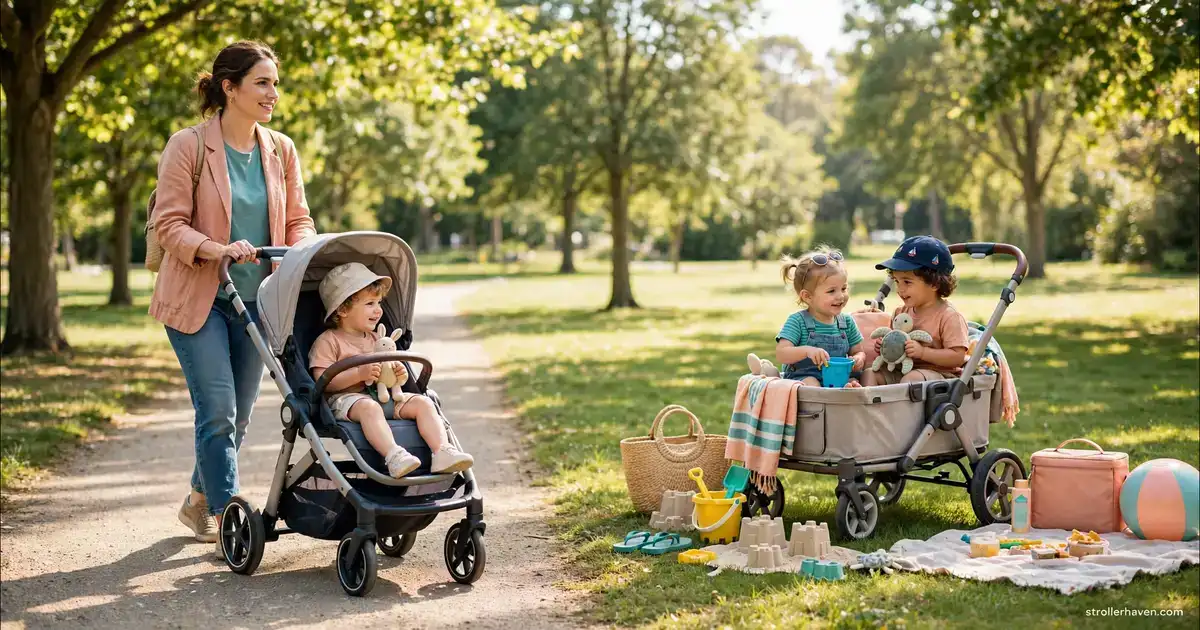
Stroller vs Wagon for Toddlers 2026 comes down to one question: what does your week actually look like? The short answer is that a stroller wins for most toddlers most days — one child, errands, naps, tight shops, buses and small trunks — while a wagon wins on the big outdoor days: the zoo, the beach, the park and the sports field, especially once you have two kids who can sit up. There is no single winner for every family, and plenty of families end up owning both: a light stroller for weekdays and a wagon for Saturdays.
This guide is research-based. It compares the two side by side on comfort, maneuverability, storage, fold and trunk fit, safety, cost, age limits and where each one is allowed — using the three leading 2026 comparison guides, the makers’ own spec pages, CPSC and AAP safety guidance, and Walt Disney World’s published park rules. No product here is described as physically tested by StrollerHaven.
The Short Answer
A stroller is usually the better pick for daily life with a toddler, especially if your child is still young, naps on the go, or needs firmer containment. CPSC stroller safety guidance emphasises brakes, stability and occupant retention, and that matters most when your child is constantly trying to wriggle free. A wagon can be helpful when you need more room for a second child, snacks, a diaper bag or beach gear — but for a toddler who hates sitting still, it often works best once they are older and better able to stay seated.
The practical test is simple: if you can picture your child calmly staying seated for a 20-minute walk, a wagon may work. If not, stick with the stroller. And if Disney is on your calendar, the decision is already made for you — wagons and stroller wagons are prohibited at Walt Disney World theme parks and water parks, while strollers are allowed within the 31-by-52-inch size limit. Our best stroller for Disney World 2026 guide covers the strollers that fit the rules.
Stroller vs Wagon for Toddlers 2026 at a Glance
| Category | Stroller | Stroller wagon |
|---|---|---|
| Youngest rider | From birth with a lie-flat seat, bassinet or infant car seat (check your model) | 6 months and up; younger only with a car seat adapter where offered |
| Riders | Usually 1 (doubles hold 2) | 2 to 4 seats, depending on model |
| How you move it | Push | Push or pull on many models |
| Typical weight | 15–25 lb (single); doubles 25–40 lb folded | 30–40 lb typical; 2-seaters 35–55 lb with seats; 4-seaters up to 60 lb+ |
| Reclining seat | Common — most toddler strollers recline for naps | Most don’t recline, per Radio Flyer |
| Child weight capacity | Usually 50 lb per seat | 150–300 lb total, depending on model (45–50 lb per seat) |
| Federal stroller standard | 16 CFR 1227 (ASTM F833) | Look for ASTM F833 on the label or manual |
| Theme parks | Usually allowed within size limits | Banned at Walt Disney World parks |
| Fold and trunk | Compact; fits most trunks | Bulky; takes a large share of trunk and garage space |
| Typical price | $100–$400 (singles; premium doubles more) | $400–$800 |
| Best for | Babies, errands, transit, crowds, naps | Siblings, outings with gear, kids who refuse the stroller |
Weight and price ranges are maker/retailer ranges: Kinderkraft lists typical strollers at 15–25 lb and $100–$400 against stroller wagons at 30–40 lb and $400–$800, and GoodBuyGear puts double strollers at 25–40 lb folded and stroller wagons at 30–60 lb folded. Individual models vary a lot — always check your exact model’s label.
What’s the Difference Between a Double Stroller and a Wagon?
A stroller is a push-only, seated ride for one child (or two in a double) with individual harness seats, a tight turning radius and a fold designed for everyday errands, walks and naps on the go. A stroller wagon is a hybrid between a wagon and a stroller that holds two to six kids in an open bench-style cabin, can usually be pushed or pulled, and is built with bigger wheels that handle sand, grass, gravel and all-day outings.
What is a double stroller?
A double stroller is a stroller designed to carry two children at once, and it typically comes in two main configurations: side-by-side doubles, where kids sit next to each other with the same view, and tandem doubles, where one child sits behind the other, making the stroller narrower and easier to fit through doorways, store aisles and crowded sidewalks. Many double strollers also work with car seats for infant and toddler setups, and some convert from a single stroller into a double as families grow. A general guideline from GoodBuyGear: if you’re mostly in open spaces, go side-by-side; if you’re constantly in and out of buildings or tight areas, go with a tandem. If a double is what you actually need, start with our best double stroller for newborn and toddler 2026 guide rather than jumping straight to a wagon.
What is a stroller wagon?
A stroller wagon is a hybrid between a traditional pull wagon and a stroller, designed with bench-style open seating, 5-point harnesses, push and pull handles and features like canopies and extra storage. Most are built to meet stroller safety standards (including ASTM F833 compliance) for child transport, unlike a classic Radio Flyer-style pull wagon, which is not designed with the same safety requirements. They are typically intended for children who can sit unassisted rather than infants who need bassinet or car seat compatibility, and are most often used for hauling two or more kids over varied terrain like parks, beaches and events where flexibility and higher capacity matter more than compact folding or tight indoor maneuvering. For the wagon side in depth, see our best stroller wagon for 2 kids 2026 and best stroller wagon 6 top picks for family adventures guides.
How a Stroller Works for Toddlers
The Consumer Product Safety Commission defines a stroller as a wheeled vehicle that carries one or more infants or children in a sitting-up or semi-reclined position. It notes strollers are typically used from infancy to 36 months, and every one sold in the US has to meet the federal standard at 16 CFR part 1227, which pulls in ASTM F833.
In practice, that’s the stroller’s big strength. It handles a newborn (with the right seat or attachment), it reclines for naps, it turns tightly in a grocery aisle, and it folds into a car trunk without a wrestling match. Our best toddler stroller 6 top picks for growing kids guide covers the models that do this best.
The weak spot is older toddlers. Radio Flyer notes that many families find older kids hit an “I don’t do strollers anymore” stage quickly, and a single stroller can’t carry the bag, the snacks and a sibling all at once.
How a Stroller Wagon Works
A stroller wagon puts kids side by side or face to face in a tub with seats, harnesses and a canopy. Radio Flyer pitches it as the steering of a stroller with the freedom of a wagon, and says its stroller wagons are ready from 6 months and up, or from day one with its car seat adapter accessory.
The scale is the thing to grasp before you buy. WonderFold’s X2R manual — cited by ToddlerNotes — lists that 2-seat wagon at 35 lb with seats, certified to ASTM F833-21, holding 2 children up to a combined 150 lb, and intended for children 6 months and older. WonderFold’s own product pages put its bigger W2 Luxe Pro at 49.2 lb with seats, with a 200 lb total capacity and 50 lb per seat, also for ages 6 months and up. Radio Flyer adds that most stroller wagons don’t recline, which matters if your toddler still naps on the go.
So the trade is simple. More room and more riders, in exchange for weight, width and a seat that usually sits upright. A wagon is not a bigger stroller; it is a different vehicle with different strengths, and judging it by stroller standards — or a stroller by wagon standards — is how families end up disappointed.
What Matters Most When Your Toddler Won’t Stay Put
If your toddler refuses to sit still, the safest, least frustrating setup usually comes down to restraint, control, and where you plan to use it.
Harness and containment
If your child is a climber, the restraint system matters more than the cute extras. Strollers are built around seated use, and standard safety guidance focuses on proper harnessing, brakes, and secure seating. Wagons can work, but they usually feel more open. That can be fine for a calm child, yet less ideal for a toddler who wants to lean out, wiggle, or unbuckle. Both types should have a 5-point harness — if a wagon has no harness at all, treat it as a ride for a steady sitter on a slow walk, not as a stroller replacement. Our wagon safety guide, are stroller wagons safe for toddlers, covers harness and age checks in detail.
Control in tight spaces
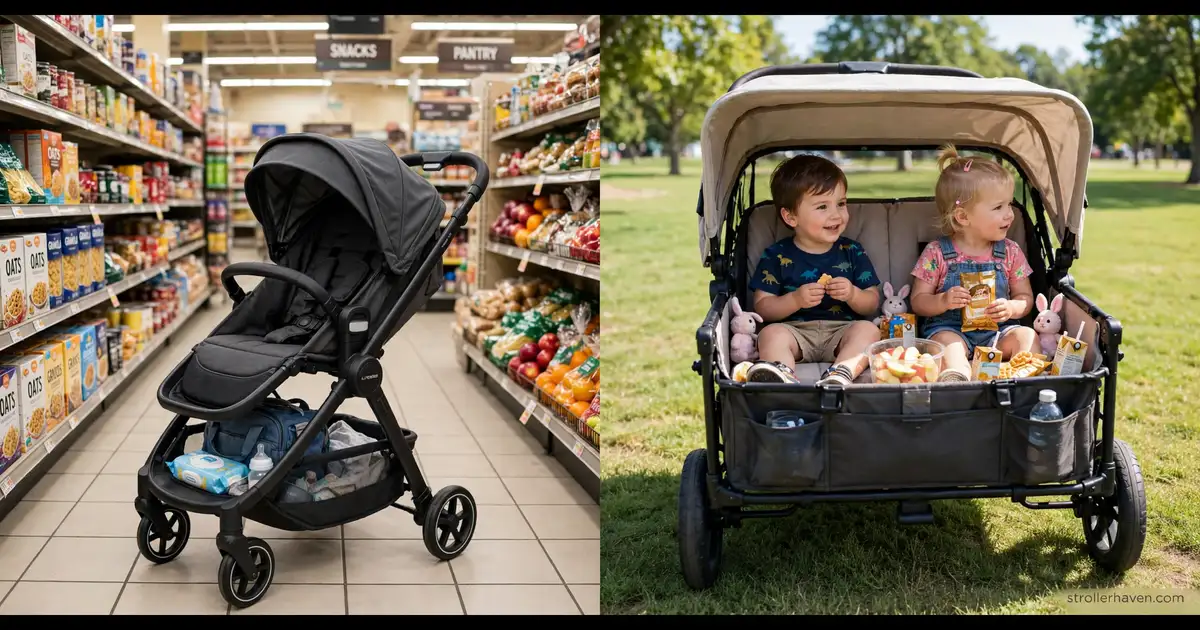
For grocery aisles, crowded sidewalks, doctor visits, and quick errands, a stroller is usually easier to steer and park. Parents often find wagons feel bulkier in stores and tighter spaces, even when they’re great outdoors. That difference shows up fast when you’re juggling a diaper bag, a cell phone, and a child who wants down the second you stop moving. A wagon’s push-or-pull handle helps outdoors, but in a shop it is still a wide, long vehicle that other shoppers have to walk around — and many venues simply won’t let one in.
Comfort and naps
If your toddler still naps on outings, a stroller usually wins. Many wagons don’t recline much, so they are less friendly for sleepy kids. A stroller also tends to feel more familiar for a child who wants a more enclosed, supported ride. This is the single most underestimated difference in the whole comparison: a stroller is a nap machine, and a wagon is a viewing platform. If your toddler still sleeps on the go most days, that alone settles it — see how long can baby stay in a stroller for the safe-sleep limits that apply to naps in any ride. If naps have already stopped, the wagon’s case gets much stronger.
When a Stroller Is Still the Safer Everyday Pick
Younger toddlers need more structure
Strollers are generally used from infancy to about 36 months, while wagons are more often a better fit once a child is closer to toddler-preschool age. That age difference matters when your child still needs close support and firm harnessing. A 12- to 18-month-old who cannot yet sit steadily for long stretches, stay seated when something interesting passes, or follow a simple “stay sitting” rule is a stroller child, not a wagon child — even if the wagon’s age label says 6 months and up. The label is a minimum, not a recommendation for your child today.
Better for newborn-plus-toddler life
If you have a baby and a toddler, a stroller is usually the more practical starting point. Families often use strollers for a newborn plus a toddler, then think about a wagon later when the younger child can sit more securely. A stroller (or double stroller) takes a bassinet or an infant car seat; most wagons do not, unless you buy the maker’s car seat adapter — Radio Flyer’s adapters are sold separately and fit only specific Graco seats on specific Voya models, so check compatibility before you count on it. A travel system is the cleanest version of this setup: the Graco Modes Pramette Travel System clicks its SnugRide LX infant car seat (4–30 lb, up to 32″) onto the frame, converts to a pramette for a newborn lying flat, then to a reversible toddler seat — stroller weight 20.9 lb, stroller child limit 50 lb. That is the everyday single-stroller example in this comparison: light, newborn-ready, and a fraction of a wagon’s weight.
Easier to store and transport
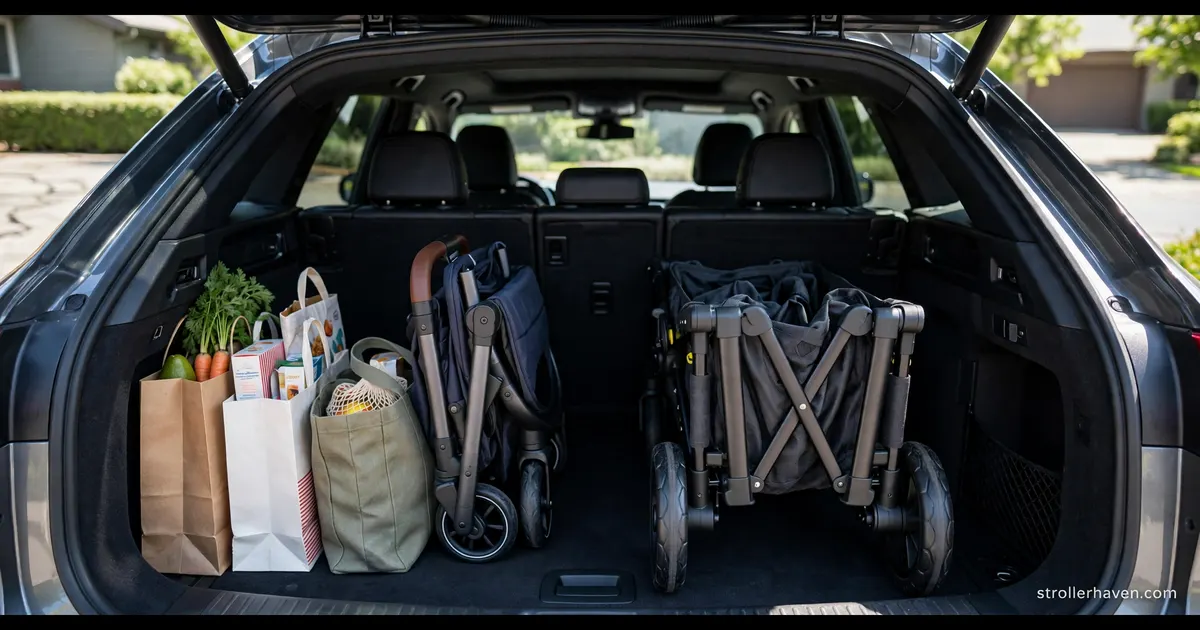
A stroller is generally easier to lift into a trunk, maneuver through an apartment elevator, and store at home. Wagons can be heavy and bulky, and some models are much harder to fit into smaller cars. The numbers make it concrete: a typical single stroller weighs 15–25 lb, while a 2-seat WonderFold W2 Luxe Pro weighs 49.2 lb with seats — roughly double. Measure your trunk before you buy either one, and fold it yourself in the shop if you can — that lift is the test you will repeat four times a day.
When a Wagon Makes Life Easier
Bigger kids and bigger loads
A wagon is often useful once your toddler is sturdier and you need room for more than one child. Families with multiple little ones often like the extra space for snacks, towels, toys, and diaper gear. The capacity figures tell the story: a WonderFold W2 Luxe Pro carries 200 lb total (50 lb per seat), a Radio Flyer Pathfinder+ carries 250 lb, and a Voya 2.0 XT carries 300 lb — against a single stroller’s 50 lb child limit and one small under-seat basket. Just remember the catch GoodBuyGear’s parents keep reporting: once both kids are inside, there’s very little (or no) room left for the diaper bag, so the wagon’s cargo advantage shrinks exactly when the wagon is full.
Outdoor outings on flat ground
Wagons usually shine on sidewalks, paved paths, and other smoother terrain — and, with their big wheels, on grass, gravel and sand too, where small stroller wheels sink. For a family day at the zoo or a long neighborhood walk, they can feel easier than constantly lifting a heavy stroller basket in and out of the car.
Older toddlers who fight the stroller
If your child is around 2 or older and absolutely hates the stroller, a wagon can feel like a useful compromise. It gives them more room to sit, shift, and look around without feeling as boxed in. That said, the tradeoff is less containment, so it tends to work best with a child who already has better impulse control. A wagon will not fix a child who climbs out of everything — it gives a climber more room to climb. But for the toddler who is simply bored of facing forward in a seat and wants to sit facing a sibling, share snacks and climb in and out on their own at the park, the wagon’s open tub is genuinely the better experience.
Double Stroller vs. Wagon by Use Case
The right choice usually comes down to how you actually spend your days, so here’s how each one performs in the real-life situations parents keep running into.
| Scenario | Winner | Why |
|---|---|---|
| Daily errands & neighborhood walks | Stroller | Tight turns, doorways, quick trunk loading |
| Zoo & big outdoor days | Wagon | Capacity, big wheels, kids climb in and out |
| Beach, sand & grass | Wagon | Wide wheels roll where stroller wheels sink |
| Theme parks & Disney | Stroller | Wagons banned at Disney; strollers allowed within 31 × 52 in |
| Travel & flights | Stroller | Smaller fold; wagons are heavy and bulky to check |
| Jogging & trails | Stroller (jogging model) | Wagons are not rated for running |
| Infant + toddler combo | Stroller / double stroller | Bassinet and car seat support; wagons need 6 months+ |
| 2 toddlers, one outing | Wagon | Two harnessed seats plus gear in one vehicle |
| 3 or 4 kids | Wagon (quad) | Only a quad wagon carries 3–4 in one ride |
| Toddler who hates the stroller | Wagon (age 2+) | Open seating feels less boxed-in |
Daily errands and neighborhood walks
Double strollers win for tight aisles, doorways and quick trunk loading when you’re in and out all day. Tandem doubles are especially helpful, because they fit through standard doorways better than side-by-side models. Wagons tend to be harder to maneuver in shops and are not practical for stairs or public transit. Verdict: stroller.
Theme parks and Disney
Double strollers are allowed in most Disney parks, but stroller wagons are not permitted under Disney’s published stroller size and wagon policy (maximum 31 x 52 inches). Many large theme parks follow similar rules, so double strollers are the safer bet for travel planning. Verdict: stroller — the wagon is not allowed in.
Jogging, running and trails
If you run with your little ones, a jogging stroller is the only safe option designed for that kind of movement. Wagons are not rated for running and aren’t built for that type of impact or control — the WonderFold X2R manual states plainly that it isn’t suitable for running or skating. A jogging stroller example is the Baby Trend Expedition Zero Flat Jogger with LED Lights (29.9 lb — note this is the Zero Flat variant, not the standard Expedition at about 24 lb; never mix the two figures). Verdict: jogging stroller.
Beach, pumpkin patches and grass
Wagons are great for uneven terrain and hauling capacity during longer outings. They also work especially well for activities like zoos, splash pads and pumpkin patches where kids are constantly climbing in and out. Verdict: wagon.
2 under 2 and infant + toddler combos
Most stroller wagons are not safe for babies under 6 months old, because they require upright sitting in an open cabin. A double stroller with a car seat adapter or bassinet is the safest and most practical setup for this stage, especially when naps and containment matter most. Verdict: double stroller.
3 or 4 kids in 1 family
Quad wagons usually win out when you’re transporting more than two kids regularly. Some double strollers offer standing boards, which can be a great bridge for an older sibling who only rides part of the time. But if your age gap is 3 or more years, a wagon (or a single stroller plus buggy board) is often the more flexible first purchase. Verdict: wagon (quad) — or single stroller + buggy board.
Stroller Wagon Safety Rules Worth Knowing
These come straight from WonderFold’s X2R manual, and I’d treat them as good habits for any stroller wagon:
- Always use the 5-point harness. The manual warns about kids falling or sliding out.
- Never exceed the seat count or weight limit. Overloading can make the wagon unstable.
- Set the brake whenever you load or unload, and any time the wagon is parked.
- Never take children up or down stairs in the wagon.
- Don’t press down on the handlebar to pop a curb. Lift by the frame instead.
- It’s not a jogger. The manual says it isn’t suitable for running or skating.
- No drivers under 12. The manual says children under 12 must not operate it.
Don’t skip the curb rule. Leaning on the handle of a loaded wagon is exactly the move that tips one backward. And read the CPSC’s stroller safety guidance before you buy — the CPSC stroller safety blog covers the common problems (brakes, stability, harness fit) that cause most stroller injuries, and the AAP guide to buying a safe stroller is the checklist to run through for either purchase. Our full safety deep-dive is are stroller wagons safe for toddlers.
Safety and Age Fit
Check the product rules first
Strollers sold in the U.S. must meet CPSC safety requirements, including braking, stability, and restraint standards. That means the safest choice is not just about stroller versus wagon. It is also about whether the child fits the product as intended and whether you can buckle them correctly every single time. Check the age, weight and seat-count limits printed on your exact model, because they vary — a WonderFold W2 Luxe Pro allows 50 lb per seat and 200 lb total, a Radio Flyer Pathfinder+ allows 250 lb total, and a Voya 2.0 XT allows 300 lb. Never assume one wagon’s limits apply to another.
Look for readiness, not just age
A wagon usually makes more sense when your toddler can sit steadily, stay seated, and follow simple safety rules. If they are still trying to stand up constantly, a stroller is the better call. For many families, the practical test is simple: if you can picture your child calmly staying seated for a 20-minute walk, a wagon may work. If not, stick with the stroller. Age labels help — 6 months and up is the standard wagon minimum, and most families find the wagon clicks somewhere between 18 months and 3 years — but readiness is the real gate, not the birthday.
Think about where you actually go
If most outings are errands, appointments, school pickup, and indoor stops, stroller wins. If most outings are parks, beaches, and open-air family trips, a wagon becomes more appealing. The right answer is the one that fits your real week, not the one that looks nicest on paper. Count your outings for one normal week before you buy: if more than half involve pavement, shops or naps, the stroller is not optional and a wagon doesn’t replace it.
Where Each One Is Allowed
This catches people out. Walt Disney World’s park rules say wagons are prohibited at its theme parks and water parks, and that stroller wagons are prohibited too. Strollers larger than 31 inches wide and 52 inches long aren’t allowed either. The official Walt Disney World Property Rules state it plainly: “Strollers that are greater than 31″ (79 cm) in width and 52″ (132 cm) in length. Stroller wagons are also prohibited. Wagons are prohibited at any theme park or water park.” A stroller wagon can fit inside 31 × 52 inches and still be prohibited, because Disney bans stroller wagons as a category, whether pushed or pulled — the size limit and the wagon ban are two separate rules. Check the current Walt Disney World Property Rules before your trip, since Disney can change its rules at any time.
Air travel is friendlier than you’d think. Alaska Airlines, for example, carries a stroller wagon free if it’s designed to carry children and folds to under 90 linear inches and 35 pounds — a limit most full-size wagons will struggle to meet once seats are counted, so check your airline’s exact rule and weigh your folded wagon before you fly. In general, a stroller is the travel tool and a wagon is the stay-local tool.
What About a Classic Pull Wagon?
A traditional pull wagon is built for older kids and cargo. Radio Flyer says most of its wagons are designed for children ages one and up, and points parents of younger babies toward stroller wagons with harnesses. My advice, following ToddlerNotes: if a wagon has no harness, treat it as a ride for a steady sitter on a slow walk, not as a stroller replacement. Check the age and weight limits printed on your exact model, because they vary.
The three-way distinction matters here: a stroller is a harnessed, reclining, push-only ride; a stroller wagon is a harnessed, push-or-pull ride with seats that meets the stroller safety standard (look for ASTM F833); a utility/pull wagon is a gear hauler with no seats and no harness. Only the first two are child transport.
A Third Option: Buggy Boards and Standing Platforms
If your older kid mostly walks but occasionally wants a ride at the drop of a hat, a buggy board or standing platform that clips onto the back of a single stroller is the most overlooked middle-ground option. It lets a tired toddler or preschooler hop on for stretches while you keep using the stroller you already own, and it typically costs far less than upgrading to a double stroller or wagon. Some stroller brands (like Mockingbird, UPPAbaby, Bugaboo and a few other premium models) offer their own integrated ride-along accessories, while universal buggy boards are designed to fit a wide range of stroller frames.
Keep in mind: the trailing kid is between you and the stroller, so longer-armed parents have an easier time, and most buggy boards only work for kids up to around 50 pounds. For a family with a 3-year-old who walks 80% of the time and a baby who still needs the seat, single stroller plus board beats both a double stroller and a wagon on cost, weight and trunk space.
Is a Wagon Safer Than a Stroller?
Neither is automatically safer. Both are only as safe as the harness you actually buckle and the limits you actually respect. What I’d look for is the standard. A stroller sold in the US must meet 16 CFR 1227, and a stroller wagon that lists ASTM F833 on its label or manual has been built to that same stroller standard. A pull wagon without harnesses wasn’t designed around a strapped-in toddler, so I wouldn’t treat it as one.
The risks are different, not bigger or smaller in some absolute sense. A stroller’s risks are tip-overs from bags hung on the handlebar, a child unbuckled on a slope, and a brake left unset. A wagon’s risks are a child standing and falling out of an open tub, overloading past the weight limit, and tipping backward when the handle is pressed to pop a curb. Both are controlled the same way: harness every ride, respect the weight and seat limits, and set the brake every stop.
Which Should You Choose? — Stroller vs Wagon for Toddlers 2026
- Choose a stroller if you have one child, a baby under 6 months, a small car trunk, or you ride buses and trains. Also if your toddler still needs a recline for naps.
- Choose a stroller wagon if you have two or more kids over 6 months, spend weekends at parks, sports fields or the beach, or have a toddler who now refuses the stroller.
- Choose both if you do daily errands with a baby and big outings with older siblings. The pick for that household: a light stroller on weekdays and a wagon for Saturdays.
- Skip a plain pull wagon as a stroller replacement for a toddler who can’t sit steadily and doesn’t have harnesses to use.
Still deciding between stroller styles? Our best toddler stroller 6 top picks for growing kids covers the single-stroller side, and best stroller wagon for 2 kids 2026 covers the wagon side — read the one that matches the life you actually live.
Frequently Asked Questions — Stroller vs Wagon for Toddlers 2026
What is the difference between a stroller and a stroller wagon?
A stroller is built around one or two seated riders and a tight turning circle. A stroller wagon is a larger tub with 2 to 4 harnessed seats that you can usually push or pull, and most models don’t recline. A stroller is the everyday tool; a wagon is the outing tool.
Is it better to have a double stroller or a wagon?
It’s better to start with a double stroller if your kids are under 1 or you need something flexible enough for daily errands; it’s better to start with a wagon if both kids can sit up and you spend most of your time at parks, beaches and outdoor events. For an infant and a toddler specifically, a double stroller with a car seat adapter or bassinet is almost always the better first purchase.
What age can a child ride in a stroller wagon?
Radio Flyer says its stroller wagons suit kids from 6 months, or from birth with its car seat adapter. WonderFold’s X2R manual also says 6 months and older. Always follow your model’s label — and remember that 6 months is a minimum, not a sign your child is ready: most families find the wagon works best from around 18 months to 2 years.
Can a newborn ride in a stroller wagon?
Newborns generally can’t ride in a stroller wagon, because they require kids to sit upright unassisted and don’t offer true bassinet or full car seat integration. A double stroller with a car seat adapter or bassinet is the safer, more appropriate choice from birth through about 6 months — with the exception of wagons used with the maker’s own car seat adapter, such as Radio Flyer’s, where the adapter is fitted.
Is a wagon safer than a stroller?
Not by default. Look for the federal stroller standard, ASTM F833, on a stroller wagon’s label or manual, always use the harness, and never exceed the seat or weight limit. A stroller is the safer everyday choice for a climber or a child under 2; a wagon is equally safe for a calm, seated toddler when its rules are followed.
Can you take a stroller wagon to Disney World?
No. Walt Disney World’s park rules prohibit wagons and stroller wagons at its theme parks and water parks, whether pushed or pulled. Strollers are allowed if they stay within Disney’s limit of 31 inches wide and 52 inches long.
Why does Disney not allow stroller wagons?
Disney does not allow stroller wagons because they exceed the parks’ 31- by 52-inch stroller size limit and can contribute to congestion in the park. The policy applies to both Walt Disney World and Disneyland parks. Note that the ban applies to stroller wagons as a category — even a wagon that fits inside 31 × 52 inches is still prohibited.
Are stroller wagons hard to push?
They’re heavier than most strollers. WonderFold lists its 2-seat X2R at 35 lb with seats (per its manual), and its W2 Luxe Pro at 49.2 lb with seats, so curbs and stairs need more care, and the manual says to lift by the frame rather than pressing on the handlebar. On flat park paths they push well; in shops, on stairs and into small trunks they are noticeably harder work than a stroller.
How much does a double stroller weigh compared to a wagon?
A double stroller typically weighs about 25 to 40 pounds folded, while a stroller wagon typically weighs about 30 to 60 pounds folded. Premium four-seater wagons can exceed 70 pounds once you factor in added seats, canopies and accessories. In general, double strollers are easier to lift in and out of a trunk, while wagons trade that lighter feel for higher capacity and more all-terrain durability.
At what age should kids stop using a wagon?
Most kids age out of stroller wagons between ages 4 and 5, once they start approaching the typical 50- to 55-pound weight limit per seat and prefer walking or riding in shorter bursts. Many families end up passing down or selling their wagon around the time their youngest is starting kindergarten, when it becomes more of a “just in case” item than an everyday necessity.
Should you get a double stroller or a wagon for an infant and toddler?
For an infant and a toddler, a double stroller with a car seat adapter or bassinet is almost always the better first purchase. Most stroller wagons are intended for kids around 6 months and older who can sit unassisted. Families often start reconsidering a wagon as a second option once their littlest can sit up independently and their toddler is in a more consistent walking phase.
What should I know before buying a stroller or a wagon?
Before buying, plan for added weight, a wider footprint and a cargo basket (or tub) that fills up fast once you add a diaper bag, snacks and any extras. The single most useful pre-purchase check is measuring your car trunk and the narrowest doorway you regularly push through. Also check the Disney rules if a theme-park trip is on your calendar, and confirm the recline if your toddler still naps on the go.
The Bottom Line on Double Strollers and Wagons
Stroller vs Wagon for Toddlers 2026 has no single winner — it has a winner per family, per week, per outing. A stroller is the better first purchase for most families with a toddler, especially when naps, errands and daily walks are still a big part of the routine, when there is a baby under 6 months in the mix, or when Disney is on the calendar. A wagon is the better first purchase for families with two or more kids who can sit up unassisted, an age gap of three or more years, and a lifestyle filled with trips to parks, beaches and outdoor events. Many parents eventually end up using both at different stages — a light stroller for weekdays, a wagon for Saturdays — and that is not a failure of the decision, it is the decision working as intended. Buy for the week you actually live, check the weight limits and the Disney rules before you pay, and test the fold in your own trunk before you commit.

Sanat Barua is the founder of Stroller Haven. He researches stroller models, manufacturer specifications, and safety standards to help parents compare options and make confident, informed decisions.
His research draws on official manufacturer documentation and product manuals, publicly available owner feedback, and safety guidance from sources such as the U.S. Consumer Product Safety Commission (CPSC) and the American Academy of Pediatrics (AAP). Stroller Haven is a research-based website: products are not described as physically tested unless an article states that testing took place. Stroller Haven is updated regularly as new models and safety information become available.