

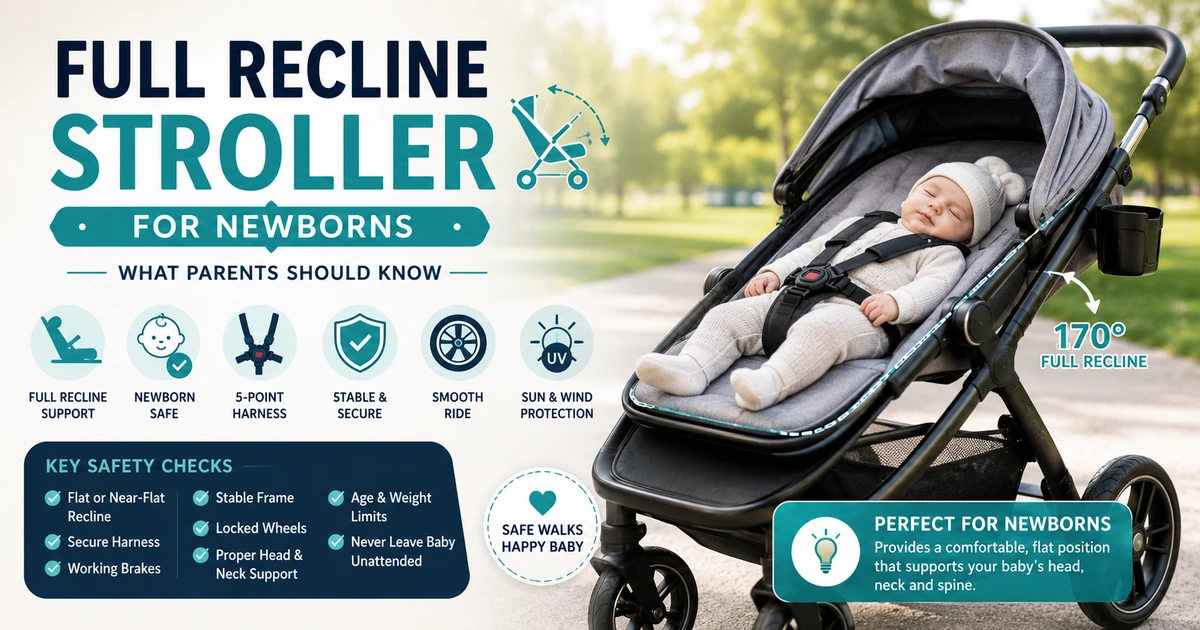
Choosing a stroller for a newborn can feel confusing, especially when brands use words like “full recline,” “near-flat recline,” “suitable from birth,“ and “newborn-ready.“ For first-time parents, the big question is simple: Is a full recline stroller for newborns actually safe? A full recline stroller can be helpful for newborns because young babies need better head, neck, and body support. However, full recline alone does not automatically mean a stroller is safe from birth. Parents still need to check the stroller manual for age and weight limits, the harness system, frame stability, brake quality, and whether a bassinet or infant car seat attachment is required. If you are still learning the basics, start with our newborn stroller safety checklist and our guide to which stroller types are safe for newborns. Then use this article to understand how full recline works and what to check before buying.
Table of Contents
- What Is a Full Recline Stroller?
- Why Newborns Need a Reclined Stroller Seat
- Is a Full Recline Stroller Safe for Newborns?
- Full Recline Stroller vs Bassinet Stroller
- Full Recline Stroller vs Infant Car Seat Travel System
- Key Features to Check Before Buying
- How to Use the Recline Position Safely
- When Not to Use a Full Recline Stroller
- Amazon Buying Tips for Parents
- Common Mistakes Parents Should Avoid
- Quick Full Recline Stroller Checklist
- FAQs
- Final Thoughts
What Is a Full Recline Stroller?
A full-recline stroller is a stroller with a seat that can recline almost flat or fully flat. This design helps young babies rest in a more supported position compared with an upright stroller seat.
Some strollers have a true flat recline, while others have a near-flat recline. This difference matters for newborns. A stroller may look flat in photos, but the seat angle may still be slightly raised. That is why parents should always check the product manual rather than relying solely on marketing claims.
A full recline stroller may be useful for:
- Newborn walks when the stroller is approved from birth
- Babies who cannot sit upright yet
- Short outdoor trips with better body support
- Parents who want one stroller for the newborn and infant stages
- Families who prefer not to use an infant car seat on the stroller for every walk
However, full recline is only one part of newborn stroller safety. You still need a secure harness, stable frame, strong brakes, safe canopy, and clear newborn approval from the stroller brand.
Why Newborns Need a Reclined Stroller Seat
Newborns cannot sit upright like older babies. Their neck muscles are still weak, and their head needs proper support. If a stroller seat is too upright, a newborn may slump down or have their head fall forward.
A safer newborn stroller position usually keeps the baby’s body supported and prevents the chin from pressing down toward the chest. This is why many newborn-friendly strollers offer a bassinet, a fully reclined seat, or a compatible infant car seat system.
Before choosing a stroller, check these basic points:
- Does the stroller clearly say it is suitable from birth?
- Does the seat recline flat or nearly flat?
- Does the stroller need a newborn insert, bassinet, or car seat?
- Can the Harness fit a small newborn securely?
- Does the manual give instructions for newborn use?
For more help with age and stage, read our guide on when a baby can sit in a stroller. It explains why newborns, infants, and toddlers need different stroller positions.
Is a Full Recline Stroller Safe for Newborns?
A full-recline stroller can be safe for newborns if it is designed and approved for newborn use. The safest answer depends on the specific stroller model, not just the recline feature.
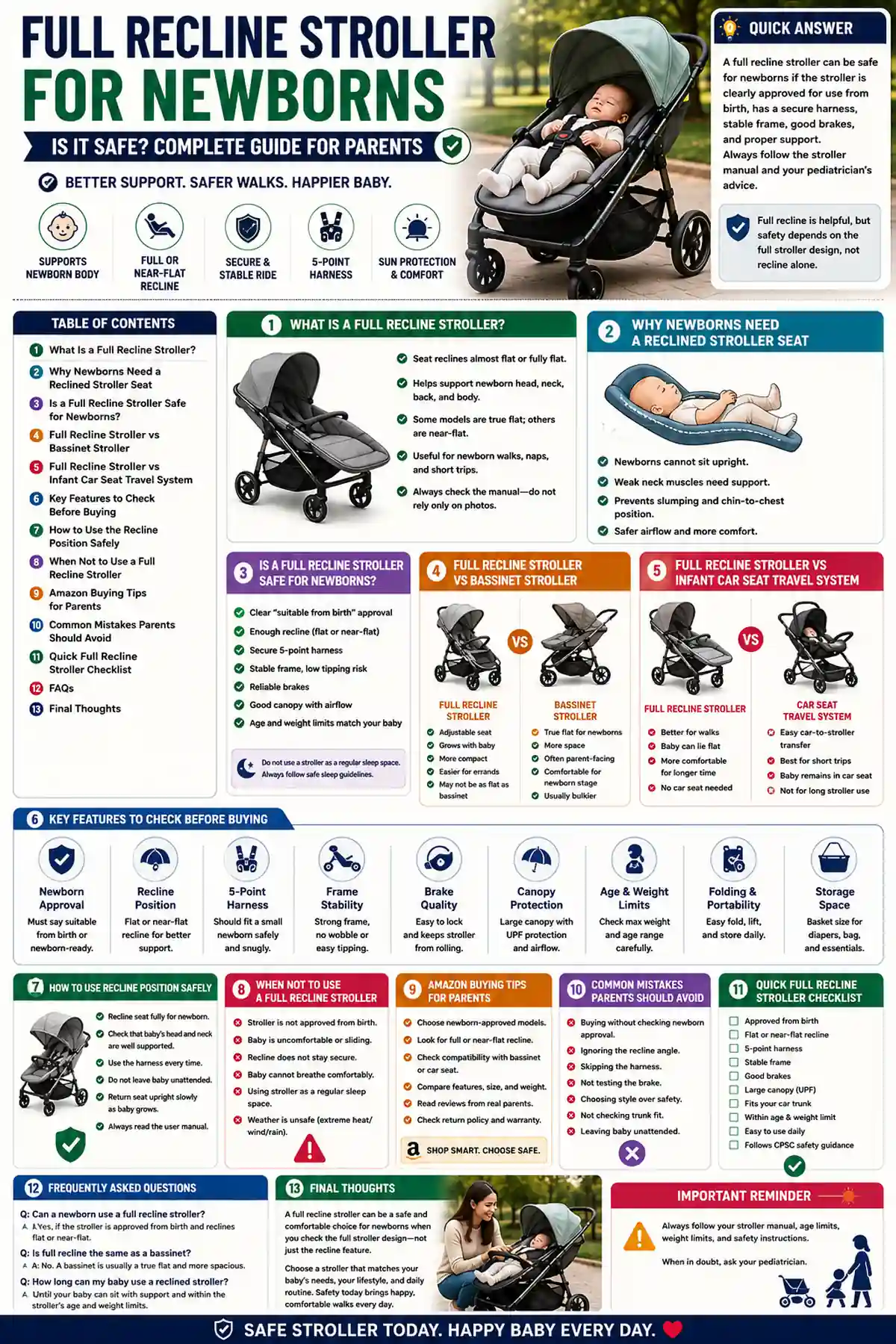
For a full recline stroller to be a good newborn option, it should have:
- Clear “suitable from birth“ or newborn approval
- A seat that reclines enough to support a young baby
- A secure 5-point harness
- A stable frame that does not tip easily
- Working brakes
- A canopy that gives shade without blocking airflow
- Age and weight limits that match your baby
The U.S. Consumer Product Safety Commission provides official stroller guidance covering safety areas such as stability, brakes, restraint systems, folding mechanisms, wheel assembly, and car seat attachment points. You can read the official CPSC stroller guidance here: CPSC Carriages and Strollers Guidance.
Also, a stroller should not be used as your newborn’s regular sleep space. Even if the seat reclines, safe sleep guidance is different from stroller use. For sleep safety, see the section below on safe sleep and stroller naps.
If you want to compare newborn-ready full-recline stroller options, check the current choices here: View full-recline strollers for newborns on Amazon.
Full Recline Stroller vs Bassinet Stroller
A full recline stroller and a bassinet stroller can both be useful for newborns, but they are not exactly the same.
A full recline stroller uses the regular stroller seat in a flat or near-flat position. It may be more flexible because parents can continue using the same seat as the baby grows.
A bassinet stroller uses a separate bassinet attachment. It usually gives a flatter, more open space for newborns during walks. Some parents prefer a bassinet for the early months because it feels more like a newborn carriage setup.
| Feature | Full Recline Stroller | Bassinet Stroller |
|---|---|---|
| Newborn support | Good if approved from birth | Often very good for early newborn walks |
| Seat style | Regular stroller seat reclines back | Separate flat bassinet attachment |
| Long-term use | Usually useful as baby grows | Bassinet may be used for a shorter stage |
| Storage | Often easier to fold and store | Bassinet may need extra storage space |
| Best for | Parents wanting one flexible stroller seat | Parents wanting a more newborn-focused setup |
If you are deciding between these two options, read our detailed comparison: Bassinet Stroller vs Car Seat Stroller: Which Is Better?. You may also like our upcoming newborn cluster guide on bassinet stroller safety.
Want to compare bassinet-style options too? See current bassinet stroller choices here: View bassinet strollers for newborns on Amazon.
Full Recline Stroller vs Infant Car Seat Travel System
An infant car seat travel system lets you attach the baby car seat to the stroller frame. This can be helpful for car trips, quick errands, and moving a sleeping baby from the car to the stroller for a short time.
A full-recline stroller, on the other hand, lets your baby rest in the seat itself if the seat is newborn-approved. This may be more comfortable for walks because the baby is not always sitting in a car seat position.
Here is the simple difference:
- Full recline stroller: Better for regular walks if approved from birth.
- Infant car seat travel system: Convenient for car-to-stroller transfers.
- Bassinet stroller: Often a strong choice for newborn-focused walks.
If you use an infant car seat with a stroller, make sure the car seat is compatible with that stroller model and clicks securely into place. Never use random adapters unless the manufacturer approves them.
For more on this topic, read our stroller and infant car seat safety guide for new parents.
Key Features to Check Before Buying
When buying a full-recline stroller for newborns, do not choose based only on design or price. Look closely at the safety and comfort features.
1. Newborn Approval
The stroller should clearly say it is suitable from birth or safe for newborn use with the correct setup. If the manual recommends the seat only for older babies, do not use it for a newborn.
2. Recline Angle
Check whether the stroller has a true flat recline or only a deep recline. A near-flat position may be fine for some models if the stroller is approved from birth, but parents should confirm this in the manual.
3. 5-Point Harness
A 5-point harness helps secure your baby at the shoulders, hips, and between the legs. HealthyChildren, from the American Academy of Pediatrics, recommends looking for a stroller with a 5-point harness. You can read their official stroller buying guide here: HealthyChildren: How to Choose a Safe Baby Stroller.
You can also read our full 5-point harness stroller safety guide for more details.
4. Strong Brakes
Good brakes are important for every stroller. Use the brakes whenever the stroller is stopped, especially when placing your newborn in or taking your baby out.
For more brake safety tips, visit our stroller brake safety guide for parents.
5. Stable Frame
A newborn stroller should feel stable and balanced. Avoid overloading the handlebars with bags because this can increase the risk of tipping.
6. Smooth Wheels
Smooth wheels make walking more comfortable and easier to control. Before each walk, check that the wheels are clean, secure, and not damaged. You can learn more in our stroller wheel safety guide for parents.
7. Canopy and Airflow
A canopy helps protect your baby from the sun and wind, but airflow matters too. Do not cover the stroller completely with a thick blanket, especially in warm weather.
For related advice, read our guide on how to protect a baby from the sun in a stroller.
How to Use the Recline Position Safely
Even if the stroller has a full recline, parents should still use it carefully. The recline setting must be locked, and the baby should remain visible and properly buckled.
Before every walk, check:
- The recline position is locked
- The baby’s head is supported
- The chin is not pressed down toward the chest
- The Harness is snug but comfortable
- The baby is not sliding down in the seat
- The baby’s face is not covered by blankets or fabric
- The stroller is not overloaded with bags
If your baby keeps sliding, slumping, or looking uncomfortable, stop using that recline setup and check the manual. You may need a bassinet, newborn insert, or a different stroller style.
When Not to Use a Full Recline Stroller
A full recline stroller is not always the right choice. In some cases, parents should avoid using it until the baby is older or until the correct accessory is added.
Do not use a full recline stroller for a newborn if:
- The stroller manual does not recommend newborn use
- The seat does not recline enough
- The baby’s head falls forward often
- The Harness does not fit securely
- The frame feels loose or unstable
- The brakes do not work properly
- The stroller has broken or missing parts
- The stroller has an active safety recall
Also, do not use a stroller as your baby’s regular sleep space. HealthyChildren/AAP safe sleep guidance says if a baby falls asleep in a stroller, car seat, swing, infant carrier, or sling, they should be moved to a firm sleep surface on their back as soon as possible. Read the official safe sleep guidance here: HealthyChildren: How to Keep Your Sleeping Baby Safe.
Amazon Buying Tips for Parents
Amazon can help compare stroller features, prices, reviews, and product photos. But parents should not choose a stroller only because it has high ratings. Always check the manual, brand details, age limits, and safety features.
When checking stroller listings, look for:
- “Suitable from birth“ wording
- Full recline or near-flat recline details
- Weight and height limits
- 5-point harness information
- Bassinet or infant car seat compatibility
- Birth parent reviews mentioning newborn use
- Clear product photos showing recline positions
- Return policy and warranty details
Compare full-recline and newborn-ready stroller options here: Shop full-recline newborn strollers on Amazon.
If you prefer a travel system, compare infant car seat and stroller combos here: View infant car seat stroller travel systems on Amazon.
Common Mistakes Parents Should Avoid
Many parents buy a stroller quickly and only later notice that it is not ideal for a newborn. Avoid these common mistakes before you spend money.
- Assuming every reclining stroller is newborn-safe
- Ignoring the minimum age recommendation
- Using the stroller without reading the manual
- Leaving the Harness loose because the baby is lying down
- Using thick blankets under the Harness
- Covering the stroller fully and blocking airflow
- Using a stroller with weak or broken brakes
- Hanging a heavy diaper bag from the handlebars
- Letting the baby sleep in the stroller as a regular nap space
- Buying only by price without checking safety features
If you want to avoid more beginner mistakes, read our guide on common stroller mistakes first-time parents make.
Quick Full Recline Stroller Checklist
| Safety Point | What Parents Should Check |
|---|---|
| Newborn approval | The stroller clearly says it is suitable from birth or newborn-safe with the correct setup. |
| Recline position | The seat reclines flat or near-flat and locks securely. |
| Harness | The 5-point harness fits snugly and keeps baby from sliding. |
| Frame | The stroller frame is fully open, locked, and stable. |
| Brakes | The brakes work and are used every time the stroller stops. |
| Wheels | The wheels are secure, clean, and smooth for daily walks. |
| Canopy | The canopy gives shade without blocking airflow. |
| Storage | Heavy bags are placed in the basket, not on the handlebar. |
| Sleep safety | The stroller is not used as the baby’s regular sleep space. |
FAQs
Is a full recline stroller good for newborns?
Yes, a full-recline stroller can be good for newborns if it is approved from birth and has proper safety features such as a secure harness, a stable frame, working brakes, and clear instructions for newborn use.
Does full recline mean the stroller is safe from birth?
No. Full recline alone does not always mean the stroller is safe from birth. Parents should check the stroller manual for the minimum age, weight limit, and whether a bassinet or newborn insert is required.
Is a bassinet better than a full recline stroller?
A bassinet can be better for some newborns because it usually offers flatter, more open space. However, a full recline stroller can also be useful if it is designed and approved for newborn use.
Can a newborn sleep in a full recline stroller?
A newborn may fall asleep during a walk, but a stroller should not be used as a regular sleep space. Safe sleep guidance recommends moving a sleeping baby from a stroller to a firm, flat sleep surface as soon as possible.
What recline angle is best for newborns?
The best recline angle depends on the stroller design and the manufacturer’s newborn guidance. In general, newborns need a flat or near-flat supported position, but parents should always follow the stroller manual.
Can I use a full recline stroller instead of an infant car seat?
For walking, a newborn-approved full recline stroller may be a good option. For car travel, babies must use a properly installed rear-facing car seat. A stroller seat cannot replace a car seat in a vehicle.
Final Thoughts
A full-recline stroller for newborns can be a smart choice, but only when it is truly designed for newborn use. Do not rely on the recline feature alone. Check the manual, age and weight limits, Harness, brakes, frame stability, wheels, canopy, and safe-use instructions.
If you want a simple rule, remember this: newborns need support, supervision, and the right stroller setup. A full-recline seat may help, but safety depends on the stroller’s overall design.
Before buying, compare full recline strollers with bassinet strollers and travel systems. You can continue with our guides on choosing a stroller for a newborn, bassinet strollers vs car seat strollers, and a stroller weight limit guide for parents.

Sanat Barua is the founder of Stroller Haven. He researches stroller models, manufacturer specifications, and safety standards to help parents compare options and make confident, informed decisions.
His research draws on official manufacturer documentation and product manuals, publicly available owner feedback, and safety guidance from sources such as the U.S. Consumer Product Safety Commission (CPSC) and the American Academy of Pediatrics (AAP). Stroller Haven is a research-based website: products are not described as physically tested unless an article states that testing took place. Stroller Haven is updated regularly as new models and safety information become available.