

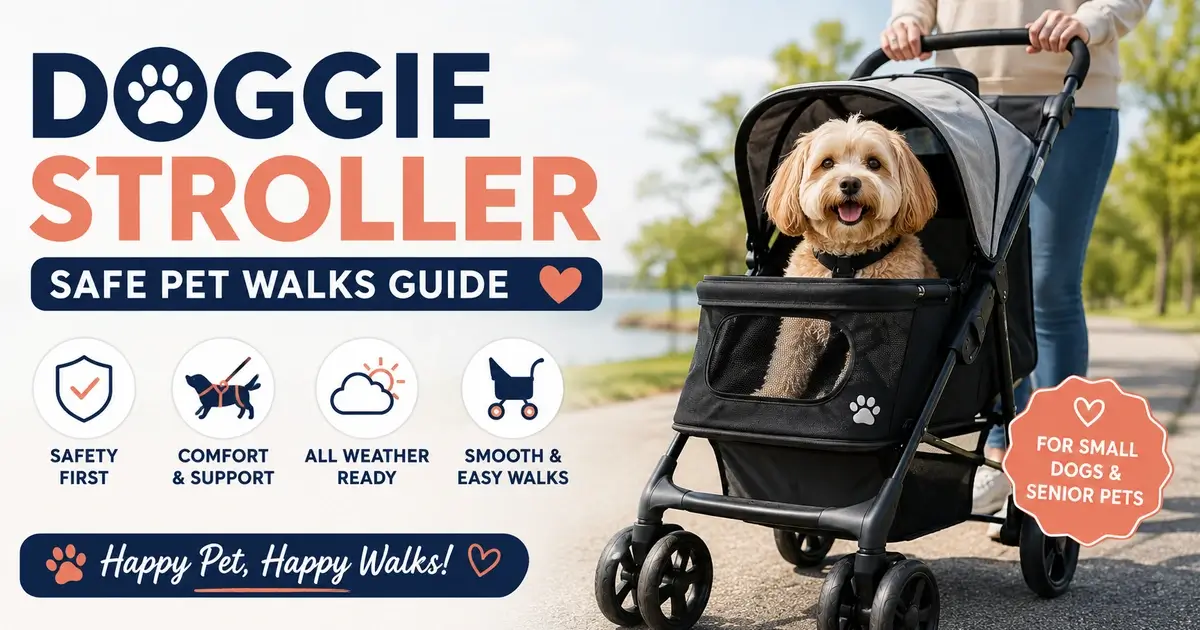
A doggie stroller can help an older, injured, small, or easily tired dog enjoy outdoor time. It gives the dog a secure place to rest while staying close to the family.
However, safe stroller use requires more than placing your dog inside and starting a walk. You must check the stroller, secure the dog, choose a suitable route, and watch the weather. You also need to introduce the stroller slowly. Some dogs feel comfortable at once. Others need several short training sessions. This guide explains how to use a dog stroller safely. It covers harnesses, tethers, brakes, wheels, weather, terrain, loading, training, and every-walk inspections. Important: A stroller does not replace veterinary care or suitable exercise. Ask your veterinarian for advice if your dog has an injury, breathing problem, mobility condition, recent surgery, or another health concern.
Table of Contents
- Quick doggie stroller safety answer
- Which dogs may benefit?
- Make sure the stroller fits
- What to check before first use
- How to train your dog
- Harness and tether safety
- Safe loading and unloading
- Brake safety
- Wheels and terrain
- Weather and ventilation
- Safe walking techniques
- Crowds and public places
- Using one stroller for two dogs
- Safety for senior dogs
- Safety for puppies
- Can you jog with a dog stroller?
- Vehicle and travel safety
- Every-walk safety checklist
- Cleaning and maintenance
- Common safety mistakes
- What to carry on longer walks
- Frequently asked questions
How Do You Use a Doggie Stroller Safely?
First, choose a stroller that fits your dog’s weight and body size. Your dog should have enough room to sit, lie down, and change position.
Next, check the frame, wheels, brakes, mesh, zippers, and safety tether. Complete these checks before every walk.
Attach the interior tether to a properly fitted harness. Do not rely on an open cabin or your dog’s calm behavior.
Then apply the parking brake before loading. Keep the stroller still while your dog enters or leaves.
During the walk, use smooth movements. Avoid steep slopes, stairs, escalators, rough trails, and fast turns.
Finally, watch your dog’s comfort. Stop if the dog shows fear, breathing trouble, unusual panting, weakness, or repeated escape attempts.
The American Kennel Club notes that a dog should have enough space in a stroller to sit, lie down, and turn around. You can review its official dog stroller guidance for more background.
If you still need help choosing the right model, read our complete buying guide for dog strollers.
View doggie stroller options on Amazon.
Which Dogs May Benefit From a Doggie Stroller?
A stroller can support many dogs. However, the reason for using it should match the individual dog’s needs.
Senior dogs
Older dogs may still enjoy outdoor sights and smells. Yet they may not manage a long walk.
A stroller allows a senior dog to walk for a comfortable distance. The dog can then ride when it becomes tired.
Dogs with limited mobility
Dogs with weak legs, arthritis, disability, or poor balance may benefit from assisted transport. A stroller can help them reach a suitable outdoor area.
Still, the dog’s veterinarian should decide how much movement is appropriate.
Dogs recovering from an injury
A recovering dog may need reduced exercise. In some cases, a stroller allows controlled outdoor time without a long walk.
Always follow the recovery plan given by the veterinarian.
Small dogs
Small dogs can be difficult for pedestrians to notice. A secure stroller may keep them away from heavy foot traffic.
It may also help in busy shopping areas or public events.
Dogs with reduced stamina
Some dogs can walk for a short period but become tired during longer outings. A stroller gives them a place to rest.
This can help the dog remain included without forcing it to walk too far.
Anxious dogs
Some dogs feel safer inside a partly enclosed cabin. The canopy and mesh may create a protected space.
However, other dogs may dislike confinement. Introduce the stroller slowly and observe the dog’s body language.
Dogs that should not use a stroller without guidance
A stroller may not suit a dog that panics in enclosed spaces. It may also be unsafe for a dog that repeatedly bites the mesh or tries to escape.
Highly reactive dogs may become more stressed when people or animals approach the cabin. Ask a veterinarian or qualified behavior professional for help.
Ready to compare models? If a stroller is suitable for your dog, see our Best Dog Stroller guide to compare options by pet size, terrain, cabin design, mobility needs, and everyday use.
Make Sure the Doggie Stroller Fits Correctly
A safe walk begins with a correct fit. A stroller that is too small can make the dog uncomfortable.
A stroller that is too weak may also become difficult to steer or stop.
Check the weight capacity.
Compare your dog’s weight with the manufacturer’s maximum load. The stated capacity must be higher than the full load.
The load may include:
- Your dog
- A second pet
- A cabin liner
- A small cushion
- Items placed inside the cabin
Do not exceed the stated limit. Extra weight can affect the frame, wheels, brakes, and balance.
Check the cabin length.
Your dog should be able to lie down naturally. Long-bodied dogs may need more space than their weight suggests.
Compare your dog’s body length with the usable interior floor length.
Check the cabin width.
The dog should be able to turn and change position. Its body should not remain pressed against both sides.
Check the canopy height.
Your dog should be able to sit without pressing its head against the canopy. Measure the dog while it sits naturally.
Check the floor support.
The cabin floor should stay reasonably level under the dog’s weight. Deep sagging can make standing difficult.
This matters even more for senior dogs and pets with balance problems.
For more help with dimensions and capacity, use our dog stroller sizing and buying guide.
What Should You Check Before the First Use?
Do not take the stroller directly out of the box for a long outdoor walk. First, inspect and test it at home.
Read the product manual.
Read the setup, folding, brake, wheel, tether, and cleaning instructions. Different strollers use different locking systems.
Do not assume that every frame opens or folds in the same way.
Confirm that the frame locks.
Open the stroller fully. Then confirm that each frame lock has engaged.
A partly opened stroller may fold during use.
Check the wheel attachments.
Pull each wheel gently after installation. Make sure it cannot slide away from the axle.
Some wheels require a click, a pin, a cap, or a locking button.
Test the parking brake.
Engage the brake on a flat surface. Push the stroller gently.
The stroller should remain still. If it moves, check the brake setup before use.
Inspect the cabin
Look for sharp edges, loose fabric, plastic packaging, cords, or small parts. Remove anything that could cause injury or choking.
Test the zippers
Open and close every zipper. Check whether the cabin closes without large gaps.
A determined dog may push against a weak closure.
Inspect the mesh
Check for holes, loose seams, or weak sections. The mesh should allow airflow while keeping the dog contained.
Find the correct tether point.
Locate the interior tether and learn how to adjust it. Do not attach the dog until you understand how the clip works.
How to Train Your Dog to Use a Stroller
A slow introduction can reduce fear. It can also make future walks easier.
Step 1: Leave the stroller in a quiet room
Apply the brake and allow your dog to inspect the stroller. Let the dog sniff it without pressure.
Do not force the dog into the cabin.
Step 2: Reward calm behavior
Use praise or a suitable treat when your dog calmly approaches the stroller. Keep the session short.
Stop before the dog becomes bored or stressed.
Step 3: Encourage the dog to enter
Open the lowest entrance. Place a familiar blanket or reward inside if appropriate.
Allow the dog to enter and leave freely during early sessions.
Step 4: Practice sitting inside
Keep the stroller stationary. Ask your dog to sit or lie inside for a few seconds.
Then allow the dog to leave.
Step 5: Introduce the harness tether
Attach the tether to the dog’s harness. Keep the session short and calm.
Adjust the tether so the dog can sit and lie down.
Step 6: Close the cabin briefly
Close the canopy or mesh for a few seconds. Reward calm behavior.
Open it again before the dog becomes worried.
Step 7: Move the stroller indoors
Push the stroller slowly across a smooth floor. Move only a short distance.
Avoid sudden turns and stops.
Step 8: Try a quiet outdoor route
Choose a familiar area with little traffic. Keep the first walk short.
Increase the distance only when your dog appears relaxed.
Signs that your dog needs more training
- Repeated escape attempts
- Trembling
- Whining
- Constant barking
- Rigid body posture
- Refusing to enter
- Biting the mesh
- Heavy panting in mild weather
Do not punish fear. Return to an easier training step and progress more slowly.
Dog Harness and Stroller Tether Safety
The interior tether is one of the stroller’s most important safety features. It can reduce the chance of jumping or falling.
Use a properly fitted harness.
Attach the tether to a suitable dog harness. A sudden jump can place pressure on the neck when the tether connects to a collar.
The harness should fit securely without restricting normal breathing or movement.
Check the harness before every walk.
Look for damaged straps, weak stitching, broken buckles, and loose adjustment points. Replace a damaged harness.
Adjust the tether length.
The tether should allow the dog to sit and lie down. However, it should not allow the dog to climb over the edge of the cabin.
A long tether may also wrap around the dog’s legs.
Use one tether for each dog.
If two dogs share the stroller, each pet needs a suitable restraint point. Do not attach both dogs to one clip unless the manufacturer allows it.
Do not rely only on the tether.
Close the mesh or canopy when the dog may jump. The tether and cabin closure should work together.
Never leave a tethered dog unattended.
How to Load and Unload a Dog Safely
Many stroller accidents occur when the dog enters or leaves. Therefore, use a simple loading routine.
Choose a flat surface.
Load the dog on level ground whenever possible. Avoid slopes, curbs, and loose gravel.
Apply the parking brake.
Lock the brake before opening the cabin. Test that the stroller remains still.
Our stroller brake safety guide explains why brakes should be checked before each outing.
Use the lowest entrance.
Open the lowest door for a senior, injured, or large dog. A low entry can reduce jumping.
Use a ramp when provided
A ramp may help a large or mobility-limited dog. Confirm that it is attached securely.
Keep the stroller steady as the dog approaches.
Lift small dogs carefully.
Support the dog’s body while lifting. Avoid lifting by the front legs, collar, or harness strap.
Attach the tether before moving.
Once the dog is inside, connect the tether to the harness. Then close the cabin as needed.
Unload in reverse order.
Apply the brake first. Open the cabin only after the stroller has stopped fully.
Remove or control the tether before allowing the dog to step out.
Doggie Stroller Brake Safety
A parking brake does not stop a moving stroller like a vehicle brake. Its main purpose is to hold the stroller while it is stationary.
Use the brake every time you stop.
Apply the brake while loading, unloading, adjusting the harness, or reaching into the basket.
Also, use it during short stops.
Test the brake before each walk.
Engage the brake on a flat surface. Push the handle gently.
If the wheels move, do not load the dog.
Keep the brake area clean.
Mud, fur, string, and debris can affect wheel or brake movement. Inspect the brake mechanism regularly.
Do not trust the brake on a steep slope.
A parking brake may not safely hold a loaded stroller on a steep hill. Avoid parking on steep ground.
Keep your hand on the handle whenever possible.
Check both sides
Some strollers use separate rear-wheel brakes. Make sure both sides lock.
Other models use one linked brake bar. Follow the product manual.
Choose Safe Wheels and Suitable Terrain
The correct wheels make the stroller easier to control. They can also reduce uncomfortable shaking.
Smooth sidewalks
Small swivel wheels may work well on smooth pavement. They can turn easily in narrow areas.
However, they may stop suddenly at deep cracks.
Grass and park paths
Larger wheels usually move over grass more easily. Some suspension can also improve comfort.
Gravel and uneven pavement
An all-terrain stroller may provide better control. Look for larger tires, a stable frame, and suitable ground clearance.
View all-terrain dog strollers on Amazon.
Rough trails
Do not assume that “all-terrain” means every trail is safe. Roots, deep mud, steep hills, and loose rocks can reduce control.
Follow the manufacturer’s terrain limits.
Check the front wheel setting.
A swivel front wheel helps with slow turns. A locked wheel may improve straight tracking on uneven surfaces.
Use the correct setting for your stroller and route.
Inspect the wheels before every walk.
Check that each wheel is secure. Look for cracks, wear, low pressure, or trapped debris.
Read our stroller wheel safety guide for a complete inspection routine.
Avoid stairs and escalators.
Do not push a loaded dog stroller up or down stairs. Use a ramp or elevator.
Never place a stroller on an escalator. A wheel can become trapped between moving steps.
Dog Stroller Weather and Ventilation Safety
A stroller canopy can provide shade. However, it cannot eliminate all weather risks.
Warm-weather walks
Choose cooler parts of the day. Morning and evening may feel more comfortable than midday.
The American Veterinary Medical Association advises pet owners to provide fresh water and shade during warm weather. Review its official warm-weather pet safety guidance.
Keep the mesh clear.
Do not block the ventilation panels with bags, blankets, or accessories. Air should move through more than one side.
Do not cover the full stroller.
A thick blanket can trap heat and reduce airflow. Use the built-in canopy for shade.
Keep the mesh areas open when safe to do so.
Watch for heat distress.
Stop the walk if your dog shows unusual heavy panting, weakness, confusion, vomiting, poor coordination, or collapse.
Move the dog to a cooler place and contact a veterinarian when needed.
Carry water
Bring fresh water during longer walks. Use a clean portable bowl.
Do not wait until the dog shows clear distress.
Rain-cover safety
A fitted rain cover can help during light rain. However, it must leave enough ventilation.
Do not use a cover that seals every opening. Read our stroller rain cover safety guide before using one.
Cold-weather walks
Mesh panels allow cold air into the cabin. Consider your dog’s age, coat, health, and cold tolerance.
Keep the walk shorter when conditions become uncomfortable.
Strong wind
Strong wind can affect steering and stroller balance. Avoid exposed routes during severe weather.
Do not attach loose covers that may catch the wind.
Safe Doggie Stroller Walking Techniques
The way you push the stroller affects safety. Smooth movements help the dog remain balanced.
Start slowly
Begin at a calm walking speed. Give the dog time to adjust to the movement.
Keep both hands available.
Use both hands near roads, curbs, slopes, and uneven ground. This gives you better control.
Avoid phone distraction
Do not look at your phone while crossing roads or moving through crowded areas. Watch the route ahead.
Slow down before turning.
Fast turns can shift the dog’s weight. Slow down before changing direction.
Approach cracks at an angle.
Deep pavement cracks can stop small front wheels. Approach obstacles slowly.
Choose another path when the surface looks unsafe.
Use care near curbs.
Do not push the stroller quickly down a high curb. The sudden drop can move the dog forward.
Use a curb ramp whenever possible.
Keep bags away from the handle.
Heavy handlebar bags can affect balance. Store supplies in the lower basket.
Our stroller storage basket safety guide explains how to place loads safely.
Keep control of slopes.
Walk slowly on mild slopes. Keep both hands on the handle.
Avoid steep hills that make braking or pushing difficult.
Check your dog often.
Look into the cabin during the walk. Check the dog’s posture, breathing, tether, and comfort.
Using a Dog Stroller in Crowded Public Places
A stroller can keep a small dog away from busy foot traffic. However, crowded places create other risks.
Keep the cabin closed.
A person, dog, or sudden noise may surprise your pet. Close the mesh when an escape is possible.
Do not allow strangers to reach inside.
Even a friendly dog may feel trapped inside a stroller. Ask people to give the dog space.
Keep a distance from unfamiliar dogs.
Do not allow another dog to place its face against the mesh. Your dog may feel unable to move away.
Avoid blocked walkways
Park the stroller away from doors, stairs, ramps, and emergency exits. Apply the brake whenever you stop.
Watch for dropped food.
Busy areas may contain food, gum, medication, or other unsafe items. Keep the dog inside the cabin when the ground is unsuitable.
Leave if your dog becomes stressed.
Do not continue simply because you planned a long outing. Move to a quieter place when the dog becomes worried.
Can Two Dogs Safely Share One Stroller?
Two compatible dogs may share a stroller. However, the stroller must support their combined weight.
The cabin must also provide enough space for both pets.
Check the total load.
Add the weight of both dogs and all cabin items. Keep the total below the maximum capacity.
Use separate tether points.
Each dog should have a suitable tether. Keep the tethers short enough to prevent tangling.
Watch the dogs’ behavior.
One dog should not stand on, block, or trap the other. Stop the ride if either dog shows fear or guarding behavior.
Consider a divided stroller.
Separate compartments work better when the dogs differ in size or temperament.
Check balance
Two dogs may move at the same time. Make sure the stroller remains stable as their weight shifts.
Extra Doggie Stroller Safety for Senior Dogs
Senior dogs may need more support during entry, riding, and unloading.
Choose a low entrance.
A low door reduces the step height. A ramp may help a larger senior dog.
Use a supportive liner.
A soft liner may improve comfort. However, it should not create an unstable surface.
Avoid rough routes
Strong shaking may cause discomfort. Choose smooth surfaces when possible.
Provide more rest
Senior dogs may become tired or hot sooner. Keep the outing suitable for the individual dog.
Watch for stiffness
A dog that stays in one position for a long time may become stiff. Allow safe breaks when the veterinarian permits movement.
View senior dog stroller options on Amazon.
Doggie Stroller Safety for Puppies
A stroller can provide controlled outdoor exposure for a puppy. However, it should not replace safe training and socialization.
Ask about vaccination timing.
Speak with your veterinarian about public-ground exposure. Disease risks may vary by location.
Use a secure harness.
A puppy may move suddenly. Attach the tether and close the cabin when necessary.
Remove chewable hazards
Puppies may chew straps, zippers, liners, and mesh. Supervise the puppy throughout the ride.
Keep early rides short.
A short and positive ride can build confidence. Stop before the puppy becomes restless.
Continue normal training
Teach leash walking, calm greetings, and safe outdoor behavior. Do not use the stroller for every trip.
Can You Jog With a Doggie Stroller?
You should jog only with a stroller that the manufacturer specifically approves for running.
A three-wheel design alone does not make a stroller safe for jogging.
Check the product manual.
Look for clear jogging instructions. Also check the minimum speed, wheel setting, and terrain limits.
Use the correct front-wheel setting.
Many jogging models require a locked front wheel. This can improve straight tracking.
Use every safety feature.
Secure the dog with the interior tether. Use the wrist strap when the manufacturer provides one.
Start with walking
Allow the dog to become comfortable at a slow speed. Increase the pace gradually.
Avoid heat and rough terrain.
Running increases movement and vibration. Choose a smooth route and comfortable weather.
View jogging dog stroller options on Amazon.
Dog Stroller Vehicle and Travel Safety
A stroller helps during walks. However, it is not automatically safe as a vehicle restraint.
Do not use the stroller as a car seat.
Only use a detachable cabin inside a vehicle when the manufacturer approves it for that purpose.
Follow the exact installation instructions.
Secure the folded stroller.
Place the folded stroller where it cannot slide or strike the dog during a sudden stop.
Carry a pet travel kit.
The ASPCA recommends carrying items such as water, bowls, a leash, waste bags, medication, and first-aid supplies. See its official pet travel safety tips.
Check access before leaving home.
Confirm that the destination allows dogs and pet strollers. Also check ramps, elevators, and walking surfaces.
Never leave the dog inside a parked vehicle.
A parked vehicle can become dangerous quickly. Take the dog with you and follow current veterinary safety guidance.
Doggie Stroller Safety Checklist Before Every Walk
Use this checklist before placing your dog inside.
- Open the stroller fully.
- Confirm that the frame locks.
- Check the frame for cracks or bends.
- Make sure each wheel is secure.
- Check tire pressure when required.
- Remove hair and debris from the wheels.
- Test the parking brake.
- Inspect the interior tether.
- Check the dog’s harness.
- Test the zippers and latches.
- Inspect the mesh for holes.
- Make sure the liner lies flat.
- Remove loose cabin objects.
- Check that ventilation panels remain clear.
- Confirm that the weather is suitable.
- Carry water when needed.
- Choose a suitable route.
- Secure the dog before moving.
- Keep heavy bags away from the handle.
- Never leave the dog unattended.
For a broader pre-walk inspection, read our stroller safety checklist before every walk.
How to Clean and Maintain a Doggie Stroller
Regular care helps the stroller move correctly. It also helps you identify damage early.
Remove fur and loose dirt.
Brush or vacuum the cabin after use. Pay attention to corners and seams.
Clean spills quickly
Follow the manufacturer’s fabric instructions. Avoid cleaning products that may irritate the dog.
Wash the liner
Remove the liner when allowed. Wash it using the recommended method.
Let it dry fully before placing it back.
Clean the wheels
Remove mud, grass, hair, and string. Check the axle area for trapped debris.
Our guide on how to clean stroller wheels and fabric safely provides a longer cleaning routine.
Inspect the mesh
Look for holes, weak seams, and stretched areas. Repair or replace damaged parts before use.
Test the brake
The brake should hold the stroller securely. Stop using the stroller if it cannot remain still.
Store the stroller dry.
Allow wet fabric to dry before folding. Store the stroller away from extreme heat and moisture.
Read our guide on how to fold and store a stroller safely for more storage precautions.
Common Doggie Stroller Safety Mistakes
Skipping the harness tether
A calm dog can still jump after a sudden noise. Use the tether every time.
Attaching the tether to an unsuitable collar
A sudden movement may place pressure on the neck. Use a properly fitted harness.
Leaving the cabin open
An open cabin may not contain an excited or nervous dog. Close the mesh when needed.
Forgetting the parking brake
A stroller can move while the dog enters. Apply the brake before opening the cabin.
Hanging bags from the handle
Heavy bags may affect balance. Use the lower storage area.
Walking too fast
Fast turns and sudden stops can move the dog around. Use a smooth pace.
Using small wheels on rough ground
Small wheels may get stuck in cracks or on stones. Choose a suitable route.
Covering the full stroller
A thick blanket can reduce airflow. Keep ventilation panels clear.
Using a normal stroller for jogging
Only jog with a manufacturer-approved model.
Ignoring signs of stress
Do not continue when the dog shows fear, overheating, or repeated escape behavior.
Leaving the dog unattended
A parked stroller can move, tip, or overheat. Stay with your dog.
Using the stroller instead of all exercise
A healthy dog still needs suitable physical activity and enrichment.
What Should You Carry on a Longer Pet Walk?
A small travel kit can make the outing safer and easier.
Consider carrying:
- Fresh water
- A portable bowl
- Waste bags
- A normal leash
- Any required medication
- A small towel
- Basic pet first-aid supplies
- Your veterinarian’s contact details
- Pet identification information
- A light rain cover when appropriate
Store these items in the lower basket. Keep heavy supplies away from the handlebars.
Frequently Asked Questions About Doggie Strollers
Are doggie strollers safe?
They can be safe when the stroller fits both the dog and the owner and is used correctly. Check the frame, brakes, wheels, harness, tether, mesh, and weather before each walk.
Should I use a harness in a dog stroller?
Yes. Attach the interior tether to a properly fitted harness unless the manufacturer provides different instructions.
Can I leave the stroller canopy open?
You may leave it open when the dog is secure, and there is no risk of escape. Close the mesh near crowds, unfamiliar dogs, traffic, or sudden noise.
Can my dog jump out of a stroller?
Yes. Even a calm dog may jump after becoming excited or frightened. Use the tether and cabin closure.
Can I take a dog stroller on an escalator?
No. Use an elevator or accessible ramp instead. Stroller wheels can become trapped on escalator steps.
Can two dogs share one stroller?
Yes, when the stroller supports their combined load and provides enough room. Each dog should have a suitable tether point.
Can I jog with a dog stroller?
Only jog with a model that the manufacturer clearly approves for running.
Can a senior dog use a stroller?
Yes. A low entry, firm floor, stable frame, and smooth wheels may help a senior dog ride more comfortably.
Can a puppy use a doggie stroller?
Yes, under close supervision. Ask your veterinarian about vaccinations and public-ground exposure.
How do I keep a dog stroller from tipping?
Stay below the weight limit, avoid hanging bags from the handle, use suitable terrain, and keep the load centered inside the cabin.
Should I use a blanket over the stroller?
Do not cover the full stroller with a thick blanket. It may reduce ventilation and trap heat.
Can a dog stroller be used as a car seat?
Not unless the manufacturer specifically approves the cabin for vehicle use and provides installation instructions.
How often should I inspect the stroller?
Complete a brief check before every walk. Inspect the frame, wheels, brakes, mesh, zippers, tether, and harness.
How often should I clean a dog stroller?
Remove fur and dirt after regular use. Clean accidents quickly and inspect moving parts during cleaning.
Does a dog stroller replace walking?
No. A healthy dog still needs suitable movement and enrichment. Use the stroller as transport or a rest area.
Final Thoughts
A doggie stroller can help a senior, injured, small, or easily tired dog enjoy safer outdoor trips.
However, the stroller must fit the dog correctly. The cabin should provide enough room to sit, lie down, and turn.
Before every walk, check the frame, wheels, brakes, mesh, zippers, tether, and harness. Apply the parking brake before loading or unloading.
During the walk, move at a smooth pace. Avoid unsafe slopes, rough trails, stairs, escalators, and fast turns.
Also, watch the weather. Keep the cabin ventilated, provide water, and stop when your dog shows discomfort.
Finally, introduce the stroller slowly. Short and positive training sessions can help your dog feel secure.
When used correctly, a dog stroller can provide transport, comfort, and a safe resting place during suitable family outings.

Sanat Barua is the founder of Stroller Haven. He researches stroller models, manufacturer specifications, and safety standards to help parents compare options and make confident, informed decisions.
His research draws on official manufacturer documentation and product manuals, publicly available owner feedback, and safety guidance from sources such as the U.S. Consumer Product Safety Commission (CPSC) and the American Academy of Pediatrics (AAP). Stroller Haven is a research-based website: products are not described as physically tested unless an article states that testing took place. Stroller Haven is updated regularly as new models and safety information become available.